answer.
Ask question
Login Signup
Ask question
All categories
  • English
  • Mathematics
  • Social Studies
  • Business
  • History
  • Health
  • Geography
  • Biology
  • Physics
  • Chemistry
  • Computers and Technology
  • Arts
  • World Languages
  • Spanish
  • French
  • German
  • Advanced Placement (AP)
  • SAT
  • Medicine
  • Law
  • Engineering
madam [21]
2 years ago
5

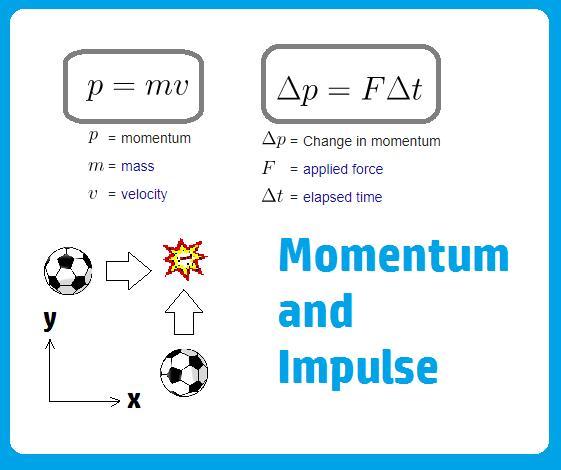
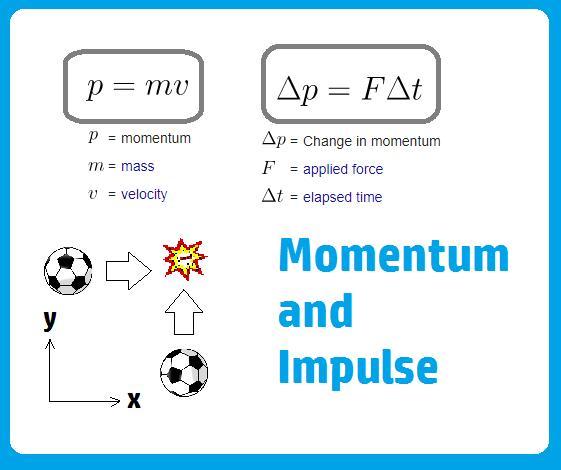
A 2.0-kg ball moving eastward at 3.0 m/s suddenly collides with and sticks to a 4.0-kg ball moving northward at 2.0 m/s. What is

the magnitude of the momentum of this system just after the collision?

Physics
2 answers:
Reptile [31]2 years ago
4 0

Answer:

10 kg m/s

Explanation:

Due to the law of conservation of momentum, the total momentum after the collision must be equal to the total momentum before the collision.

The momentum of each ball is given by:

p = mv

where m is the mass of the ball and v its velocity.

The momentum of ball 1 is:

p = mv = (2.0 kg)(3.0 m/s) = 6.0 kg m/s in the eastward direction

The momentum of ball 2 is:

p = mv = (4.0 kg)(2.0 m/s) = 8.0 kg m/s in the northward direction

The two momenta are in perpendicular directions, so the magnitude of the total momentum can be found as:

p=\sqrt{p_1^2 + p_2^2 }= \sqrt{(6.0 kg m/s)^2 + (8.0 kg m/s)^2}=10 kg m/s

and due to the law of conservation of the momentum, this is also equal to the total momentum after the collision.

lidiya [134]2 years ago
3 0

The magnitude of the momentum of this system just after the collision is about 10.0 kg.m/s

\texttt{ }

<h3>Further explanation</h3>

Let's recall Impulse formula as follows:

\boxed {I = \Sigma F \times t}

<em>where:</em>

<em>I = impulse on the object ( kg m/s )</em>

<em>∑F = net force acting on object ( kg m /s² = Newton )</em>

<em>t = elapsed time ( s )</em>

Let us now tackle the problem!

\texttt{ }

<u>Given:</u>

mass of first ball = m₁ = 2.0 kg

velocity of first ball = v₁ = 3.0i m/s

mass of second ball = m₂ = 4.0 kg

velocity of second ball = v₂ = 2.0j m/s

<u>Asked:</u>

magnitude of the final momentum = p = ?

<u>Solution:</u>

<em>We will use Conservation of Momentum formula to solve this problem:</em>

\texttt{Total Momentum Before Collision = Total Momentum After Collision}

m_1 v_1 + m_2 v_2 = \overrightarrow{p}

2.0 ( 3.0\ \widehat{i} ) + 4.0 ( 2.0 \ \widehat{j} ) = \overrightarrow{p}

\overrightarrow{p} = 6.0 \ \widehat{i} + 8.0 \ \widehat{j}

|\overrightarrow{p}| = \sqrt{ 6.0^2 + 8.0^2 }

|\overrightarrow{p}| = 10.0 \texttt{ kg.m/s}

\texttt{ }

<h3>Learn more</h3>
  • Velocity of Runner : brainly.com/question/3813437
  • Kinetic Energy : brainly.com/question/692781
  • Acceleration : brainly.com/question/2283922
  • The Speed of Car : brainly.com/question/568302
  • Average Speed of Plane : brainly.com/question/12826372
  • Impulse : brainly.com/question/12855855
  • Gravity : brainly.com/question/1724648

\texttt{ }

<h3>Answer details</h3>

Grade: High School

Subject: Physics

Chapter: Dynamics

You might be interested in
A pilot in a small plane encounters shifting winds. He flies 26.0 km northeast, then 45.0 km due north. From this point, he flie
cluponka [151]

Answer:

a) v₃ = 19.54 km, b)  70.2º north-west

Explanation:

This is a vector exercise, the best way to solve it is finding the components of each vector and doing the addition

vector 1 moves 26 km northeast

let's use trigonometry to find its components

         cos 45 = x₁ / V₁

         sin 45 = y₁ / V₁

         x₁ = v₁ cos 45

         y₁ = v₁ sin 45

         x₁ = 26 cos 45

         y₁ = 26 sin 45

         x₁ = 18.38 km

         y₁ = 18.38 km

Vector 2 moves 45 km north

        y₂ = 45 km

Unknown 3 vector

          x3 =?

          y3 =?

Vector Resulting 70 km north of the starting point

           R_y = 70 km

we make the sum on each axis

X axis

      Rₓ = x₁ + x₃

       x₃ = Rₓ -x₁

       x₃ = 0 - 18.38

       x₃ = -18.38 km

Y Axis

      R_y = y₁ + y₂ + y₃

       y₃ = R_y - y₁ -y₂

       y₃ = 70 -18.38 - 45

       y₃ = 6.62 km

the vector of the third leg of the journey is

         v₃ = (-18.38 i ^ +6.62 j^ ) km

let's use the Pythagorean theorem to find the length

         v₃ = √ (18.38² + 6.62²)

         v₃ = 19.54 km

to find the angle let's use trigonometry

           tan θ = y₃ / x₃

           θ = tan⁻¹ (y₃ / x₃)

           θ = tan⁻¹ (6.62 / (- 18.38))

           θ = -19.8º

with respect to the x axis, if we measure this angle from the positive side of the x axis it is

          θ’= 180 -19.8

          θ’= 160.19º

I mean the address is

          θ’’ = 90-19.8

          θ = 70.2º

70.2º north-west

3 0
2 years ago
When the boy crashes his bumper car into the girl's bumper car, the momentum from his car is transferred to hers. What evidence
Darya [45]

Answer:

Where is the text?

Explanation:

If you refer to the short sentence you wrote as text, I believe the answer is probably the word "crashes" because it shows how the momentum was transferred.

8 0
2 years ago
Read 2 more answers
The food calorie, equal to 4186J , is a measure of how much energy is released when food is metabolized by the body. A certain b
vovangra [49]
<h2>The hiker will go up to 850 m on the hill</h2>

Explanation:

The total energy gained  by the hiker = 140 x 4186 J

This energy is consumed in the potential energy acquired , while climbing up the hill.

The potential energy P.E = mass of hiker x acceleration due to gravity x height

Thus

140 x 4186 = 69 x 10 x h

or h = \frac{4186x140}{69x10}  = 850 m

If the 20% of the total energy is used

the height h₀ = \frac{0.2x4186x140}{69x10} = 170 m

5 0
2 years ago
Table 2.4 shows how the dispacement of a runner changed during a sprint race. Draw a dispacement-time graph to show this data, a
GalinKa [24]
4. Table 2.4 shows how the displacement of a runner changed
during a sprint race. Draw a displacement–time graph to show
this data, and use it to deduce the runner’s speed in the middle
of the race.
Table 2.4 Data for a sprinter during a race
Displacement
(m)
0 4 10 20 50 80 105
Time (s) 1 2 3 6 9 12
8 0
2 years ago
Use the drop-down menus to complete the statements. The atoms in a solid . The arrangement of atoms in a solid causes it to have
Natalija [7]

Answer:The atoms in a solid  .

remain in fixed position

The arrangement of atoms in a solid causes it to have a definite  .

 shape and value

Solids in which the atoms have no particular order or pattern are called   solid

noncrystalline

Explanation:
8 0
2 years ago
Read 2 more answers
Other questions:
  • What two properties show that the drink is a fluid
    13·2 answers
  • The first thing to focus on when creating a workout plan is
    7·2 answers
  • 0 the period of a pendulum is the time it takes the pendulum to swing back and forth once. if the only dimensional quantities th
    6·1 answer
  • A 6.5 l sample of nitrogen at 25◦c and 1.5 atm is allowed to expand to 13.0 l. the temperature remains constant. what is the fin
    14·1 answer
  • A space probe is built with a mass of 1700 pound-mass [lbm] before launch on Earth. The probe is powered by four ion thrusters,
    8·2 answers
  • Imagine that you are sitting in a closed room (no windows, no doors) when, magically, it is lifted from Earth and sent accelerat
    14·1 answer
  • It takes Venus 225 days to orbit the sun. If the Earth-sun distance is 1.5 × 10^11 m, what
    7·1 answer
  • Choose the correct statement of Kirchhoff's voltage law.
    8·1 answer
  • A 1.5 volt, AAA cell supplies 750 milliamperes of current through a flashlight bulb for 5.0 minutes, while a 1.5 volt, C cell su
    7·1 answer
  • Felipe walks from the house to his truck on the way to work. He walks 20m to the truck and another 60m in his truck for a total
    15·2 answers
Add answer
Login
Not registered? Fast signup
Signup
Login Signup
Ask question!