answer.
Ask question
Login Signup
Ask question
All categories
  • English
  • Mathematics
  • Social Studies
  • Business
  • History
  • Health
  • Geography
  • Biology
  • Physics
  • Chemistry
  • Computers and Technology
  • Arts
  • World Languages
  • Spanish
  • French
  • German
  • Advanced Placement (AP)
  • SAT
  • Medicine
  • Law
  • Engineering
MrRa [10]
2 years ago
4

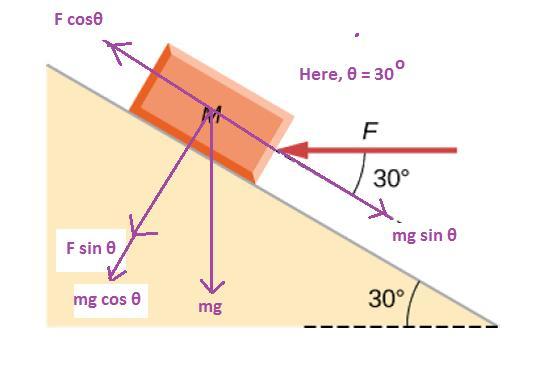
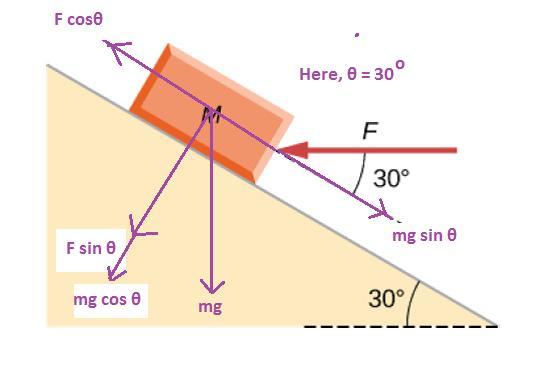
5.90. A force is applied to a block to move it up a 30° incline. The incline is frictionless. If F = 65.0 N and M = 5.00 kg , wh

at is the magnitude of the acceleration of the block? Enter your answer in units of m/s^2m/s 2 , without units, to the nearest hundredth.

Physics
1 answer:
Strike441 [17]2 years ago
7 0

Answer:

The acceleration of the block is 6.35 m/s².

Explanation:

It is given that,

A force is applied to a block to move it up a 30° incline. The applied force is, F = 65 N

Mass of the block, m = 5 kg

We need to find the acceleration of the block. From the attached figure, it is clear that.

F_x=ma_x

F\ cos\theta-mg\ sin\theta=ma_x

a_x=\dfrac{F\ cos\theta-mg\ sin\theta}{m}

a_x=\dfrac{65\ N\ cos(30)-5\ kg\times 9.8\ m/s^2\ sin(30)}{5\ kg}

a_x=6.35\ m/s^2

So, the acceleration of the block is 6.35 m/s². Hence, this is the required solution.

You might be interested in
Which statements describe vectors? Check all that apply. -Vectors have magnitude only. -Vectors have direction only. -Vectors ha
Natali [406]

Answer:

Vectors have both magnitude and direction

Explanation:

Vectors show how strong the force in because the bigger the arrow, the stronger the force.  Also, it obviously shows direction because its an arrow.

6 0
2 years ago
Read 2 more answers
If low CVP precipitates a suction alarm, rapid infusion of volume can remedy the situation after dropping the P-level.
motikmotik

Answer:

d

Explanation:

8 0
2 years ago
A 92-kg skier is sliding down a ski slope that makes an angle of 30 degrees above the horizontal direction. The coefficient of k
9966 [12]

Answer:

a = 4.05 m/s²

Explanation:

Known data

m= 92 kg  : mass of the  skier

θ =30°  :angle θ of the ski slope  with respect to the horizontal direction

μk= 0.10 : coefficient of kinetic friction

g = 9.8 m/s² : acceleration due to gravity

Newton's second law:

∑F = m*a Formula (1)

∑F : algebraic sum of the forces in Newton (N)

m : mass s (kg)

a : acceleration  (m/s²)

We define the x-axis in the direction parallel to the movement of the block on the ramp and the y-axis in the direction perpendicular to it.

Forces acting on the skier

W: Weight of the skier : In vertical direction

N : Normal force : perpendicular to the ski slope

f : Friction force: parallel to the ski slope

Calculated of the W

W= m*g

W=  92kg* 9.8 m/s² = 901,6 N

x-y weight components

Wx= Wsin θ= 901,6 N *sin 30° = 450.8 N

Wy= Wcos θ = 901,6 N *cos 30° =780.8 N

Calculated of the N

We apply the formula (1)

∑Fy = m*ay    ay = 0

N - Wy = 0

N = Wy

N = 780.8 N

Calculated of the f

f = μk* N=  0.10*780.8 N  

f = 78.08 N

We apply the formula (1) to calculated acceleration of the skier:

∑Fx = m*ax  ,  ax= a  : acceleration of the block

Wx - f = m*a

450.8- 78.08 = ( 92)*a

372.72 =  (92)*a

a = (372.72)/ (92)

a = 4.05 m/s²
6 0
2 years ago
a 100 kg gymnast comes to a stop after tumbling. her feet do -5000J of net work to stop her. Use the work-kinetic energy theorem
VikaD [51]
W=ΔKE , W=-5000j
KEinitial=(1/2)mv² , KEfinal=0j 
ΔKE=-(1/2)mv²
-5000=-(1/2)(100kg)v²
v=10 m/s

6 0
2 years ago
Read 2 more answers
A tennis player standing 12.6m from the net hits the ball at 3.00 degrees above the horizontal. To clear the net, the ball must
mezya [45]
We actually don't need to know how far he/she is standing from the net, as we know that the ball reaches its maximum height (vertex) at the net. At the vertex, it's vertical velocity is 0, since it has stopped moving up and is about to come back down, and its displacement is 0.33m. So we use v² = u² + 2as (neat trick I discovered just then for typing the squared sign: hold down alt and type 0178 on ur numpad wtih numlock on!!!) ANYWAY....... We apply v² = u² + 2as in the y direction only. Ignore x direction. 
IN Y DIRECTION: v² = u² + 2as 0 = u² - 2gh u = √(2gh) (Sub in values at the very end) 
So that will be the velocity in the y direction only. But we're given the angle at which the ball is hit (3° to the horizontal). So to find the velocity (sum of the velocity in x and y direction on impact) we can use: sin 3° = opposite/hypotenuse = (velocity in y direction only) / (velocity) So rearranging, velocity = (velocity in y direction only) / sin 3° = √(2gh)/sin 3° = (√(2 x 9.8 x 0.33)) / sin 3° = 49 m/s at 3° to the horizontal (2 sig figs)
4 0
2 years ago
Read 2 more answers
Other questions:
  • A ladder is leaning against a vertical wall, and both ends of the ladder are at the point of slipping. The coefficient of fricti
    10·1 answer
  • A car with an initial velocity of 16.0 meters per second east slows uniformly to 6.0 meters per second east in 4.0 seconds. What
    8·1 answer
  • A rightward force is applied to a 6-kg object to move it across a rough surface at a constant velocity. The object encounters 25
    13·1 answer
  • A weatherman carried an aneroid barometer from the ground floor to his office atop the Sears Tower in Chicago. On the level grou
    10·1 answer
  • Finally, you are ready to answer the main question. Cheetahs, the fastest of the great cats, can reach 50.0 miles/hourmiles/hour
    8·1 answer
  • You throw a tennis ball (mass 0.0570 kg) vertically upward. It leaves your hand moving at 15.0 m/s. Air resistance cannot be neg
    6·1 answer
  • A 15.0 kg load of bricks hangs from one end of a rope that passes over a small, frictionles pulley. A 28.0 kg counterweight is s
    6·1 answer
  • A nail gets magnetized when kept close to a magnet
    8·1 answer
  • An automobile is traveling at a constant 15 m/s, then it undergoes acceleration from that moment forward. Which statement best d
    7·1 answer
  • A water park is designing a new water slide that finishes with the rider flying horizontally off the bottom of the slide. The sl
    6·1 answer
Add answer
Login
Not registered? Fast signup
Signup
Login Signup
Ask question!