answer.
Ask question
Login Signup
Ask question
All categories
  • English
  • Mathematics
  • Social Studies
  • Business
  • History
  • Health
  • Geography
  • Biology
  • Physics
  • Chemistry
  • Computers and Technology
  • Arts
  • World Languages
  • Spanish
  • French
  • German
  • Advanced Placement (AP)
  • SAT
  • Medicine
  • Law
  • Engineering
GrogVix [38]
2 years ago
6

Which solution below most likely shows a vivid color?

Chemistry
2 answers:
VikaD [51]2 years ago
7 0
Hi there! :D

Which solution below most likely shows a vivid color?a. potassium chloride
b. nickel chloride 
c. hydrogen chloride 
d. lithium chloride

b. nickel chloride 
sergij07 [2.7K]2 years ago
3 0
Well the only one that actually has a color is nickel chloride the rest are salts or gases.
You might be interested in
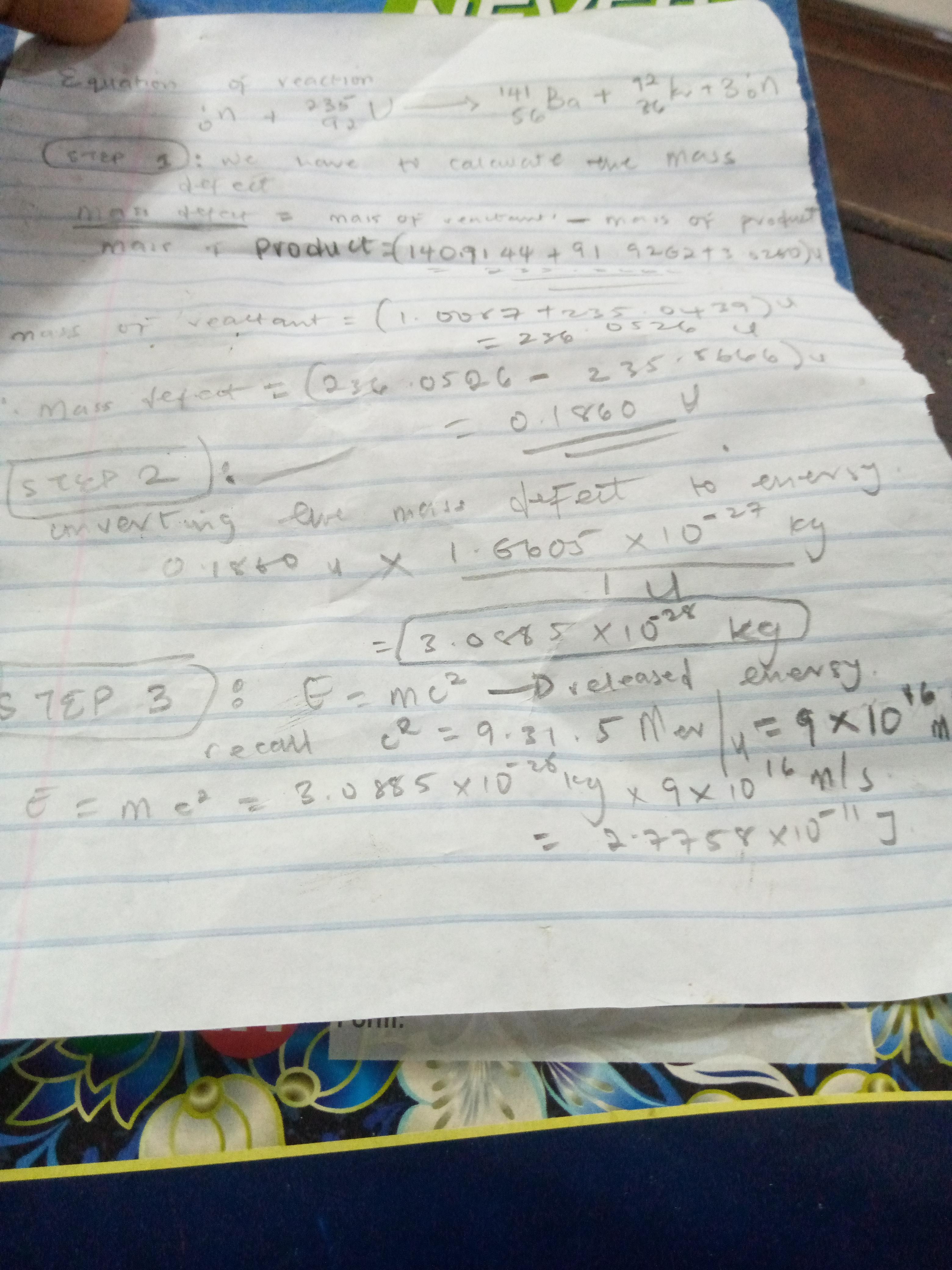
What is the reaction energy Q of this reaction? Use c2=931.5MeV/u. Express your answer in millions of electron volts to three si
emmasim [6.3K]

Answer:

Energy= 2.7758 × 10^-11 J ;

71.112×10^-6 kJ.

Mass defect in Kilogram= 3.0885×10^-28 kg.

That is; 3.1×10^-28 kg(to two significant figure).

Explanation:

(Note: Check equation of reaction in the attached file/picture).

STEP ONE: we have to calculate the Mass defect.

Mass defect= Mass of reactants -- Mass of products.

Mass of the products: (140.9144+91.9262+3.060) u.

= 235.8666 u.

Mass of reactants: (1.0087+235.0439) u= 236.0526 u.

Therefore, the Mass defect= (236.0526 -- 235.8666) u

= 0.1860 u.

STEP TWO: Converting the Mass defect to energy;

0.18860 × 1.6605 × 10^27 kg

= 3.0885× 10^-28 kg

STEP THREE: Calculating energy released . Recall(from the question) c^2= 931.5 Mev/u. This is also equals to 9×10^16 m/s.

E=Mc^2.

Where E= energy released, c= speed of light, M= Mass.

Slotting in the values;

E= 3.0885×10^-28 kg × 9×10^16 m/s.

E=2.7758 × 10^-11 J.

Know that;( 1g of uranium × 1 mol of uranium ÷ 235.0439 g of uranium) × (6.002×10^23 atom of uranium/ 1 mol of uranium) × 2.7758× 10^-11.

=7.1112×10^-10 J

= 71.112×10^6 kJ.

3 0
2 years ago
A 60.0 mL solution of 0.112 M sulfurous acid (H2SO3) is titrated with 0.112 M NaOH. The pKa values of sulfurous acid are 1.857 (
djverab [1.8K]

Answer:

a)4.51

b) 9.96

Explanation:

Given:

NaOH = 0.112M

H2S03 = 0.112 M

V = 60 ml

H2S03 pKa1= 1.857

pKa2 = 7.172

a) to calculate pH at first equivalence point, we calculate the pH between pKa1 and pKa2 as it is in between.

Therefore, the half points will also be the middle point.

Solving, we have:

pH = (½)* pKa1 + pKa2

pH = (½) * (1.857 + 7.172)

= 4.51

Thus, pH at first equivalence point is 4.51

b) pH at second equivalence point:

We already know there is a presence of SO3-2, and it ionizes to form

SO3-2 + H2O <>HSO3- + OH-

Kb = \frac{[ HSO3-][0H-]}{SO3-2}

Kb = \frac{10^-^1^4}{10^-^7^.^1^7^2} = 1.49*10^-^7

[HSO3-] = x = [OH-]

mmol of SO3-2 = MV

= 0.112 * 60 = 6.72

We need to find the V of NaOh,

V of NaOh = (2 * mmol)/M

= (2 * 6.72)/0.122

= 120ml

For total V in equivalence point, we have:

60ml + 120ml = 180ml

[S03-2] = 6.72/120

= 0.056 M

Substituting for values gotten in the equation Kb=\frac{[HSO3-][OH-]}{[SO3-2]}

We noe have:

1.485*10^-^7=\frac{x*x}{(0.056-x)}

x = [OH-] = 9.11*10^-^5

pOH = -log(OH) = -log(9.11*10^-^5)

=4.04

pH = 14- pOH

= 14 - 4.04

= 9.96

The pH at second equivalence point is 9.96

4 0
2 years ago
Match the following names of glassware with what you would use them for.(1) Glassware used to accurately transfer small volumes.
Andrei [34K]

Answer:

(1)=(A), (2)=(B), (3)=D, (4)=C, (5)=E, (6)=F

Explanation:

(1) Glassware used to accurately transfer small volumes = (A) Graduated pipette, that is basically a glass tube with graduation of different volumes to be dispensed.

(2) Glassware used to accurately transfer a small, single volume = (B) Volumetric pipette, that is a glass tube with a central glass bulb and is used to dispense accurately an unique volume of liquid everytime.

(3) Glassware to deliver a volume not known in advance = (D) Buret (or burette), that is used to dispense slowly a volume of liquid when a titration process is needed

(4) Glassware best used when greater access to the contents is needed = (C) Beaker, that is basically a very open glass cylinder with a spout

(5) Glassware used to prevent splashing or evaporation = (E) Erlenmeyer flask, that has a small open at the top and is useful when the liquid needs to be swirled as, for example, during a titration.

(6) Glassware used to make accurate solutions = (F) Volumetric flask, that has a long slim neck that provides a higher accuracy when a exact volume of liquid needs to be used for preparation of a solution.

8 0
2 years ago
A goldsmith melts 12.4 grams of gold to make a ring. The temperature of the gold rises from 26°C to 1064°C, and then the gold me
DiKsa [7]

Problem One

You will use both m * c * deltaT and H = m * heat of fusion.

Givens

m = 12.4 grams

c = 0.1291

t1 = 26oC

t2 = 1204

heat of fusion (H_f) = 63.5 J/grams.

Equation

H = m * c * deltaT + m * H_f

Solution

H = 12.4 * 0.1291 * (1063 - 26) + 12.4 * 63.5

H = 1660.1 + 787.4

H = 2447.5 or 2447.47 is the exact answer. I have to leave the rounding to you. I have no idea where to round it although I suspect 2450 would be right for 3 sig digs.

Problem Two

Formula and Givens

t1 = 14.5

t2 = 50.0

E = 5680

c = 4.186

m = ??

E = m c * deltaT

Solution

5680 = m * 4.186 * (50 - 14.5)

5680 = m * 4.186 * (35.5)

5680 = m * 148.603 * m

m = 5680 / 148.603

m = 38.22 grams That isn't very much. Be very sure you are working in joules. You'd leave that many grams in the kettle after drying it thoroughly.

m = 38.2 to 3 sig digs.

8 0
2 years ago
Read 2 more answers
A species has the following MO configuration: (σ1s)2(σ1s*)2(σ2s)2(σ2s*)2(σ2p)2(π2p)2. This substance is:_______.
Goshia [24]

Answer :  The correct option is, (a) paramagnetic with two unpaired electrons.

Explanation :

According to the molecular orbital theory, the general molecular orbital configuration will be,

(\sigma_{1s}),(\sigma_{1s}^*),(\sigma_{2s}),(\sigma_{2s}^*),(\sigma_{2p_z}),[(\pi_{2p_x})=(\pi_{2p_y})],[(\pi_{2p_x}^*)=(\pi_{2p_y}^*)],(\sigma_{2p_z}^*)

As there are 14 electrons present in the given configuration.

The molecular orbital configuration of molecule will be,

(\sigma_{1s})^2,(\sigma_{1s}^*)^2,(\sigma_{2s})^2,(\sigma_{2s}^*)^2,(\sigma_{2p_z})^2,[(\pi_{2p_x})^1=(\pi_{2p_y})^1],[(\pi_{2p_x}^*)^0=(\pi_{2p_y}^*)^0],(\sigma_{2p_z}^*)^0

The number of unpaired electron in the given configuration is, 2. So, this is paramagnetic. That means, more the number of unpaired electrons, more paramagnetic.

Hence, the correct option is, (a) paramagnetic with two unpaired electrons.

3 0
2 years ago
Other questions:
  • Calculate the number of carbon atoms in 25.0 grams of isopropyl alcohol (c3h8o)
    5·2 answers
  • Match each decimal number to the correct scientific notation. 30,700 0.000307 0.00000307 3,070,000 3.07 × 10⁻⁶ arrowRight 3.07 ×
    12·2 answers
  • A 0.1064 g sample of a pesticide was decomposed by the action of sodium biphenyl. The liberated Cl- was extracted with water and
    13·1 answer
  • How many moles of lithium chloride will be formed by the reaction of chlorine with 0.046 mol of lithium bromide in the following
    6·1 answer
  • When 13.6 g of calcium chloride, CaCl2, was dissolved in 100.0 mL of water in a coffee cup calorimeter, the temperature rose fro
    7·1 answer
  • 1. What are small-scale techniques in chemistry? <br>​
    11·1 answer
  • The decomposition of AB given here in this balanced equation 2AB (g)⟶ A2 (g) + B2 (g), has rate constants of 8.58 x 10⁻⁹ L/mol s
    14·1 answer
  • When the following equation is balanced, the coefficients are __________. Al(NO3)3 + Na2S → Al2S3 + Na(NO3)
    11·1 answer
  • Calculate the molar mass of a 2.89 g gas at 346 ml, a temperature of 28.3 degrees Celsius, and a pressure of 760 mmHg.
    14·1 answer
  • Calcite is mineral that is found in limestone and marble. A model of the extended structure of calcite is
    5·1 answer
Add answer
Login
Not registered? Fast signup
Signup
Login Signup
Ask question!