answer.
Ask question
Login Signup
Ask question
All categories
  • English
  • Mathematics
  • Social Studies
  • Business
  • History
  • Health
  • Geography
  • Biology
  • Physics
  • Chemistry
  • Computers and Technology
  • Arts
  • World Languages
  • Spanish
  • French
  • German
  • Advanced Placement (AP)
  • SAT
  • Medicine
  • Law
  • Engineering
Ann [662]
2 years ago
5

At 20°C, an aqueous solution that is 24.0% by mass in ammonium chloride has a density of 1.0674 g/mL. What is the molarity of am

monium chloride in the solution? The formula weight of NH4Cl is 53.50 g/mol.
Chemistry
1 answer:
AfilCa [17]2 years ago
8 0

Answer:

Molarity = 4.79 M

Explanation:

Mass percentage -

Mass percentage of A is given as , the mass of the substance A by mass of the total solution multiplied by 100.

i.e.

mass % A = mass of A / mass of solution * 100  

Given,

24% by mass of ammonium chloride,

so,

100 g solution contains , 24 g of ammonium chloride,

mass of solution = 100g

and mass of the solute , i.e. , ammonium chloride = 24 g .

Hence,

Moles -

Moles are calculated as the given mass divided by the molecular mass.  

i.e. ,

moles = ( mass / molecular mass )

Given,

The molecular mass of ammonium chloride is 53.50 g /mol

moles of ammonium chloride = 24 g / 53.50 g /mol

moles of ammonium chloride = 0.449 mol

Density -

Density of a substance is given as the mass divided by the volume ,

Density = mass / volume ,

Volume = mass / density

Given ,

Density of ammonium chloride = 1.0764 g /mL

Calculated above , mass of solution = 100 g

volume of solution = 100 g / 1.0764 g/ mL

volume of solution = 93.69 mL

Since , 1 ml = 1/1000 L

volume of solution = 93.69 /1000 L

volume of solution = 0.09369 L

Molarity -

Molarity of a solution is given by the moles of solute per liter of the solution

Hence,  

M = moles of solute / volume of solution (in L)

As calculated above,

moles of ammonium chloride = 0.449 mol

volume of solution = 0.09368 L

Putting in the above formula

Molarity = 0.449 mol / 0/09368 L

Molarity = 4.79 M

You might be interested in
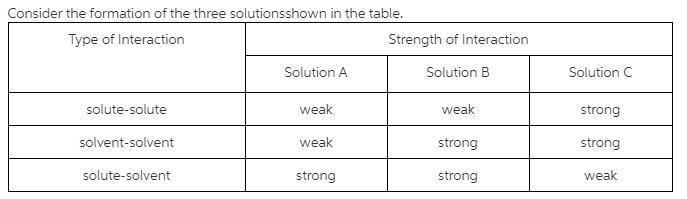
Rank the formation of the solutions A, B, and C from the most exothermic to the most endothermic. Rank the enthalpy of solution
Elodia [21]

This is an incomplete question, the table is attached below.

Answer : The correct ranking of the solution from most exothermic to most endothermic will be: A, B and C.

Explanation :

As we know that the intermolecular force of attraction play an important role in the interaction of solute-solute, solute-solvent and solvent solvent solution.

In the solution A, the solute-solute and solvent-solvent interactions are weak. So, their solute-solvent interaction will be strong. That means, the solution will be more exothermic.

In the solution C, the solute-solute and solvent-solvent interactions are strong. So, their solute-solvent interaction will be weak. That means, the solution will be more endothermic.

Thus, the correct ranking of the solution from most exothermic to most endothermic will be: A, B and C.

4 0
2 years ago
A newborn blue whale measures 6.0 to 7.9 m long and weighs up to 3003 kg. The blue whale produces the loudest sound by any livin
Dafna11 [192]
H
Ztdtdyfugughfhfhdtxycycyfugufufuvuguguv
3 0
2 years ago
Paige heated 3.00 g mercury (II) oxide (HgO, 216.59 g/mol) to form mercury (Hg, 200.59 g/mol) and oxygen (O2, 32.00 g/mol). She
stepan [7]

the balanced chemical equation for decomposition of HgO is as follows

2HgO --> 2Hg + O₂

stoichiometry of HgO to O₂ is 2:1

number of HgO moles heated are - 3.00 g / 216.59 g/mol = 0.0139 mol

according to stoichiometry of reaction -

number of O₂ moles formed = 0.0139 mol/ 2 = 0.00695 mol

mass of O₂ to be formed - 0.00695 mol x 32.00 g/mol = 0.2224 g

but the actual yield = 0.195 g

percent yield = actual yield / theoretical yield x 100 %

percent yield = 0.195 g / 0.2224 g x 100 % = 87.7 %

answer is 87.7 %

8 1
2 years ago
Read 2 more answers
Question 3 The following chart shows where the various forms of carbon are found. What correction needs to be made? Atmosphere B
bagirrra123 [75]

Answer:

i think it is A

Explanation:

hope this helps

6 0
2 years ago
Read 2 more answers
Formulating an Investigative Question In this experiment, you will use a track and a toy car to explore the concept of movement.
Solnce55 [7]

Answer:

A scientific question to be asked is; <em>What is the average speed of the toy car?</em>

Explanation:

A scientific question is a question which is well defined, the values in the question can be measured, and the inputs and outputs related to the question are controllable

The parameters measured in the experiment are;

The time elapsed during the movement of the car, <em>Δt</em>

The distance the car moves, <em>d</em>

From the obtained measurements, the value can be calculated is the average speed of the toy car as follows;

The \ average \ speed \ of \ the \ toy \ car, \ v_{avg} = \dfrac{d}{\Delta t}

Therefore, a scientific question to be asked that will be answered by doing the experiment is; What is the average speed of the toy car?

3 0
2 years ago
Other questions:
  • Which substance can be broken down by chemical means?<br> (1) CO (3) Ca<br> (2) Ce (4) Cu
    9·2 answers
  • Making the simplistic assumption that the dissolved NaCl(s) does not affect the volume of the solvent water, determine the const
    7·2 answers
  • 45.0 g of Ca(NO3)2 are used to create a 1.3 M solution. What is the volume of the solution
    6·1 answer
  • You are asked to go into the lab and prepare an acetic acid - sodium acetate buffer solution with a ph of 4.00  0.02. what mola
    12·1 answer
  • A 1.80 g sample of barium chloride hydrate, BaCl2 ⋅ xH2O is treated with excess sulfuric acid, forming a BaSO4 precipitate which
    6·2 answers
  • A phosphorus atom with 4 bonds has a charge of ___.
    6·1 answer
  • Could the other molecules in this simulation (argon, oxygen, and water) be considered pure substances? Explain your thinking.
    14·1 answer
  • Brooke decides to model a lunar eclipse. She attaches a large poster of the Sun to her wall to represent the Sun. She then decid
    8·1 answer
  • 3.0m3 of sulfer dioxide is reacted with 2.0dm3 of oxygen . What volume of sulfur trioxide is form?
    8·1 answer
  • What volume in<br><br> L<br><br> of a 0.724 M Nal solution contains 0.405 mol of Nal ?
    10·1 answer
Add answer
Login
Not registered? Fast signup
Signup
Login Signup
Ask question!