answer.
Ask question
Login Signup
Ask question
All categories
  • English
  • Mathematics
  • Social Studies
  • Business
  • History
  • Health
  • Geography
  • Biology
  • Physics
  • Chemistry
  • Computers and Technology
  • Arts
  • World Languages
  • Spanish
  • French
  • German
  • Advanced Placement (AP)
  • SAT
  • Medicine
  • Law
  • Engineering
Ber [7]
2 years ago
15

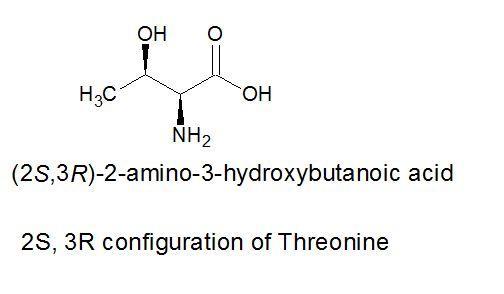
Threonine is a naturally occurring amino acid that has two stereogenic centers. The naturally occurring amino acid has the 2S, 3

R configuration at its two stereogenic centers. Draw the corresponding structure using the solid or dashed wedge bonds.

Chemistry
1 answer:
dimulka [17.4K]2 years ago
4 0

Explanation:

Amino acids are the organic compounds which contains both amine as well as carboxyl functional groups, with a side chain along to the molecule which is specific to each amino acid.

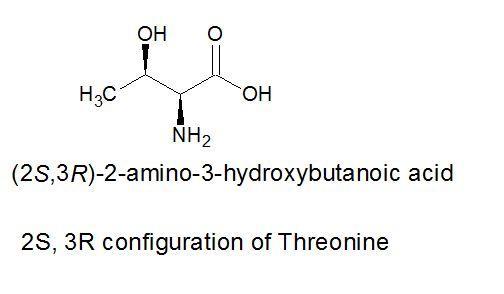
<u>Threonine is a naturally occurring amino acid which has two stereogenic centers. The possible stereoisomers of theronine is 4. The naturally occurring amino acid has the 2S, 3R configuration at its two stereogenic centers.</u>

The structure is shown in image below.

You might be interested in
A molecular biologist measures the mass of cofactor a in an average yeast cell. the mass is 41.5 pg . what is the total mass in
Ronch [10]
In this question, you are given the average cofactor mass per cell (41.5pg) and the total cells count(105 cells). You are asked how much cofactor that will be found from those cells(microgram= 10^6 picogram). Then the calculation would be:
Cofactor mass= cofactor per cell * cell count= 41.5pg/cell * 105 cells= 4357.5pg= 4.36 x 10^3pg

Then convert the picogram(pg) into microgram: 4.36 x 10^3pg/ (10^6pg/microgram)= 4.36x10^-3 microgram or 0.00436 microgram

if 105 cells mean 10^5 cells, the answer should be 4.15 microgram
6 0
2 years ago
Read 2 more answers
Identify the compounds below as a brønsted-lowry acid or lewis acid by clicking and dragging it into the correct column
Vesna [10]
There are many types of acid or bases. Based on the Bronsted-Lowry definition,

* A Bronsted-Lowry acid is a proton donor
* A Bronsted-Lowry base is a proton acceptor

Take this reaction for example:
HCl(aq)+ N<span>H</span>₃(aq)→N<span>H</span>⁴⁺(aq)+C<span>l</span>⁻(aq<span>)
</span>
HCl donates a proton, so it is a Bronsted-Lowry acid. Consequently, ammonia accepts this proton, so it is the Bronsted-Lowry base.
3 0
2 years ago
Read 2 more answers
1.05 Quiz: Measure Angles
Lelechka [254]
There’s no question for me to answer ?
6 0
2 years ago
Read 2 more answers
A sample of cacl2⋅2h2o/k2c2o4⋅h2o solid salt mixture is dissolved in ~150 ml de-ionized h2o. the oven dried precipitate has a ma
Paraphin [41]

We are given that the balanced chemical reaction is:

cacl2⋅2h2o(aq) + k2c2o4⋅h2o(aq) ---> cac2o4⋅h2o(s) + 2kcl(aq) + 2h2o(l)

We known that the product was oven dried, therefore the mass of 0.333 g pertains only to that of the substance cac2o4⋅h2o(s). So what we will do first is to convert this into moles by dividing the mass with the molar mass. The molar mass of cac2o4⋅h2o(s) is molar mass of cac2o4 plus the molar mass of h2o.

molar mass cac2o4⋅h2o(s) = 128.10 + 18 = 146.10 g /mole

moles cac2o4⋅h2o(s) = 0.333 / 146.10 = 2.28 x 10^-3 moles

Looking at the balanced chemical reaction, the ratio of cac2o4⋅h2o(s) and k2c2o4⋅h2o(aq) is 1:1, therefore:

moles k2c2o4⋅h2o(aq) = 2.28 x 10^-3 moles

Converting this to mass:

mass k2c2o4⋅h2o(aq) = 2.28 x 10^-3 moles (184.24 g /mol) = 0.419931006 g


Therefore:

The mass of k2c2o4⋅<span>h2o(aq) in the salt mixture is about 0.420 g</span>

3 0
2 years ago
Read 2 more answers
Elements that do not have full outer electron shells will donate, share, or take electrons from other atoms. Choose the items th
Tamiku [17]

it´s actually Lithium and fluorine / Magnesium and Chlorine / Beryllium and Nitrogen
8 0
2 years ago
Other questions:
  • Which is an example of practical pursuit of alchemy
    14·2 answers
  • A chemist in an imaginary universe, where electrons have a different charge than they do in our universe, performs the millikan
    6·1 answer
  • You have two containers of equal volume. one is full of helium gas. the other holds an equal mass of nitrogen gas both gases hav
    7·1 answer
  • How many free ions are there on the products side of the total ionic equations that results from the reaction between bismuth 3
    10·1 answer
  • What is the number of moles in 15.0 g AsH3?
    12·1 answer
  • A beaker contains a dilute sodium chloride solution at 1 atmosphere. What happens to the number of solute particles in the solut
    6·2 answers
  • What fact do scientists believe provides evidence for the big bang theory?a. all comets follow elliptical orbits.b. most extra-s
    10·2 answers
  • KClKCl has a lattice energy of −701 kJ/mol.−701 kJ/mol. Consider a generic salt, ABAB , where A2+A2+ has the same radius as K+,K
    13·1 answer
  • Part A Name the complex ion [Fe(CN)6]^3- . The oxidation number of iron is +3. Part B Name the complex ion [Cu(NH3)2(H2O)4]^2+ .
    15·1 answer
  • Hitesh wants to learn swimming. He brought swimming costumes and a cap. What kind of material should these be made of and why?
    11·1 answer
Add answer
Login
Not registered? Fast signup
Signup
Login Signup
Ask question!