answer.
Ask question
Login Signup
Ask question
All categories
  • English
  • Mathematics
  • Social Studies
  • Business
  • History
  • Health
  • Geography
  • Biology
  • Physics
  • Chemistry
  • Computers and Technology
  • Arts
  • World Languages
  • Spanish
  • French
  • German
  • Advanced Placement (AP)
  • SAT
  • Medicine
  • Law
  • Engineering
geniusboy [140]
2 years ago
8

What kind(s) of intermolecular forces exist in the compounds given below? (a) CH3CH2CH2CH2CH3(l) dispersion forces dipole-dipole

forces hydrogen bonding (c) H2CO(l) dispersion forces dipole-dipole forces hydrogen bonding (b) CH3CH2OH(l) dispersion forces dipole-dipole forces hydrogen bonding (d) O2(l) dispersion forces dipole-dipole forces hydrogen bonding
Chemistry
1 answer:
Ira Lisetskai [31]2 years ago
7 0

Answer:

(a) CH3CH2CH2CH2CH3(l)

  • dispersion

(b) CH3CH2OH(l)

  • Dipole-dipole interaction
  • Dispersion forces
  • Hydrogen bonding

(c) H2CO(l)

  • Dipole-dipole
  • Dispersion

(d) O2(l)

  • Dispersion

Explanation:

Dispersion forces are those forces that occur between two non polar molecules.They form the weakest bonds.Here electrons of one molecule is attracted to the nucleus of the other molecule. Example are;

  • Interaction of two methyl (-CH₃) group
  • Interaction between nitrogen gas , N₂ molecules
  • Interaction between oxygen gas ,O₂ molecules

Dipole-Dipole interaction happens when two polar molecules interact.Positive charges in one molecule is attracted to negative charge of another molecule.Examples

  • Chloroform (CHCl₃)
  • Ammonia (NH₃)

Hydrogen bonding are created when an hydrogen atom bonded to an electronegative atom is attracted to a another electronegative atom.Example is the hydrogen bond between oxygen atom and hydrogen is water (H₂O).

You might be interested in
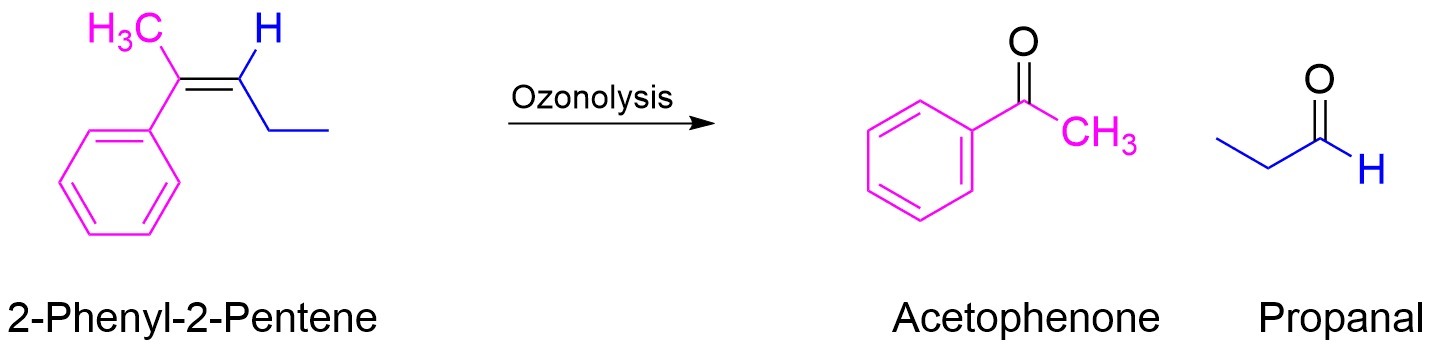
Compound a on ozonolysis yields acetophenone and propanal. what is the structure of compound a? 1-phenyl-1-hexene 1-phenyl-2-pen
astra-53 [7]
Answer:
            2-Phenyl-2-Penetene on ozonolysis <span>yields acetophenone and propanal.

Explanation:
                   The tricky way to solve such questions is to simply break the double bond in alkene and place oxygen atom at each broken half double bond making it carbonyl group. The reaction of given statement is as follow,</span>

6 0
2 years ago
he first-order rate constant for the gas-phase decomposition of dimethyl ether, (CH3)2O → CH4 + H2 + CO is 3.2 ✕ 10−4 s−1 at 450
seropon [69]

Answer:

0.290 atm is the pressure of the system after 7.7min

Explanation:

The general first-order rate constant is:

ln [A] = -kt + ln [A]₀

<em>Where [A] is concentration of A in time t,</em>

<em>K is rate constant, 3.2x10⁻⁴s⁻¹</em>

<em>[A]₀ is initial concentration = 0.336atm.</em>

<em />

7.7 min are:

7.7min * (60s / 1min) = 462s

Solving:

ln [A] = -kt + ln [A]₀

ln [A] = -<em>3.2x10⁻⁴s⁻¹*462s</em> + ln [0.336atm]

ln [A] = -1.238

[A] =

<h3>0.290 atm is the pressure of the system after 7.7min</h3>

<em />

6 0
2 years ago
A gas occupies a volume at 34.2 mL at a temperature of 15.0 C and a pressure of 800.0 torr. What will be the volume of this gas
Grace [21]
The answer is 34.1 mL.
Solution:
Assuming ideal behavior of gases, we can use the universal gas law equation
     P1V1/T1 = P2V2/T2
The terms with subscripts of one represent the given initial values while for terms with subscripts of two represent the standard states which is the final condition.
At STP, P2 is 760.0torr and T2 is 0°C or 273.15K. Substituting the values to the ideal gas expression, we can now calculate for the volume V2 of the gas at STP:
     (800.0torr * 34.2mL) / 288.15K = (760.0torr * V2) / 273.15K
     V2 = (800.0torr * 34.2mL * 273.15K) / (288.15K * 760.0torr)
     V2 = 34.1 mL
3 0
2 years ago
Read 2 more answers
4. a) The enthalpy change of combustion of hexane was measured using a calorimeter containing 200 cm3 of water; 0.5g of hexane (
mamaluj [8]

Answer:

The heat of combustion of hexane is -4324kjmol-1

Explanation:

Heat of combustion is the heat evolved when a mole of a substance is burned completely in oxygen under standard conditions.

To solve this problem, all the required values have been given.

Change in temperature ΔT = 30K

Mass of water =200cm3= 200g

Mass of Hexane burned = 0.5g

Step 1:

Find the amount of hear given off

Heat evolved= mass * specific eat capacity of water* temperature change

= 200 * 4.18 * 30

= 25080J

Step 2:

Calculate the relative molecular mass of hexane

RMM of C6H14 = 86g/mole.

Step 3:

Calculate the number of moles of Hexane burned

Numbrt of mole of hexane = mass / molar mass

n = 0.5 / 86

n = 0.0058mole

Step 4:

Calculate the enthalpy change of combustion for 1mole

Combustion of 0.0058mole hexane produces 25080J of heat energy

I mole hexane produces 25080 /0.0058

= 4324kJ of heat energy.

The enthalpy change of combustion of Hexane is -4,324kJmol-1.

There is no need to do anything else for the question.

7 0
2 years ago
A student reacts 20.0 mL of 0.248 M H2SO4 with 15.0 mL of 0.195 M NaOH. Write a balanced chemical equation to show this reaction
Molodets [167]

<u>Answer:</u> The concentration of salt (sodium sulfate), sulfuric acid and NaOH in the solution is 0.0418 M, 0.0999 M and 0 M respectively.

<u>Explanation:</u>

To calculate the number of moles for given molarity, we use the equation:

\text{Molarity of the solution}=\frac{\text{Moles of solute}}{\text{Volume of solution (in L)}}     .....(1)

<u>For NaOH:</u>

Initial molarity of NaOH solution = 0.195 M

Volume of solution = 15.0 mL = 0.015 L   (Conversion factor:   1 L = 1000 mL)

Putting values in equation 1, we get:

0.195M=\frac{\text{Moles of NaOH}}{0.015L}\\\\\text{Moles of NaOH}=(0.195mol/L\times 0.015L)=2.925\times 10^{-3}mol

<u>For sulfuric acid:</u>

Initial molarity of sulfuric acid solution = 0.248 M

Volume of solution = 20.0 mL = 0.020 L

Putting values in equation 1, we get:

0.248M=\frac{\text{Moles of }H_2SO_4}{0.020L}\\\\\text{Moles of }H_2SO_4=(0.248mol/L\times 0.020L)=4.96\times 10^{-3}mol

The chemical equation for the reaction of NaOH and sulfuric acid follows:

2NaOH+H_2SO_4\rightarrow Na_2SO_4+2H_2O

By Stoichiometry of the reaction:

2 moles of NaOH reacts with 1 mole of sulfuric acid

So, 2.925\times 10^{-3} moles of KOH will react with = \frac{1}{2}\times 2.925\times 10^{-3}=1.462\times 10^{-3}mol of sulfuric acid

As, given amount of sulfuric acid is more than the required amount. So, it is considered as an excess reagent.

Thus, NaOH is considered as a limiting reagent because it limits the formation of product.

Excess moles of sulfuric acid = (4.96-1.462)\times 10^{-3}=3.498\times 10^{-3}mol

By Stoichiometry of the reaction:

2 moles of KOH produces 1 mole of sodium sulfate

So, 2.925\times 10^{-3} moles of KOH will produce = \frac{1}{2}\times 2.925\times 10^{-3}=1.462\times 10^{-3}mol of sodium sulfate

  • <u>For sodium sulfate:</u>

Moles of sodium sulfate = 1.462\times 10^{-3}moles

Volume of solution = [15.0 + 20.0] = 35.0 mL = 0.035 L

Putting values in equation 1, we get:

\text{Molarity of sodium sulfate}=\frac{1.462\times 10^{-3}}{0.035}=0.0418M

  • <u>For sulfuric acid:</u>

Moles of excess sulfuric acid = 3.498\times 10^{-3}mol

Volume of solution = [15.0 + 20.0] = 35.0 mL = 0.035 L

Putting values in equation 1, we get:

\text{Molarity of sulfuric acid}=\frac{3.498\times 10^{-3}}{0.035}=0.0999M

  • <u>For NaOH:</u>

Moles of NaOH remained = 0 moles

Volume of solution = [15.0 + 20.0] = 35.0 mL = 0.035 L

Putting values in equation 1, we get:

\text{Molarity of NaOH}=\frac{0}{0.050}=0M

Hence, the concentration of salt (sodium sulfate), sulfuric acid and NaOH in the solution is 0.0418 M, 0.0999 M and 0 M respectively.


8 0
2 years ago
Other questions:
  • A laboratory manual gave precise instructions for carrying out the reaction described by the chemical equation, C2H6O + O2 C2H4O
    6·1 answer
  • Balance the following reaction. A coefficient of "1" is understood. Choose option "blank" for the correct answer if the coeffici
    8·2 answers
  • How to calculate electronegativity with 3 elements?
    11·1 answer
  • The reaction of 0.779 g K with O2 forms 1.417 g potassium superoxide, a substance used in self-contained breathing devices. Dete
    15·1 answer
  • A grocery store has 75 dozen packages of hotdogs In stock. If there are 10 hot dogs in each package, how many moles of hot dogs
    13·2 answers
  • Explain why you hear a “whoosh” sound when you open a can containing a carbonated drink. Which gas law applies?
    8·2 answers
  • Justin is growing a garden and has many different types of liquids with which he could water his plants. He has water, coffee, m
    11·2 answers
  • 1. Which of the following should have the highest boiling point?
    6·1 answer
  • Hydrogen peroxide, H2O2, is common in many households and is used as a bleaching agent. It usually comes in a dark, opaque bottl
    5·1 answer
  • Refer to the map of "The Major North American Land Biomes" to answer the question.
    5·1 answer
Add answer
Login
Not registered? Fast signup
Signup
Login Signup
Ask question!