answer.
Ask question
Login Signup
Ask question
All categories
  • English
  • Mathematics
  • Social Studies
  • Business
  • History
  • Health
  • Geography
  • Biology
  • Physics
  • Chemistry
  • Computers and Technology
  • Arts
  • World Languages
  • Spanish
  • French
  • German
  • Advanced Placement (AP)
  • SAT
  • Medicine
  • Law
  • Engineering
Veronika [31]
2 years ago
3

Silicon crystals are semiconductors. Which of the following is a correct reason for the increase in the conductivity of Si cryst

als when a small fraction of Si atoms are replaced with those of a different element?a. P atoms introduce additional mobile negative charges.b. P atoms introduce additional mobile positive charges.c. Ge atoms have more electrons than Si atoms.d. Ge atoms are much smaller than Si atoms.

Chemistry
1 answer:
Alik [6]2 years ago
5 0

Answer:

a. P atoms introduce additional mobile negative charges

Explanation:

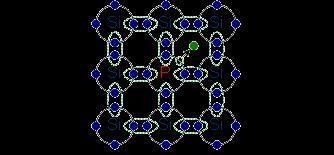
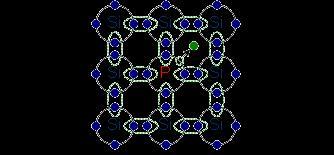
Silicon atoms have a<u> valency </u>of 4, this means that there are 4 electrons in their outermost orbital. Thus, in silicon crystals, each Si atom is connected to 4 different Si atoms.

When we replace a few of these Si atoms with P atoms, which have a valency of 5, 4 out of these 5 outermost electrons will be bonded with the surrounding Si atoms. The fifth electron would not be bonded, meaning it would be free to move, acting as a mobile negative charge carrier (See the picture below).

Just to be clear, regarding option c), it's true that Ge atoms have more electrons that Si atoms, however that it's not a reason for an increase in conductivity.

You might be interested in
Question 4: Which members of an ecosystem are part of the energy flow?
Vanyuwa [196]

Answer:

The answer is A (number 1)

5 0
2 years ago
The easiest way to determine whether a process is exothermic or endothermic is to note the change in temperature in a calorimete
Kryger [21]

Answer:

In the calorimeter, water is the <u>exothermic</u>. The salt LiCI, which will dissolve, is the <u>endothermic</u>. The final temperature of the water after the dissolution of LiCI was <u>lower</u> than the initial temperature, meaning the process is <u>exothermic</u>. In the microscopic view of the disspolution of LiCI, water molecules were seen to move <u>slowly</u> as they <u>gained </u>energy.

Explanation:

Exothermic is a process in which heat is released during the process. Endothermic reactions absorbs heat from surrounding during a chemical process. The dissolution of salt into water is an exothermic reaction. During this process heat is release and water molecules are broken down which are surrounded by salt ions.

5 0
2 years ago
An amount of solid barium chloride, 20.8 g, is dissolved in 100 g water in a coffee-cup calorimeter by the reaction: BaCl2 (s) 
mamaluj [8]

Answer : The enthalpy change during the reaction is -6.48 kJ/mole

Explanation :

First we have to calculate the heat gained by the reaction.

q=m\times c\times (T_{final}-T_{initial})

where,

q = heat gained = ?

m = mass of water = 100 g

c = specific heat = 4.04J/g^oC

T_{final} = final temperature = 26.6^oC

T_{initial} = initial temperature = 25.0^oC

Now put all the given values in the above formula, we get:

q=100g\times 4.04J/g^oC\times (26.6-25.0)^oC

q=646.4J

Now we have to calculate the enthalpy change during the reaction.

\Delta H=-\frac{q}{n}

where,

\Delta H = enthalpy change = ?

q = heat gained = 23.4 kJ

n = number of moles barium chloride = \frac{\text{Mass of barium chloride}}{\text{Molar mass of barium chloride}}=\frac{20.8g}{208.23g/mol}=0.0998mole

\Delta H=-\frac{646.4J}{0.0998mole}=-6476.95J/mole=-6.48kJ/mole

Therefore, the enthalpy change during the reaction is -6.48 kJ/mole

8 0
2 years ago
An irregularly shaped solid which has a mass of 10.283g was placed in a graduated cylinder containing an inert liquid. The initi
Gwar [14]
Liquid  + Solid = 8.89 mL
V ( Solid ) = 8.89 mL - 6.26 mL = 2.63 mL
The density of the solid = m / V = 10.283 g / 2.63 mL =
= 3.9 g/mL = 3.9 g / cm³
3 0
2 years ago
Which of the following is a valid conversion factor?
VMariaS [17]

Answer:

100 cg/1g

Step-by-step explanation:

    1 cg = 0.01 g     Multiply by 100

100 cg = 1 g

(a) is <em>wrong</em>. The correct conversion factor is 1000 cm³/1 L.

(b) is <em>wrong</em>. The correct conversion factor is 1000 mL/1 L.

(c) is <em>wrong</em>. The correct conversion factor is 1 m/10 dm.

7 0
2 years ago
Read 2 more answers
Other questions:
  • Which of these statements describes a limitation of the Treaty on Plant Genetic Resources?
    14·2 answers
  • You are riding a bicycle home from school. You average 5 meters per second and you are headed south. What motion can you determi
    15·1 answer
  • Question 1(Multiple Choice Worth 3 points)
    13·1 answer
  • Match each decimal number to the correct scientific notation. 30,700 0.000307 0.00000307 3,070,000 3.07 × 10⁻⁶ arrowRight 3.07 ×
    12·2 answers
  • 6. Find the number of centimeters in 1.00 x 10² yards. (1 yd = 3 ft, 1 ft = 12 in, 2.54 cm = 1
    5·1 answer
  • Aluminum–lithium (Al–Li) alloys have been developed by the aircraft industry to reduce the weight and improve the performance of
    8·1 answer
  • The partial pressures in an equilibrium mixture of NO, Cl2, and NOCI at 500 K are as follows: PNo = 0.240 atm, Pel2 = 0.608 atm,
    9·1 answer
  • A student wants to form 2‑hexanol using acidic hydration. He finds four alkenes in the inventory cabinet that could be possible
    12·1 answer
  • Aluminum has a specific heat of 0.902 j/gC. How much heat is lost when a piece of aluminum with a mass of 23.984 g cools from a
    6·1 answer
  • Consider a 0.238 M aqueous solution of sodium hydroxide, NaOH.
    11·1 answer
Add answer
Login
Not registered? Fast signup
Signup
Login Signup
Ask question!