answer.
Ask question
Login Signup
Ask question
All categories
  • English
  • Mathematics
  • Social Studies
  • Business
  • History
  • Health
  • Geography
  • Biology
  • Physics
  • Chemistry
  • Computers and Technology
  • Arts
  • World Languages
  • Spanish
  • French
  • German
  • Advanced Placement (AP)
  • SAT
  • Medicine
  • Law
  • Engineering
sleet_krkn [62]
2 years ago
11

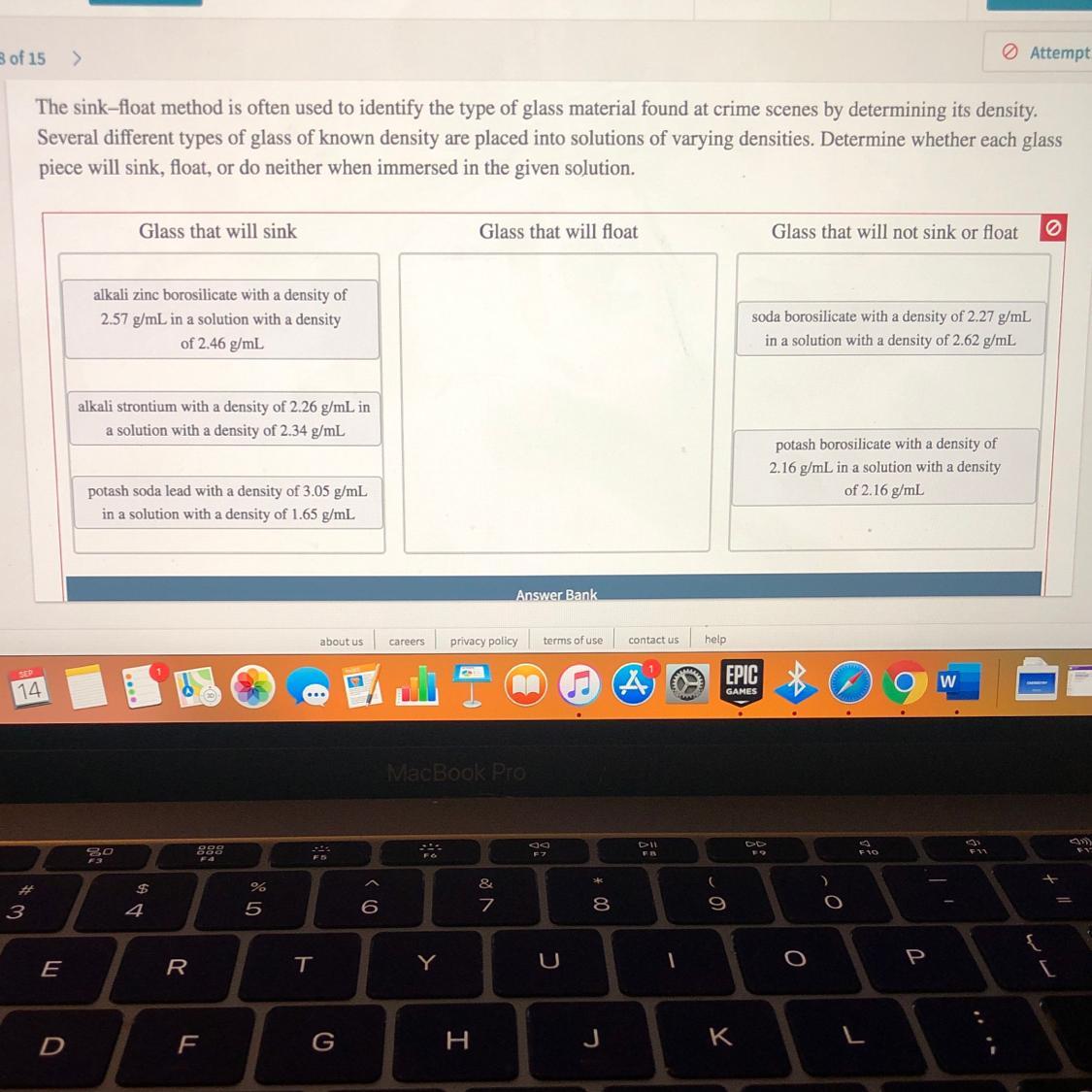
The sink-float method is often used to identify the type of glass material found at crime scenes by determining its density.

Chemistry
1 answer:
Olegator [25]2 years ago
8 0

Answer:

<em><u>Glass that will sink</u></em>

  • alkali zinc borosilicate with a density of 2.57 g/mL in a solution with a density of 2.46 g/mL

  • potash soda lead with a density of 3.05 g/mL in a solution with a density of 1.65 g/mL

<em><u>Glass that will float</u></em>

  • soda borosilicate with a density of 2.27 g/mL in a solution with a density of 2.62 g/mL

  • alkali strontium with a density of 2.26 g/mL in a solution with a density of 2.34 g/mL

<em><u>Glass that will not sink or float</u></em>

  • potash borosilicate with a density of 2.16 g/mL in a solution with a density of 2.16 g/mL

Explanation:

Density is the property of matter that states the ratio of the amount of matter, its mass, to the space occupied by it, its volume.

So, the mathematical expression for the density is:

  • density = mass / volume

By comparing the density of a material with the density of a liquid, you will be able to determine whether object will float, sink, or do neither when immersed in the liquid.

The greater the density of an object the more it will try to sink in the liquid.

As you must have experienced many times an inflatable ball (whose density is very low) will float in water, but a stone (whose denisty is greater) will sink in water.

The flotation condition may be summarized by:

  • When the density of the object < density of the liquid, the object will float
  • When the density of the object = density of the liquid: the object will neither float nor sink
  • When the density of the object > density of the liquid: the object will sink.

<em><u>Glass that will sink</u></em>

  • alkali zinc borosilicate with a density of 2.57 g/mL in a solution with a density of 2.46 g/mL, because 2.57 > 2.46.

  • potash soda lead with a density of 3.05 g/mL in a solution with a density of 1.65 g/mL, because 3.05 > 1.65.

<u><em>Glass that will float</em></u>

  • soda borosilicate with a density of 2.27 g/mL in a solution with a density of 2.62 g/mL, because 2.27 < 2.62.

  • alkali strontium with a density of 2.26 g/mL in a solution with a density of 2.34 g/mL, because 2.26 < 2.34.

<em><u>Glass that will not sink or float</u></em>

  • potash borosilicate with a density of 2.16 g/mL in a solution with a density of 2.16 g/mL, because 2.16 = 2.16
You might be interested in
Calculate the freezing point of a 0.08500 m aqueous solution of nano3. the molal freezing-point-depression constant of water is
Citrus2011 [14]
Depression in freezing point (ΔT_{f}) = K_{f}×m×i,
where, K_{f} = cryoscopic constant = 1.86^{0} C/m,
m= molality of solution = 0.0085 m
i = van't Hoff factor = 2 (For NaNO_{3})

Thus, (ΔT_{f}) = 1.86 X 0.0085 X 2 = 0.03162^{0}C

Now, (ΔT_{f}) = T^{0} - T
Here, T = freezing point of solution
T^{0} = freezing point of solvent = 0^{0}C
Thus, T = T^{0} - (ΔT_{f}) = -0.03162^{0}C
8 0
2 years ago
Read 2 more answers
A curium-245 nucleus is hit with a neutron and changes as shown by the equation. Complete the equation by filling in the missing
Lera25 [3.4K]

Try this option:

^{245}_{96}Cm+^1_0n=^{103}_{42}Mo+^{245+1-103-3*1}_{96+0-42-3*0}(X)+3^1_0n;

^{245}_{96}Cm+^1_0n=> ^{103}_{42}Mo+^{140}_{54}(X)+3^1_0n;

^{245}_{96}Cm+^1_0n=> ^{103}_{42}Mo+^{140}_{54}Xe+3^1_0n;

Answer:

^{140}_{54}Xe

8 0
2 years ago
Read 2 more answers
The recommended daily intake of potassium ( K ) is 4.725 g . The average raisin contains 3.513 mg K . Fill in the denominators o
kondor19780726 [428]

Explanation:

It is known that 1 gram contains 1000 milligrams. And, mathematically we can represent it as follows.

             \frac{1 g}{1000 mg} or \frac{1000 mg}{1 g}

So, when we have to convert grams into milligrams then we simply multiply the digit with 1000. And, if we have to convert a digit from milligrams to grams then we simply divide it by 1000.

4 0
2 years ago
Consider a culture medium on which only gram-positive organisms such as Staphylococcus aureus colonies can grow due to an elevat
Olin [163]
<h2>Selective & Differential Medium</h2>

Explanation:

  • Selective media allow specific types of organisms to develop, and inhibit the development of different living beings. The selectivity is cultivated in a few ways.For model, living beings that can use a given sugar are handily screened by making that sugar the main carbon source in the medium. On the other hand,selective hindrance of certain sorts of microorganisms can be accomplished by adding dyes, anti-infection agents, salts or explicit inhibitors which influence the digestion or enzyme systems of the living beings
  • Differential media are utilized to separate firmly related life forms or groups of living beings. owing to the pre of specific colors or synthetic compounds in the media, the creatures will deliver trademark changes or development designs that are utilized for ID or separation. An assortment of particular and differential media are utilized in clinical, demonstrative and water contamination research facilities, and in food and dairy laboratories
  • Selective media because elevated NaCI level is designed to help grow selective bacteria.differential media because the fermented sugar gives off a yellow halo which allows for differentiate between bacteria

4 0
2 years ago
Dehydrohalogenation of tert-pentyl bromide at higher temperatures will produce 2-methyl-1-butene as the chief product when
salantis [7]

I'm going to suppose you want the adjusted chemical reaction, using the formulas of the compounds. You can see it in the image attached.

6 0
2 years ago
Other questions:
  • What is the stoichiometric ratio between BaCl2 and NaCl
    11·1 answer
  • A 52.0 mL volume of 0.25 M HBr is titrated with 0.50 M KOH. Calculate the pH after addition of 26.0 mL of KOH at 25 ∘C.
    14·1 answer
  • A gas of potassium chlorate molecules KClO3 all decompose into potassium chloride, KCl, and diatomic oxygen, O2. The products an
    9·1 answer
  • A student prepared an unknown sample by making a dilute solution of the unknown sample. The dilute sample was prepared by adding
    12·1 answer
  • Consider the nuclear equation below. Superscript 124 subscript 56 B a right arrow superscript 124 subscript 55 upper C s plus qu
    14·2 answers
  • This formula equation is unbalanced. P4(s) + Cl2(g) Right arrow. PCl3(l) Which coefficient should be placed in front of PCl3 to
    15·2 answers
  • The energy gap between the valence band and the conduction band in the widely-used semiconductor gallium arsenide (GaAs) is Δ =
    13·1 answer
  • How many chiral centers does clavulanic acid have?
    5·1 answer
  • What happens when carbon dioxide is cooled to 780C?<br>Where is carbon dioxide found in nature?​
    9·1 answer
  • What is the compound name for PCl8
    5·2 answers
Add answer
Login
Not registered? Fast signup
Signup
Login Signup
Ask question!
