answer.
Ask question
Login Signup
Ask question
All categories
  • English
  • Mathematics
  • Social Studies
  • Business
  • History
  • Health
  • Geography
  • Biology
  • Physics
  • Chemistry
  • Computers and Technology
  • Arts
  • World Languages
  • Spanish
  • French
  • German
  • Advanced Placement (AP)
  • SAT
  • Medicine
  • Law
  • Engineering
lutik1710 [3]
2 years ago
14

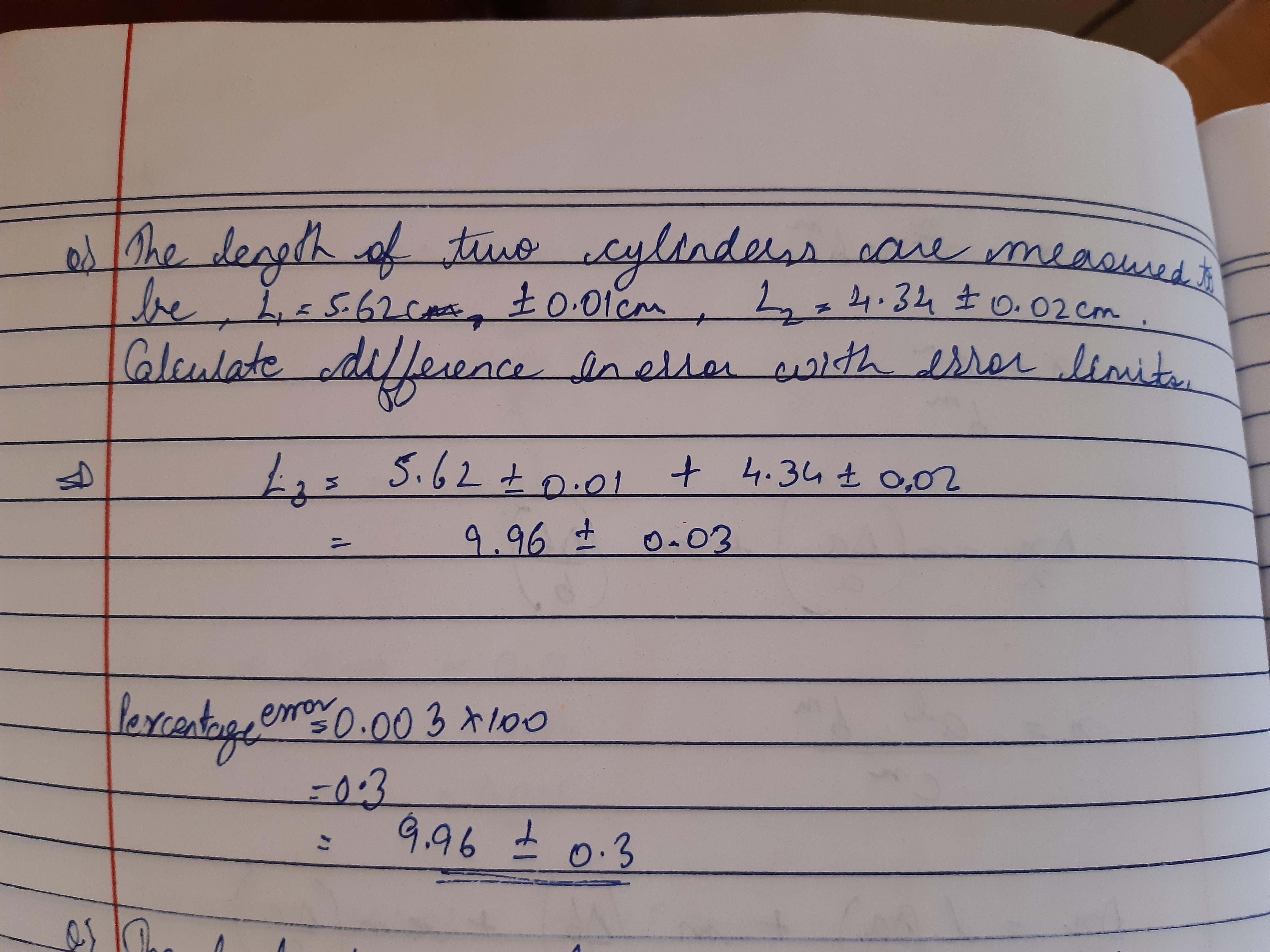
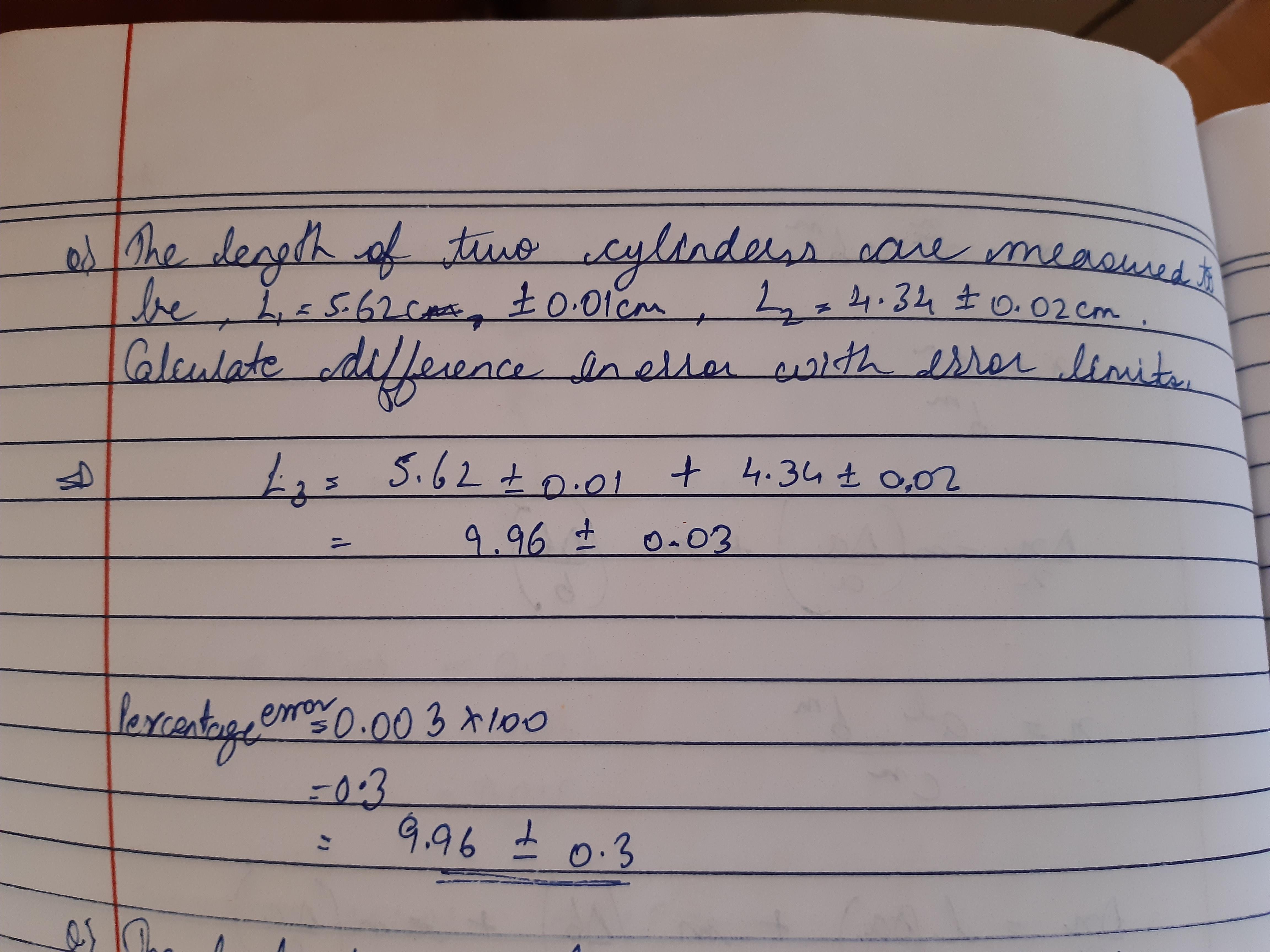
Length of two cylinders are measured to be L1 = 5.62 +/- 0.01cm and L2 = 4.34 +/- 0.02cm.

Physics
1 answer:
zavuch27 [327]2 years ago
7 0

Answer:

Explanation:

Just look at the figure

You might be interested in
In preparation for a demonstration, your professor brings a 1.50−L bottle of sulfur dioxide into the lecture hall before class t
mina [271]

Answer:

n = 2.06 moles

Explanation:

The absolute pressure at depth of 27 inches can be calculated by:

Pressure = Pressure read + Zero Gauge pressure

Zero Gauge pressure = 14.7 psi

Pressure read = 480 psi

Total pressure = 480 psi + 14.7 psi = 494.7 psi

P (psi) = 1/14.696  P(atm)

So, Pressure = 33.66 atm

Temperature = 25°C

The conversion of T( °C) to T(K) is shown below:

T(K) = T( °C) + 273.15  

So,  

T = (25 + 273.15) K = 298.15 K  

T = 298.15 K  

Volume = 1.50 L

Using ideal gas equation as:

PV=nRT

where,  

P is the pressure

V is the volume

n is the number of moles

T is the temperature  

R is Gas constant having value = 0.0821 L.atm/K.mol

Applying the equation as:

33.66 atm × 1.50 L = n × 0.0821 L.atm/K.mol × 298.15 K  

⇒n = 2.06 moles

7 0
2 years ago
A conducting sphere of radius 5.0 cm carries a net charge of 7.5 µC. What is the surface charge density on the sphere?
11111nata11111 [884]

Answer:

\sigma=0.014\ C/m^2

Explanation:

Given that,

The radius of sphere, r = 5 cm = 0.05 m

Net charge carries, q = 7.5 µC = 7.5 × 10⁻⁶ C

We need to find the surface charge density on the sphere. Net charge per unit area is called the surface charge density. So,

\sigma=\dfrac{7.5\times 10^{-6}}{\dfrac{4}{3}\pi \times (0.05)^3}\\\\=0.014\ C/m^2

So, the surface charge density on the sphere is 0.014\ C/m^2.

7 0
2 years ago
A solenoid that is 35 cm long and contains 450 circular coils 2.0 cm in diameter carries a 1.75-A current. (a) What is the magne
Taya2010 [7]

Answer:

Explanation:

a )  No of turns per metre

n = 450 / .35

= 1285.71

Magnetic field inside the solenoid

B = μ₀ n I

Where I is current

B = 4π x 10⁻⁷ x 1285.71 x 1.75

= 28.26 x 10⁻⁴ T

This is the uniform magnetic field inside the solenoid.

b )

Magnetic field around a very long wire at a distance d is given by the expression

B = ( μ₀ /4π ) X 2I / d

= 10⁻⁷ x 2 x ( 1.75 / .01 )

= .35 x 10⁻⁴ T

In the second case magnetic field is much less. It is due to the fact that in the solenoid magnetic field gets multiplied due to increase in the number of turns. In straight coil this does not happen .

6 0
2 years ago
Read 2 more answers
3. In 1989, Michel Menin of France walked on a tightrope suspended under a
Tamiku [17]

Answer: 80m

Explanation:

Distance of balloon to the ground is 3150m

Let the distance of Menin's pocket to the ground be x

Let the distance between Menin's pocket to the balloon be y

Hence, x=3150-y------1

Using the equation of motion,

V^2= U^s + 2gs--------2

U= initial speed is 0m/s

g is replaced with a since the acceleration is under gravity (g) and not straight line (a), hence g is taken as 10m/s

40m/s is contant since U (the coin is at rest is 0) hence V =40m/s

Slotting our values into equation 2

40^2= 0^2 + 2 * 10* (3150-y)

1600 = 0 + 63000 - 20y

1600 - 63000 = - 20y

-61400 = - 20y minus cancel out minus on both sides of the equation

61400 = 20y

Hence y = 61400/20

3070m

Hence, recall equation 1

x = 3150 - 3070

80m

I hope this solve the problem.

6 0
2 years ago
A particle with a charge of 3.00 elementary charges moves through a potential difference of 4.50 volts. What is the change in el
ollegr [7]
The answer:
the relationship between elementary charge, potential difference and electrical potential energy is given by 
   E= qV
E:  lectrical potential energy
q:   elementary charge
V:   potential difference

but we have  e=abs val(q)=3 
so we have E= qV=3ex4.5V=<span>13.5 eV
</span>
the answer is <span>(4)13.5 eV</span>
8 0
2 years ago
Other questions:
  • Argelia has a stack of schoolbooks sitting in the backseat of her car. When Argelia makes a sharp right turn, the books slide to
    11·2 answers
  • Mari places a marble at the top of a ramp and lets it go. It rolls down. At the bottom of the ramp, the marble bumps into a bloc
    7·2 answers
  • For lunch you and your friends decide to stop at the nearest deli and have a sandwich made fresh for you with 0.300 kg of Italia
    7·1 answer
  • Susie walks 3 blocks north to the local CVS store, then 4 blocks east to her grandmother’s house. She then walks 2 blocks west a
    15·1 answer
  • A container of nitrogen (an ideal diatomic gas, molecular weight=28) is at a pressure of 2 atm and has a mass density of 1.6 gra
    13·1 answer
  • Suppose we were to attempt to use a similar machine to measure the charge-to-mass ratio of protons, instead. Suppose, for simpli
    9·1 answer
  • Antireflection coatings can be used on the inner surfaces of eyeglasses to reduce the reflection of stray light into the eye, th
    9·1 answer
  • To fully describe the photoelectric effect, scientists must consider which of
    9·1 answer
  • Four kilograms of carbon monoxide (CO) is contained in a rigid tank with a volume of 1 m^3. The tank is fitted with a paddle whe
    11·1 answer
  • A small object with mass m, charge q, and initial speed v0 = 5.00 * 103 m&gt;s is projected into a uniform electric field betwee
    13·1 answer
Add answer
Login
Not registered? Fast signup
Signup
Login Signup
Ask question!