answer.
Ask question
Login Signup
Ask question
All categories
  • English
  • Mathematics
  • Social Studies
  • Business
  • History
  • Health
  • Geography
  • Biology
  • Physics
  • Chemistry
  • Computers and Technology
  • Arts
  • World Languages
  • Spanish
  • French
  • German
  • Advanced Placement (AP)
  • SAT
  • Medicine
  • Law
  • Engineering
lidiya [134]
2 years ago
11

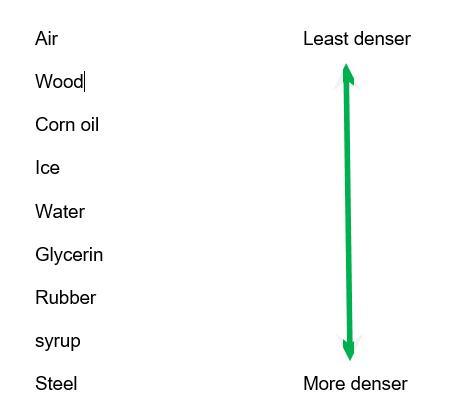
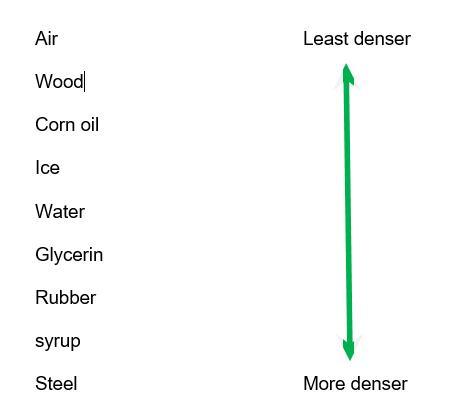
Assuming the following materials will not mix,show how the materials would "Stack up" in a graduated cylinder.

Chemistry
1 answer:
mihalych1998 [28]2 years ago
4 0

<u>Answer:</u>

Density is mass per unit volume.

Its formula is  

Density = Mass / Volume

Its units can be kg/L  or kg/(dm^3) or g/mL or g/(cm^3)

Density of various substances are given. The more denser substance goes to the bottom of the graduated cylinder.  

Air on the top then comes  Wood followed by  Corn oil followed by  Ice and then  Water followed by  Glycerin then  Rubber then  Corn syrup and at last  Steel at the bottom  which will more denser than all the substances mentioned above.

The staking up of the substances is in the order mentioned below in the tabular column

You might be interested in
A sample contains 2.2 g of the radioisotope niobium-91 and 15.4 g of its daughter isotope, zirconium-91. how many half-lives hav
dybincka [34]

Answer: 3

Explanation: This is a radioactive decay and all the radioactive process follows first order kinetics.

Equation for the reaction of decay of _{19}^{40}\textrm{K} radioisotope follows:

Moles of zirconium=\frac{\text{Given mass}}{\text{Molar mass}}=\frac{15.4}{91}=0.17moles  

Moles of niobium=\frac{\text{Given mass}}{\text{Molar mass}}=\frac{2.2}{91}=0.024moles  

_{41}^{91}\textrm{Nb}\rightarrow _{40}^{91}\textrm{Zr}+_{+1}^0e

By the stoichiometry of above reaction,

1 mole of _{40}^{91}\textrm{Zr} is produced by 1 mole _{41}^{91}\textrm{Nb}

So, 0.17 moles of _{40}^{91}\textrm{Zr} will be produced by = \frac{1}{1}\times 0.17=0.17\text{ moles of }_{40}^{91}\textrm{Nb}

Amount of _{82}^{212}\textrm{K}

decomposed will be = 0.17 moles

Initial amount of _{40}^{91}\textrm{Nb}  will be = Amount decomposed + Amount left = (0.17 + 0.024)moles =0.194 moles

a=\frac{a_o}{2^n}

where,

a = amount of reactant left after n-half lives = 0.024

a_o = Initial amount of the reactant = 0.194

n = number of half lives= ?

Putting values in above equation, we get:

0.024=\frac{0.194}{2^n}

n=3

Therefore, 3 half lives have passed.
3 0
2 years ago
Read 2 more answers
Aqueous hydrochloric acid reacts with aqueous sodium sulfite to produce aqueous sodium chloride and aqueous sulfurous acid. Writ
ohaa [14]

Answer:

2HCl(aq) + Na2SO3(aq) —> 2NaCl(aq) + H2SO3(aq)

Explanation:

HCl(aq) + Na2SO3(aq) —> NaCl(aq) + H2SO3(aq)

Let us balance the equation. This is illustrated below:

There are 2 atoms of Na on the left side of the equation and 1atom on the right side. It can be balance by putting 2 in front of NaCl as shown below:

HCl(aq) + Na2SO3(aq) —> 2NaCl(aq) + H2SO3(aq)

Now, we have 2 atoms of Cl on the right side and 1 atom on the left side. Thus, it can be balance by putting 2 in front of HCl as shown below:

2HCl(aq) + Na2SO3(aq) —> 2NaCl(aq) + H2SO3(aq)

A careful look at the equation proved that the equation is balanced as the numbers of the different atoms of the element on both side of the equation are the same.

4 0
2 years ago
Read 2 more answers
What is the molarity of a solution that is made by adding 57.3 g of MgO to 500.0 mL of solution?
kifflom [539]

Answer:

2.843 M

Explanation:

Molarity = moles / volume

<u>Milliliters to liters:</u>

500 mL <u>= .500 L</u>

<u>Grams to moles:</u>

MgO molar mass = 16.00 + 24.31 = 40.31 g/mol

57.3 g x 1 mol / 40.31 g = <u>1.421 mol</u>

<u>Molarity:</u>

1.421 mol / .500 L =  2.843 M

0 0
2 years ago
How many atoms of nitrogen are in 1.2 grams of aspartame?
qaws [65]
The molecular formula for aspartame is C14H18N2O5, and its molar mass is about 294 g/mol.

Convert 1.2 g into moles, which gives

1.2 g / 294 g/mol = 4.08 X 10⁻³ moles aspartame.

Since each mole of aspartame has 2 moles of nitrogen, you have 8.16 X 10⁻³ moles of N in your 1.2 grams of aspartame.

Finally, multiply that by Avogadro's number to get the number of N atoms:

8.16 X 10^-3 mol X 6.02 X 10^23 = 4.9 X 10^21 nitrogen atoms.
5 0
2 years ago
Which diastereomer of oct−4−ene yields a single meso compound, (4r, 5s)−4,5−dibromooctane on reaction with br2?
stepladder [879]
How does that mean that the number is a little too late and you don’t have a phone number so you please look at it
4 0
2 years ago
Other questions:
  • Suppose that a metal oxide of formula m2o3 were soluble in water. what would be the major product or products of dissolving the
    7·1 answer
  • Amy performed an experiment in lab. She improperly mixed the chemicals, and an explosion of light, sound, and heat occurred. Whe
    8·1 answer
  • How are exothermic and endothermic reactions linked in the process of refining metal ore?
    11·1 answer
  • recheck Fusion reactions power the in space. Humans currently use fusion in , but researchers are seeking more applications.
    14·1 answer
  • Type the correct answer in the box. Express the answer to three significant figures.
    8·1 answer
  • What type of bond holds amino acids together?
    14·2 answers
  • Using the van der Waals equation, the pressure in a 22.4 L vessel containing 1.00 mol of neon gas at 100 °C is ________ atm. (a
    14·1 answer
  • The engineers at a hydroelectric dam designed a computer program that will allow them to determine the amount of energy they can
    10·1 answer
  • Imagine you needed to identify if an object has undergone a physical change or a chemical change. What information would you nee
    10·1 answer
  • A student places four identical cells into four different liquids. Over time which cell will look the smallest WXY or Z
    12·1 answer
Add answer
Login
Not registered? Fast signup
Signup
Login Signup
Ask question!