answer.
Ask question
Login Signup
Ask question
All categories
  • English
  • Mathematics
  • Social Studies
  • Business
  • History
  • Health
  • Geography
  • Biology
  • Physics
  • Chemistry
  • Computers and Technology
  • Arts
  • World Languages
  • Spanish
  • French
  • German
  • Advanced Placement (AP)
  • SAT
  • Medicine
  • Law
  • Engineering
Lina20 [59]
2 years ago
11

Ibuprofen, a headache remedy, contains 75.69% C, 8.80% H, and 15.51% O by mass and has a molar mass of 206 g/mol. Express your a

nswers as chemical formulas separated by a comma. nothing Request Answer Part B Cadaverine, a foul-smelling substance produced by the action of bacteria on meat, contains 58.55% C, 13.81% H, and 27.40% N by mass; its molar mass is 102.2 g/mol. Express your answers as chemical formulas separated by a comma. nothing Request Answer Part C Epinephrine (adrenaline), a hormone secreted into the bloodstream in times of danger or stress, contains 59.0% C, 7.1% H, 26.2% O, and 7.7% N by mass; its molar mass is about 180 amu. Express your answers as chemical formulas separated by a comma. nothing
Chemistry
1 answer:
xz_007 [3.2K]2 years ago
7 0

Answer:

A)Molecular formula of ibuprofen isC_{13}H_{18}O_2

B)Molecular formula of Cadaverine is C_{5}H_{14}N_2

C)Molecular formula of Epinephrine is C_9H_{13}O_3N_1

Explanation:

Percentage of an element in a compound:

\frac{\text{Number of atoms of element}\times \text{Atomic mass of element}}{\text{molecular mass of element}}\times 100

A) Ibuprofen, a headache remedy, contains 75.69% C, 8.80% H, and 15.51% O by mass.

Molar mass of ibuprofen = 206 g/mol.

Let the molecular formula of ibuprofen be =C_xH_yO_z

Number of carbon atoms in 1 molecule of ibuprofen ;

75.69\%=\frac{x\times 12 g/mol}{206 g/mol}\times 100

x=\frac{75.69\times 206 g/mol}{100\times 12 g/mol}=12.99\approx 13

Number of hydrogen atoms in 1 molecule of ibuprofen ;

8.80\%=\frac{y\times 1 g/mol}{206 g/mol}\times 100

y=\frac{8.80\times 206 g/mol}{100\times 1 g/mol}=18.12\approx 18

Number of oxygen atoms in 1 molecule of ibuprofen ;

15.51\%=\frac{z\times 16 g/mol}{206 g/mol}\times 100

z=\frac{15.51\times 206 g/mol}{100\times 16 g/mol}=1.99\approx 2

Molecular formula of ibuprofen :

= C_xH_yO_z= C_{13}H_{18}O_2

B)  Cadaverine contains 58.55% C, 13.81% H, and 27.40% N by mass

Molar mass of Cadaverine = 102.2 g/mol.

Let the molecular formula of Cadaverine be =C_xH_yN_z

Number of carbon atoms in 1 molecule of Cadaverine ;

58.55\%=\frac{x\times 12 g/mol}{102.2 g/mol}\times 100

x=\frac{58.55\times 102.2 g/mol}{100\times 12 g/mol}=4.98\approx 5

Number of hydrogen atoms in 1 molecule of Cadaverine ;

13.81\%=\frac{y\times 1 g/mol}{102.2 g/mol}\times 100

y=\frac{13.81\times 102.2 g/mol}{100\times 1 g/mol}=14.11\approx 14

Number of nitrogen atoms in 1 molecule of Cadaverine ;

27.40\%=\frac{z\times 14 g/mol}{102.2 g/mol}\times 100

z=\frac{27.40\times 102.2 g/mol}{100\times 14 g/mol}=2.00\approx 2

Molecular formula of Cadaverine :

= C_xH_yN_z= C_{5}H_{14}N_2

C) Epinephrine  contains 59.0% C, 7.1% H, 26.2% O, and 7.7% N by mass

Molar mass of Epinephrine  = 180 g/mol.

Let the molecular formula of Epinephrine  be =C_xH_yO_zN_w

Number of carbon atoms in 1 molecule of Epinephrine  ;

59.0\%=\frac{x\times 12 g/mol}{180 g/mol}\times 100

x=\frac{59.0\times 180 g/mol}{100\times 12 g/mol}=8.85\approx 9

Number of hydrogen atoms in 1 molecule of Epinephrine  ;

7.1\%=\frac{y\times 1 g/mol}{180 g/mol}\times 100

y=\frac{7.1\times 180 g/mol}{100\times 1 g/mol}=12.78\approx 13

Number of oxygen atoms in 1 molecule of Epinephrine  ;

26.2\%=\frac{z\times 16 g/mol}{180 g/mol}\times 100

z=\frac{26.2\times 180 g/mol}{100\times 16 g/mol}=2.94\approx 3

Number of nitrogen atoms in 1 molecule of Epinephrine  ;

7.7\%=\frac{w\times 14 g/mol}{180 g/mol}\times 100

w=\frac{7.7\times 180 g/mol}{100\times 14 g/mol}=0.99\approx 1

Molecular formula of Epinephrine  :

= C_xH_yO_zN_w= C_9H_{13}O_3N_1

You might be interested in
Each student in a class placed a 2.00 g sample of a mixture of Cu and Al in a beaker and placed the beaker in a fume hood. The s
Aleks [24]

Answer:

Percentage mass of copper in the sample = 32%

Explanation:

Equation of the reaction producing Cu(NO₃) is given below:

Cu(s)+ 4HNO₃(aq) ---> Cu(NO₃)(aq) + 2NO₂(g) + 2H₂O(l)

From the equation of reaction, 1 mole of Cu(NO₃) is produced from 1 mole of copper. Therefore, 0.010 moles of Cu(NO₃) will be produced from 0.010 mole of copper.

Molar mass of copper = 64 g/mol

mass of copper = number of moles * molar mass

mass of copper = 0.01 mol * 64 g/mol = 0.64 g

Percentage by mass of copper in the 2.00 g sample = (0.64/2.00) * 100%

Percentage mass of copper in the sample = 32%

3 0
2 years ago
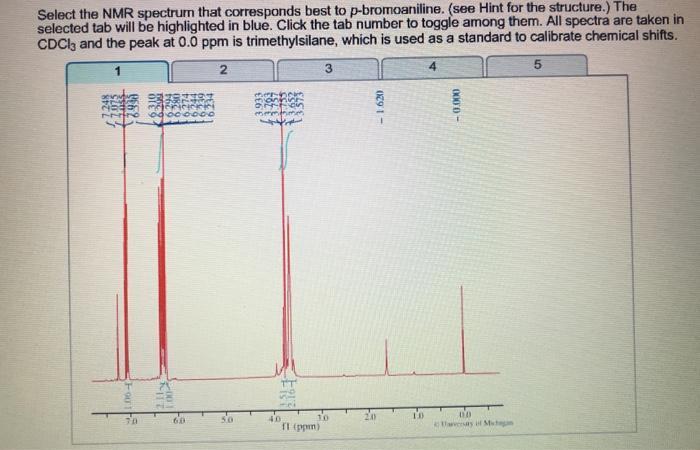
Select the NMR spectrum that corresponds best to p-bromoaniline. (see Hint for the structure.) The selected tab will be highligh
lana [24]

Answer:

The NMR spectrum that corresponds best to p-bromoaniline  is the one that is attached in the image below.

Explanation:

For the p-bromoaniline 3 types of hydrogen are observed. The first signal that appears at 3.7 ppm would be from the hydrogens of the NH2 group, the hydrogens in ortho position with respect to the NH2 group give a double at approximately 6.54 ppm, and finally the characteristic 7.21 ppm signal is observed for the hydrogens in meta position with with respect to the NH2 group.

7 0
2 years ago
2.1 liters is the same as cm3 and ml
Kipish [7]
1L = 1000ml
1ml = 1cm^3

2.1L = 2100mL = 2100cm^3

4 0
2 years ago
A water molecule is composed of a large oxygen atom bonded to two small hydrogen atoms. Which of the following would make the be
sleet_krkn [62]

The best and most correct answer among the choices provided by your question is the third choice or letter C.

The best model of a water <span>molecule would be: </span><span>Two small, plastic balls attached to a larger plastic ball by toothpicks</span>

I hope my answer has come to your help. Thank you for posting your question here in Brainly. We hope to answer more of your questions and inquiries soon. Have a nice day ahead!
5 0
2 years ago
Read 2 more answers
Groups of atoms that are added to carbon backbones and give them unique properties are known as
Irina-Kira [14]

Answer:

             Groups of atoms that are added to carbon backbones and give them unique properties are known as <u>Functional Groups</u>.

Explanation:

                   In organic chemistry they are called as Functional Group because they are the active part of a molecule. These groups give a unique characteristic to molecule both chemically and physically. Also, each functional group represent a different class of compounds.

Examples:

S No.                          Functional Group                                 Name

1                                   R--X                                             Alkyl Halides

2                                   R--OH                                          Alcohols

3                                  R--NH₂                                         Amines

4                                  R--O--R                                         Ethers

5                                   R--CO--R                                      Ketones

6                                   R--CO--H                                     Aldehydes

7                                  R--CO--OH                                  Carboxylic acids

8                                   R--CO--X                                     Acid Halides

10                                R--CO--NR₂                                 Acid Amides

11                                 R--CO-OR'                                  Esters

3 0
2 years ago
Other questions:
  • Rank the nonmetals in each set from most reactive (1) to least reactive (3). Neon: Selenium: Fluorine
    5·2 answers
  • A newly discovered element has two isotopes. one has an atomic weight of 120.9038 amu with 57.25% abundance. the other has an at
    14·2 answers
  • Five darts strike near the center of the target. Who ever threw the darks is?
    9·1 answer
  • How many moles of Cu are needed to react with 5.8 moles of AgNO3?<br> Cu + 2 AgNO3 → Cu(NO3)2 + 2 Ag
    8·1 answer
  • What is the best example of a cyclic event?
    7·1 answer
  • What is the percent by mass of 15g of sugar of 70g of water?
    8·1 answer
  • Write a chemical formula for each molecular model. (Blue ball represents nitrogen atom, red ball represents oxygen atom, white b
    8·1 answer
  • A 5-column table with 2 rows. Column 1 is labeled number of protons, with entries A and D; column 2 is number of neutrons, with
    8·1 answer
  • Montrel takes a trip to Central America during the winter. He finds out that the temperature in Central America is about the sam
    5·1 answer
  • How many elements are in H2CrO4
    15·2 answers
Add answer
Login
Not registered? Fast signup
Signup
Login Signup
Ask question!