answer.
Ask question
Login Signup
Ask question
All categories
  • English
  • Mathematics
  • Social Studies
  • Business
  • History
  • Health
  • Geography
  • Biology
  • Physics
  • Chemistry
  • Computers and Technology
  • Arts
  • World Languages
  • Spanish
  • French
  • German
  • Advanced Placement (AP)
  • SAT
  • Medicine
  • Law
  • Engineering
Amanda [17]
2 years ago
8

Groups of atoms that are added to carbon backbones and give them unique properties are known as

Chemistry
1 answer:
Irina-Kira [14]2 years ago
3 0

Answer:

             Groups of atoms that are added to carbon backbones and give them unique properties are known as <u>Functional Groups</u>.

Explanation:

                   In organic chemistry they are called as Functional Group because they are the active part of a molecule. These groups give a unique characteristic to molecule both chemically and physically. Also, each functional group represent a different class of compounds.

Examples:

S No.                          Functional Group                                 Name

1                                   R--X                                             Alkyl Halides

2                                   R--OH                                          Alcohols

3                                  R--NH₂                                         Amines

4                                  R--O--R                                         Ethers

5                                   R--CO--R                                      Ketones

6                                   R--CO--H                                     Aldehydes

7                                  R--CO--OH                                  Carboxylic acids

8                                   R--CO--X                                     Acid Halides

10                                R--CO--NR₂                                 Acid Amides

11                                 R--CO-OR'                                  Esters

You might be interested in
You are presented with a mystery as part of your practical experiment. You have a solution of Pb(NO3)2 that has a worn label mak
Orlov [11]

Answer:

Minimum volume of H₂SO₄ required for H₂SO₄ to be in excess = 0.0556 mL

Explanation:

Pb(NO₃)₂ + H₂SO₄ -----> PbSO₄ + 2HNO₃

For this reaction, we know that the max concentration of Pb(NO₃) according to the bottle is 0.999M and to ensure the other reactant in the reaction is in excess, we'll do the calculation with a Pb(NO₃) that's a bit higher, that is, 1.0M.

Knowing that Concentration in mol/L = (number of moles)/(volume in L)

Number of moles of Pb(NO₃) added = concentration in mol/L × volume in L = 1 × 0.001 = 0.001 mole

According to the reaction,

1 mole of Pb(NO₃) reacts with 1 mole of H₂SO₄

0.001 mole of Pb(NO₃) will react with 0.001×1/1 mole of H₂SO₄

Therefore number of H₂SO₄ required for the reaction and for the H₂SO₄ to be in excess is 0.001 mole of H₂SO₄

So, the concentration of commercial H₂SO₄ is usually 18.0M, using this as the assumed value.

Volume of H₂SO₄ = (number of H₂SO₄ required for it to be in excess)/(concentration of H₂SO₄)

Volume of H₂SO₄ = 0.001/18 = 0.0000556 L = 0.0556 mL.

QED!!!

5 0
2 years ago
Hydrochloric acid (75.0 mL of 0.250 M) is added to 225.0 mL of 0.0550 M Ba(OH)2 solution. What is the concentration of the exces
Shalnov [3]

Answer:  The concentration of excess [OH^-] in solution is 0.017 M.

Explanation:

1. Molarity=\frac{moles}{\text {Volume in L}}

moles of HCl=Molarity\times {\text {Volume in L}}=0.250\times 0.075=0.019moles

1 mole of HCl give = 1 mole of H^+

Thus 0.019 moles of HCl give = 0.019 mole of H^+

2. moles of Ba(OH)_2=Molarity\times {\text {Volume in L}}=0.0550\times 0.225=0.012moles

According to stoichiometry:

1 mole of Ba(OH)_2 gives = 2 moles of OH^-

Thus 0.012 moles of Ba(OH)_2 give = 2 \times 0.012=0.024 moles of OH^-

H^++OH^-\rightarrow H_2O

As 1 mole of H^+ neutralize 1 mole of OH^-

0.019 mole of H^+ will neutralize 0.019 mole of OH^-

Thus (0.024-0.019)= 0.005 moles of OH^- will be left.

[OH^-]=\frac{\text {moles left}}{\text {Total volume in L}}=\frac{0.005}{0.3L}=0.017M

Thus molarity of [OH^-] in solution is 0.017 M.

4 0
2 years ago
Read 2 more answers
What is the sequence of energy transformations that occur in a nuclear reactor? nuclear energy Right arrow. Mechanical energy Ri
Mademuasel [1]

Answer:

NUCLEAR ENERGY -----> MECHANICAL ENERGY -------> THERMAL ENERGY --------> ELECTRICAL ENERGY

Explanation:

In nuclear reactor, various energy transformations occur in order to generate electricity. Nuclear reactor converts the energy released from nuclear fission and the heat generated is removed from the reactor by a cooling system where steam is generated. The steam then drives a turbine which powers a generator to produce electricity.

A nuclear reactor is hence an equipment where nuclear chain reactions occur and control can be obtained. The nuclear reactor uses mostly uranium-235 and Plutonium-239. When these radioactive substances absorbs neutrons, they undergo nuclear fission causing the nucleus to split into two or more smaller compounds with  the release of kinetic energy a form of mechanical energy, gamma radiations and others.The kinetic energy is then harnessed in the equipment as heat (thermal energy) which is received by a cooling system and steam is generated. The steam can then power the generator from which electricity is obtained (electrical energy).

So therefore, in a nuclear reactor, the nuclear energy is transformed to mechanical energy and then thermal energy which powers the generation of the electrical energy.

6 0
2 years ago
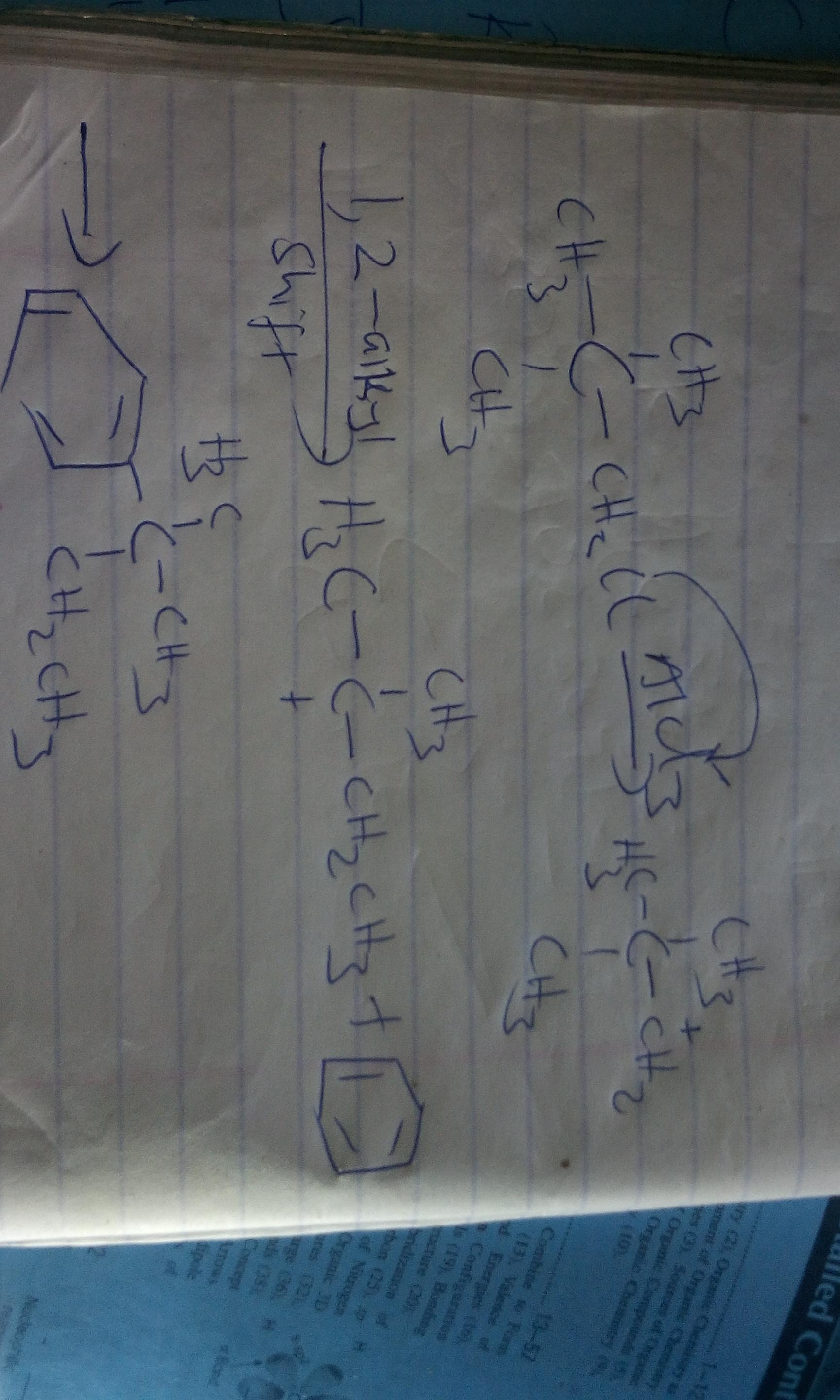
The reaction of benzene with (CH3)3CCH2Cl in the presence of anhydrous aluminum chloride produces principally which of these?
Sedaia [141]

Answer:

See explanation and image attached

Explanation:

When the carbocation is formed by the action of AlCl3 on the (CH3)3CCH2Cl, a primary carbocation is formed. The formation of the carbonation is followed by a 1,2-alkyl shift to give a tertiary carbocation which subsequently adds to the benzene ring as shown in the image attached to this answer.

6 0
2 years ago
Consider a 20.0 % (m/v) solution. how can this be written as a conversion factor?
White raven [17]
A conversion factor is a fraction or a ratio representing a relationship of two different measurement values. To write 20% m/v to a conversion factor, we need to remember that a percent is a value that represents the amount of a part per 100 units of the whole. M/v in the given value represents that the percentage is by mass per volume. So, to write it as a conversion factor, we do as follows:

20% m/v = 20 mass units / 100 volume units = 1 mass units / 5 volume units

Usually units of this are in g per L. So, it is equivalent to 1 g / 5 L
4 0
2 years ago
Other questions:
  • Determine the mass of oxygen in a 7.20 g sample of Al2(SO4)3.
    9·2 answers
  • Which of the following would most likely contain a fossil?
    11·2 answers
  • The reaction below has an equilibrium constant kp=2.2×10⁶ at 298 k. 2cof2(g)⇌co2(g)+cf4(g) calculate kp for the reaction below.
    15·2 answers
  • In the preceding information section there is a "bohr's diagram" of an atom. Which atom is it?
    9·1 answer
  • Explain why neither the oil nor the glass fiber interferes with the diffraction pattern of the crystal.
    13·1 answer
  • In looking at the bolded atoms in the answer choices, which pair consists of molecules having the same geometry? view available
    15·1 answer
  • Why are chemical tests necessary to tell a dextrose solution from a saline solution?
    14·1 answer
  • Justin is growing a garden and has many different types of liquids with which he could water his plants. He has water, coffee, m
    11·2 answers
  • A 1.800-g sample of solid phenol (C6H5OH(s)) was burned in a bomb calorimeter, which has a total heat capacity of 11.66 kJ/∘C. T
    10·1 answer
  • The diagram shows the scales used for recording temperatures. The labels for the scales are missing. 3 thermometers are oriented
    8·2 answers
Add answer
Login
Not registered? Fast signup
Signup
Login Signup
Ask question!