answer.
Ask question
Login Signup
Ask question
All categories
  • English
  • Mathematics
  • Social Studies
  • Business
  • History
  • Health
  • Geography
  • Biology
  • Physics
  • Chemistry
  • Computers and Technology
  • Arts
  • World Languages
  • Spanish
  • French
  • German
  • Advanced Placement (AP)
  • SAT
  • Medicine
  • Law
  • Engineering
d1i1m1o1n [39]
2 years ago
12

A stream consisting of 44.6 mole% benzene and 55.4% toluene is fed at a constant rate to a process unit that produces two produc

t streams, one a vapor and the other a liquid. The vapor flow rate is initially zero and asymptotically approaches half of the molar flow rate of the feed stream. Throughout this entire period, no material accumulates in the unit. When the vapor flow rate has become constant, the liquid is analyzed and found to be 28.0 mole% benzene.(a) Sketch a plot of liquid and vapor flow rates versus time from startup to when the flow rates become constant.
(b) Is this process batch or continuous? Is it transient or steady-state before the vapor flow rate reaches its asymptotic limit? What about after it becomes constant?
(c) For a feed rate of 100 mol/min, draw and fully label a flowchart for the process after the vapor flow rate has reached its limiting value, and then use balances to calculate the molar flow rate of the liquid and the composition of the vapor in mole fractions.

Chemistry
1 answer:
kramer2 years ago
5 0

Answer:

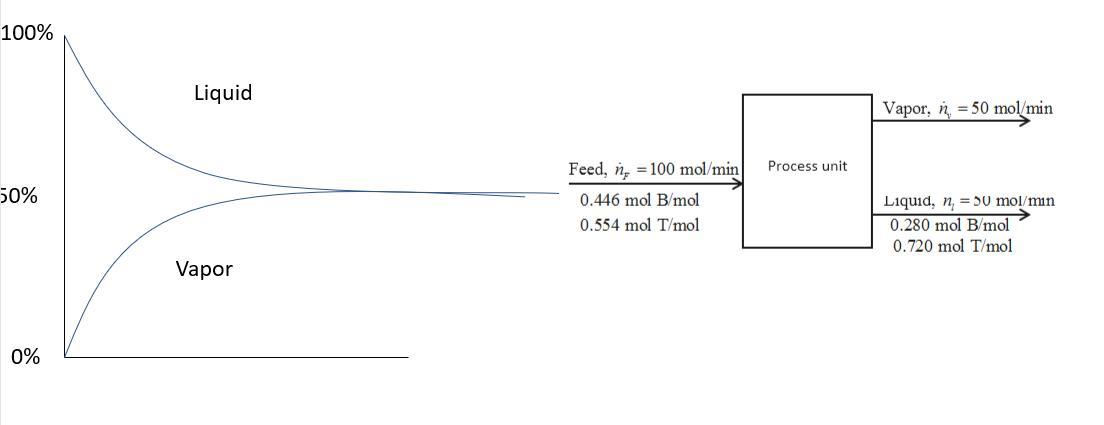
a)It is shown in the figure

b)Continuos... transient state... steady-state

c)molar flow rate of the liquid is 28 14 mol/min of bencene (28%) and 36 mol/min of toluene (72%)

Composition of vapor is 0.388 and 0.612 for B and T, respectively

Explanation:

a)In the beginning, the vapor Flow rate is 0% which means that the liquid Flow rate is 100%. The figure attached shows how at time=0, liquid=100 and vapor=0. With time, the Flow rate of vapor and liquid approach to 50% of the molar flow rate of the feed stream. The figure shows the plot of Vapor/liquid Flow rates versus time.

b)The problem mentions that the feed stream is fed at a constant rate to the reactor, thus the process is continuous. As is shown in the figure, before the Flow rate reaches the asymptotic limit, the flowrate is changing and it is time-dependent, which means before the asymptotic limit, the process is in transient state.  Then, after the asymptotic limit, the vapor/liquid flowrates are constants which means the process is in steady-state.

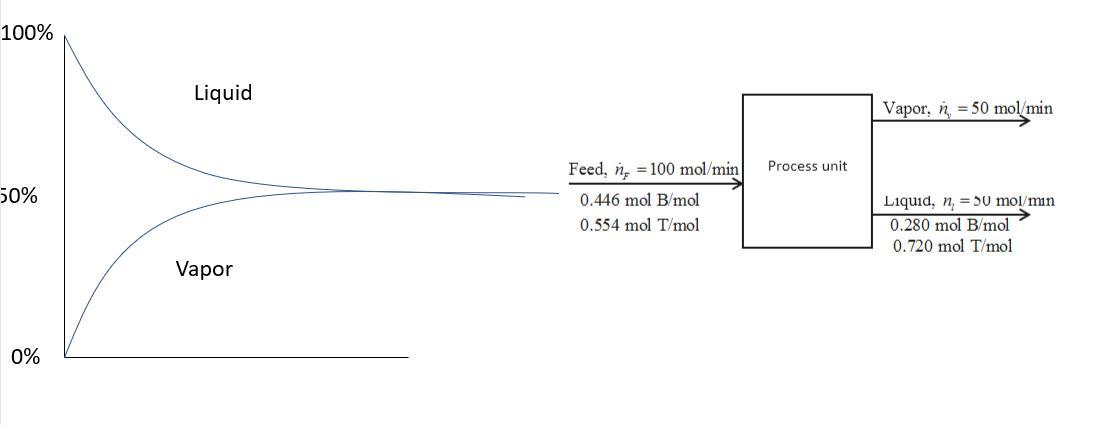
c)The Flow diagram process is shown in the figure where Benzene is represented as B and toluene as T.

<em>Feed flow rate:</em>

In the feed Flow rate, B and T are given, the molar fraction for B is 0.446 and the one for T is 55.4

B balance

we make a balance for B, we can calculate the molar Flow rate in vapor stream, the balance for B is:

A*Xba= CXbc + DXbd wher A, C and D are the feed, vapor and liquid streams, respectively, and Xba, Xbc and Xbd are the molar fractions of bencene in the corresponding stream.

A=100 mol/min, Xba=0.446, C=50 mol/min, Xbc=?, D=50 mol/min, Xbd= 0.28.

If you solve for Xbc, yo get the molar fraction of bencene in vapor stream is 0.388 and the toluene fraction is 0.612

You might be interested in
Why does silver iodide have a higher melting point than vanillin
MAVERICK [17]
AgI has a higher melting point than vanillin because it is an ionic compound. The bonds are held more tightly together than in vanillin because it is a covalent compound. Ionic bonds have a higher melting point because the electrons are being transferred from one atom to the other.
5 0
2 years ago
Shameeka is studying for an exam. She took the notes below about calcium and chlorine, which are known to form ionic bonds.Calci
AlladinOne [14]

Answer: Shameeka's error was: the individual calcium atoms become ions with a negative 2 charge

Explanation: when calcium donate two electrons, it will become positively charged i.e Ca^2+

5 0
2 years ago
Read 2 more answers
Write equation for the first ionization energy of neon. express your answer as a chemical equation. identify all of the phases i
Montano1993 [528]

The first ionization energy of a known element is the energy it needs to remove its highest energy or outermost electron. It is done to make a neutral atom be a positively charged ion. The first ionization energy of neon as a chemical equation is this:

Ne (g) -> Ne+ (g) + e-


8 0
2 years ago
Amino acids are the building blocks of proteins. The simplest amino acid is glycine (H2NCH2COOH). Draw a Lewis structure for gly
VashaNatasha [74]

Answer:

Explanation:

The lewis structure (indicating all the atoms and patterns provided as hint in the question) of glycine can be seen in the attachment below. While the chemical structure of glycine can be seen below

         H

          |

H₂N - C - C =O

          |      \

         H      OH

The structure (of glycine) above provides a "fair idea" of how the lewis structure will be.

3 0
2 years ago
A sample of gasoline contains various hydrocarbons, which comprise atoms of carbon, hydrogen, and oxygen. The hydrocarbons mix t
Naddika [18.5K]

Answer:

  • mixture
  • homogenous mixture  (of hydrocarbons)
  • compound

Explanation:

Mixture can be easily separated by physical methods. Homogeneity and heterogeneity of a mixture is determined by whether the components there in are in a single phase and evenly distributed or not.

A solution has a solute evenly dissolved in  solvent to form a liquid substance.

An element is the basic form of  substance which cannot be broke down into any other simpler unit.  

I hope this was helpful.

4 0
2 years ago
Other questions:
  • You are asked to determine the mass of a piece of copper using its reported density, 8.96 g/ml, and a 150-ml graduated cylinder.
    6·2 answers
  • How many total atoms are in 0.670 g of p2o5?
    9·1 answer
  • 40pionts
    9·1 answer
  • A 0.0200 M NaCl solution was formed when 38.0 grams of NaCl was dissolved in enough water. What was the total volume of the solu
    8·2 answers
  • A beaker contains a dilute sodium chloride solution at 1 atmosphere. What happens to the number of solute particles in the solut
    6·2 answers
  • Question 2 The metal molybdenum becomes superconducting at temperatures below 0.90K. Calculate the temperature at which molybden
    10·1 answer
  • Hydroxyapatite, Ca 10 ( PO 4 ) 6 ( OH ) 2 Ca10(PO4)6(OH)2 , has a solubility constant of Ksp = 2.34 × 10 − 59 2.34×10−59 , and d
    15·1 answer
  • A piece of silver releases 202.8 J of heat while cooling 65.0 °C. What is the mass of the sample? Silver has a specific heat of
    10·1 answer
  • Sugar is easily soluble in water and has a molar mass of 342.30 g/mol. What is the molar concentration of a 259.8 mL aqueous sol
    15·1 answer
  • This is the chemical formula for acetic acid (the chemical that gives the sharp taste to vinegar): An analytical chemist has det
    15·1 answer
Add answer
Login
Not registered? Fast signup
Signup
Login Signup
Ask question!