answer.
Ask question
Login Signup
Ask question
All categories
  • English
  • Mathematics
  • Social Studies
  • Business
  • History
  • Health
  • Geography
  • Biology
  • Physics
  • Chemistry
  • Computers and Technology
  • Arts
  • World Languages
  • Spanish
  • French
  • German
  • Advanced Placement (AP)
  • SAT
  • Medicine
  • Law
  • Engineering
BabaBlast [244]
2 years ago
9

What subatomic particle gives off visible light when it drops back down to a lower energy state?

Chemistry
1 answer:
Black_prince [1.1K]2 years ago
4 0
The subatomic particle that gives off visible light is electrons
You might be interested in
In Universe L, recently discovered by an intrepid team of chemists who also happen to have studied interdimensional travel, quan
Advocard [28]

Answer:

Manganese, Fifth transition element

[X] 3d⁶ 4s¹

Iron, Sixth transition element

[X] 3d⁶ 4s²

Explanation:

Complete Question

In Universe L, recently discovered by an intrepid team of chemists who also happen to have studied interdimensional travel, quantum mechanics works as it does in our universe, except that there are six d orbitals instead of the usual number we observe here. Use these facts to write the ground-state electron configurations of the sixth and seventh elements in the first transition series in Universe L. Note; you may use [X] to stand for the electron configuration of the noble gas at the end of the row before the first transition series.

Solution

In our universe, there are 5 d orbitals.

And according to Aufbau's principles that electrons fill the lower energy orbitals before they fill higher energy orbitals and Hund's Rule that states that electrons are fed singly to all the orbitals of a subshell before pairing occurs.

The fifth and sixth transition elements in our universe is then Manganese and Iron respectively.

Manganese - [Ar] 3d⁵ 4s²

Iron - [Ar] 3d⁶ 4s²

So, in the new universe L, where there are six d orbitals, for manganese, the fifth transition metal, because half filled orbitals are more stable than partially filled orbitals (that woukd have been rhe case if we leave 5 electrons on the 3d orbital), the 4s orbital is filled to half of its capacity and the one electron removed from the 4s is used to fill the six 3d orbital to half of its capacity too.

For the sixth transition element, the new extra electron just fills the lower energy 4s orbital, leaving the six 3d orbitals all half-filled.

Hence, they both have ground state configurations of

- Manganese, Fifth transition element

[X] 3d⁶ 4s¹

- Iron, Sixth transition element

[X] 3d⁶ 4s²

Hope this Helps!!!

7 0
2 years ago
The piece of iron that miguel measured had a mass of 51.1 g and a volume of 6.63 cm 3 . what did miguel calculate to be the dens
likoan [24]
Given:
Mass, m = 51.1 g
Volume, V = 6.63 cm³

By definition, 
Density = Mass/Volume
              = (51.1 g)/(6.63 cm³)
              = 7.7074 g/cm³

In SI units,
Density = (7.7074 g/cm³)*(10⁻³ kg/g)*(10² cm/m)³
              = 7707.4 kg/m³

Answer: 7.707 g/cm³ or 7707.4 kg/m³

4 0
2 years ago
Consider the following generic chemical equation:
vredina [299]

Answer:  238.6 J

Explanation:

According to the law of conservation of energy, energy can neither be created nor be destroyed. It can only be transformed from one form to another.

Endothermic reactions are those in which heat is absorbed by the system and thus the energy of products is higher than the energy of reactants.

For the given reaction:

A+B+energy\rightarrow C+D

Energy of A = 85.1 J

Energy of B = 87.9 J

Energy on reactant side =  Energy of A + Energy of B  + Energy absorbed 85.1 + 87.9 + 104.3 = 277.3 J

Energy on reactant side = Energy on product side = 277.3 J

Energy on product side = Energy of C + Energy of D

277.3 J = 38.7 J  + Energy of D

Energy of D = 238.6 J

Thus chemical energy product D must contain is 238.6 J

6 0
2 years ago
Read 2 more answers
A pan containing 40 grams of water was allowed to cool from a temperature of 91.0C. If the amount of heat repressed is 1,300 jou
Vinvika [58]

Answer:

83°C

Explanation:

The following were obtained from the question:

M = 40g

C = 4.2J/g°C

T1 = 91°C

T2 =?

Q = 1300J

Q = MCΔT

ΔT = Q/CM

ΔT = 1300/(4.2x40)

ΔT = 8°C

But ΔT = T1 — T2 (since the reaction involves cooling)

ΔT = T1 — T2

8 = 91 — T2

Collect like terms

8 — 91 = —T2

— 83 = —T2

Multiply through by —1

T2 = 83°C

The final temperature is 83°C

3 0
2 years ago
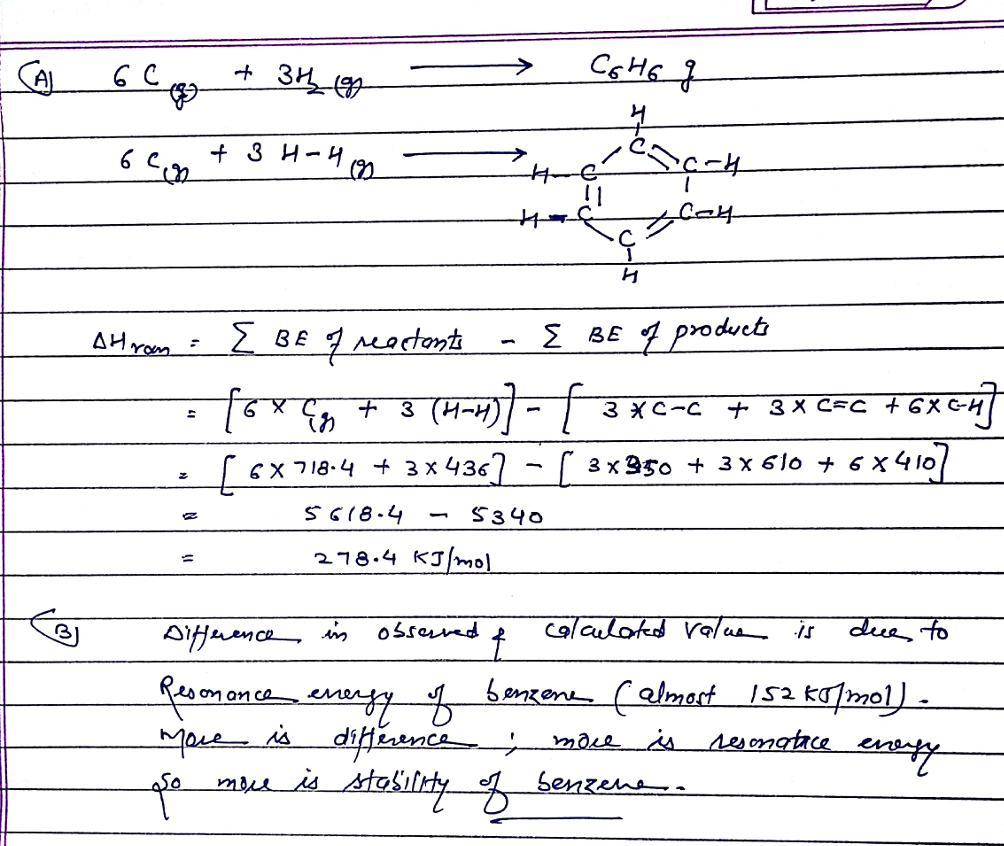
A. Use average bond energies together with the standard enthalpy of formation of C(g) (718.4 kJ/mol ) to estimate the standard e
Nana76 [90]

Answer:

a. 278.4kJ/mol

b. due to resonance, some energy are released

Explanation:

5 0
2 years ago
Other questions:
  • Explain how a solution can be both dilute and saturated.
    7·2 answers
  • As an atom's nucleus gets larger the electric charges repelling the protons get larger. To compensate for this greater electric
    10·2 answers
  • Read the given equation. 2Na + 2H2O → 2NaOH + H2
    12·1 answer
  • What are the coefficients to balance the following equation?<br><br> ba+br2=babr2
    8·2 answers
  • Does it take more, less, or the same amount of heat to melt 1.0 kg of ice at 0°C, or to bring 1.0 kg of liquid water at 0°C to t
    13·1 answer
  • Energy may not be created or destroyed, but it may be converted into different types. Categorize the examples below as either Po
    7·1 answer
  • A low level of carbon dioxide labeled with 14C is accidentally released into the atmosphere surrounding industrial workers as th
    14·1 answer
  • Suppose, in an experiment to determine the amount of sodium hypochlorite in bleach, you titrated a 26.34 mL sample of 0.0100 M K
    12·1 answer
  • Consider the following reaction at 298.15 K: Co(s)+Fe2+(aq,1.47 M)⟶Co2+(aq,0.33 M)+Fe(s) If the standard reduction potential for
    7·1 answer
  • Montrel takes a trip to Central America during the winter. He finds out that the temperature in Central America is about the sam
    5·1 answer
Add answer
Login
Not registered? Fast signup
Signup
Login Signup
Ask question!