answer.
Ask question
Login Signup
Ask question
All categories
  • English
  • Mathematics
  • Social Studies
  • Business
  • History
  • Health
  • Geography
  • Biology
  • Physics
  • Chemistry
  • Computers and Technology
  • Arts
  • World Languages
  • Spanish
  • French
  • German
  • Advanced Placement (AP)
  • SAT
  • Medicine
  • Law
  • Engineering
Andreyy89
2 years ago
13

N2 molecules absorb ultraviolet light but not visible light. I2 molecules absorb both visible and ultraviolet light. Which of th

e following statements explains the observations?
More energy is required to make N2 molecules vibrate than is required to make I2 molecules vibrate.
A

More energy is required to remove an electron from an I2 molecule than is required to remove an electron from a N2 molecule.
B

Visible light does not produce transitions between electronic energy levels in the N2 molecule but does produce transitions in the I2 molecule.
C

The molecular mass of I2 is greater than the molecular mass of N2.
Chemistry
1 answer:
Umnica [9.8K]2 years ago
4 0

C. Visible light does not produce transitions between electronic energy levels in the N₂ molecule but does produce transitions in the I₂ molecule.

Explanation:

Abortion of light by molecules will produce electronic transitions from a ground level to a higher level equal to the energy of absorbed light.

In the case of nitrogen (N₂) the allowed electronic transitions are between electronic energy levels with a energy difference equal to the energy of photons of the ultraviolet light. Nitrogen will not absorb from the visible range so it is colorless.

Now iodine (I₂) have the allowed electronic transitions between electronic energy levels with a energy difference equal to the energy of photons of the visible light. As a consequence Iodine vapors have a violet color.

Learn more about:

electronic transitions

brainly.com/question/11328705

#learnwithBrainly

You might be interested in
A chemist wants to extract copper metal from copper chloride solution. The chemist places 1.50 grams of aluminum foil in a solut
Lisa [10]

Answer: d. More than 6.5 grams of copper (II) is formed, and some copper chloride is left in the reaction mixture.

Explanation: 2Al+3CuCl_2\rightarrow 2AlCl_3+3Cu

As can be seen from the chemical equation, 2 moles of aluminium react with 3 moles of copper chloride.

According to mole concept, 1 mole of every substance weighs equal to its molar mass.

Aluminium is the limiting reagent as it limits the formation of product and copper chloride is the excess reagent as (14-7.5)=6.5 g is left as such.

Thus 54 g of of aluminium react with 270 g of copper chloride.

1.50 g of aluminium react with=\frac{270}{54}\times 1.50=7.5 gof copper chloride.

3 moles of copper chloride gives 3 moles of copper.

7.5 g of copper chloride gives 7.5 g of copper.

8 0
2 years ago
Read 2 more answers
Determine ΔH for the reaction CaCO3 → CaO + CO2 given these data: 2 Ca + 2 C + 3 O2 → 2 CaCO3 ΔH = −2,414 kJ C + O2 → CO2 ΔH = −
kicyunya [14]

Answer:

The ΔH for the reaction is -456.5 KJ

Explanation:

Here we want to determine ΔH for the reaction;

Mathematically;

ΔH = ΔH(product) - ΔH(reactant)

In the case of the first reaction;

ΔH = ΔH(CaO) + ΔH(CO2) - ΔH(CaCO3)  ...........................(*)

From the other reactions, we can get the respective ΔH for the individual molecule in the reaction

In second reaction;

Kindly note that for elements, molecule of gases, ΔH = 0

What this means is that throughout the solution;

ΔH(Ca)  = 0 KJ

ΔH(O2) = 0 KJ

ΔH(C) = 0 KJ

Thus, in writing the equation for the subsequent chemical reactions, we shall need to write and equate the overall ΔH for the reaction to that of the product alone

So in the second reaction

ΔH = 2ΔH(CaCO3)

Thus;

-2414/2 = ΔH(CaCO3)

ΔH(CaCO3) = -1,207  KJ

Moving to the third reaction, we have;

ΔH = ΔH(CO2)

Hence ΔH(CO2) = -393.5 KJ

For the last reaction;

ΔH = ΔH(CaO)

Hence ΔH(CaO) = -1270 KJ

Going back to equation *

ΔH = ΔH(CaO) + ΔH(CO2) - ΔH(CaCO3)

Using the values of the ΔH  of the respective molecules given above,

ΔH  = -1270 + (-393.5) - (-1207)

ΔH  = -456.5 KJ

8 0
2 years ago
A fox spots a rabbit in a field. The fox begins to chase the rabbit, and the rabbit runs away. Which statement best describes th
Ira Lisetskai [31]

Answer:

2 I Think

Explanation:

8 0
2 years ago
Read 2 more answers
An electron is on a -2.5 eV energy level. The electron is struck by a 2.5 eV photon. What will most likely happen?
kati45 [8]
The correct answer would be C
5 0
2 years ago
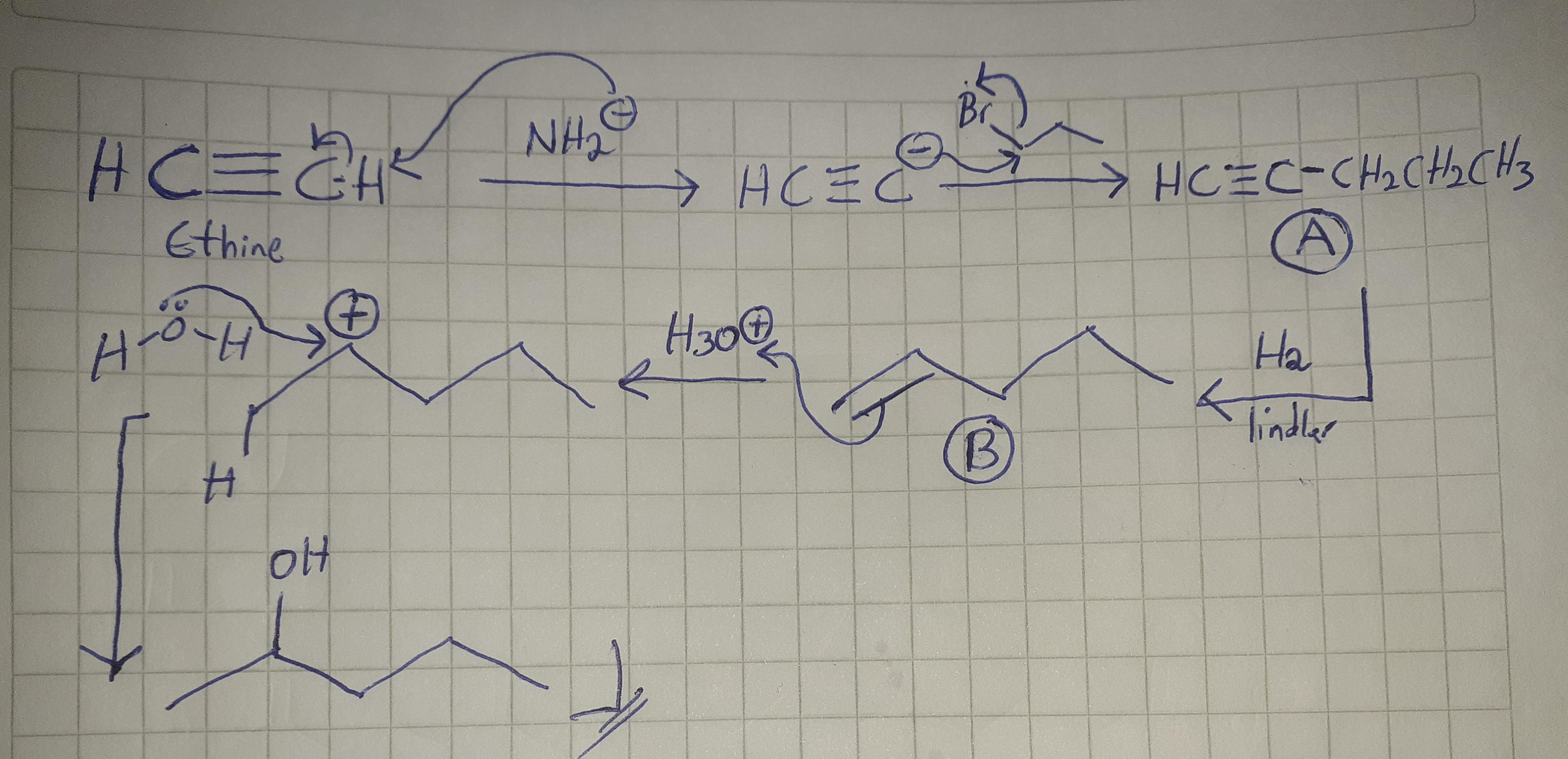
Draw the structures of organic compounds A and B. Indicate stereochemistry where applicable The starting material is ethyne, a c
k0ka [10]

Answer:

See explanation below

Explanation:

In this case we have the starting reactant which is the ethine, In the first step reacts with NaNH₂, a strong base. This base will substract the hydrogen from one of the carbon of the ethine, and form a carbanion. This will react with the propane bromide, displacing the bromine and forming a 5 carbon chain with the triple bond on the carbon 1 and 2.

In the second step, reacts with the lindlar catalyst to do a reduction, and form a double bond between carbon 1 and 2. In essence, compound A is similar to compound B.

Finally B reacts with water in acid and makes a addition reaction, and form an alcohol.

The whole process can be seen in the picture below.

Hope this helps

3 0
2 years ago
Other questions:
  • X-ray photons with a wavelength of 0.135 nm . express the energy numerically in kilojoules per mole.
    7·2 answers
  • A stone of mass 0.55 kilograms is released and falls to the ground. Measurements show that the stone has a kinetic energy of 9.8
    6·2 answers
  • When potassium bromate (kbro3 ) is heated, it decomposes into potassium bromide and a gas that supports the combustion of a glow
    8·1 answer
  • What is a characteristic of all fuel cells?
    8·2 answers
  • Addition of 6 M HCl to which substance will NOT result
    10·2 answers
  • The values used in the scale of pH and pOH are derived from a system designed by ______. Gordonsen Sorenson Curie Dalton
    10·1 answer
  • The density of an unknown crystal is 2.65gmL. If a 4.46 g sample of the crystal is added to a graduated cylinder containing 25.0
    6·1 answer
  • Read the information on Hydrochloric Acid. List four ways you can avoid injury while using HCl and three steps you would take in
    13·1 answer
  • Choose two different particles found in the air. Explain how they are different and how they are the same
    5·1 answer
  • There are many important laws and theories in science. Which of the following is a law of science?
    11·2 answers
Add answer
Login
Not registered? Fast signup
Signup
Login Signup
Ask question!