answer.
Ask question
Login Signup
Ask question
All categories
  • English
  • Mathematics
  • Social Studies
  • Business
  • History
  • Health
  • Geography
  • Biology
  • Physics
  • Chemistry
  • Computers and Technology
  • Arts
  • World Languages
  • Spanish
  • French
  • German
  • Advanced Placement (AP)
  • SAT
  • Medicine
  • Law
  • Engineering
sveticcg [70]
2 years ago
13

is said that Archimedes discovered his principle during a bath while thinking about how he could determine if King Hiero’s crown

was actually made of pure gold. While in the bathtub, he conceived the idea that he could determine the average density of an irregularly shaped object by weighing it in air and also in water. If the crown weighed 34.1 N in air and 31.4 N in water, determine if the crown is made of pure gold. The density of gold is 19,300 kg/m3. The density of water is 1000 kg/m3.
Engineering
1 answer:
KIM [24]2 years ago
6 0

Answer: The crown is not made of pure gold.

Explanation:

Archimedes discovered that any solid, of any shape, when submerged in a liquid receives an upward force, equal to the weight of the volume of the liquid removed by the solid, which is equal to the solid volume.

So, if one body is weighed in air, the normal force will be equal to the gravity force (which we call weight) which can be expressed as follows:

Fg = m g = δ V g = 34.1 N

When submerged in water, the normal force is equal to the difference between the actual weight, and the upward force due to Archimedes' principle, called buoyant force, as follows:

Fn = Fg - Ep = δx. V. g - δH20 . V. g = 31.4 N

Dividing Fg between Fn, and simplifying common terms, we have:

δx / (δx - δh20) = 34.1 / 31.4 = 1.09

Solving for δx, we get the following value:

δx = 12, 111 Kg/m3, less dense than pure gold, so we can conclude that the crown was not made of pure gold.

You might be interested in
A binary star system consists of two stars of masses m1m1m_1 and m2m2m_2. The stars, which gravitationally attract each other, r
d1i1m1o1n [39]

Answer:

          a_c_2=\dfrac{a_c_1\times m_1}{m_2}

Explanation:

The question is: <em>Find the magnitude of the centripetal acceleration of the star with mass m₂</em>

The <em>centripetal acceleration</em> is the quotient of the centripetal force and the mass.

                a_c=\dfrac{F_c}{m}

Thus, you can write the equations for each star:


       a_c_1=\dfrac{F_c_1}{m_1}

       a_c_2=\dfrac{F_c_2}{m_2}

As per Newton's third law, the centripetal forces are equal in magnitude. Then:

       a_c_1\times m_1=a_c_2\times m_2

Now you can clear a_c_2:

          a_c_2=\dfrac{a_c_1\times m_1}{m_2}

6 0
2 years ago
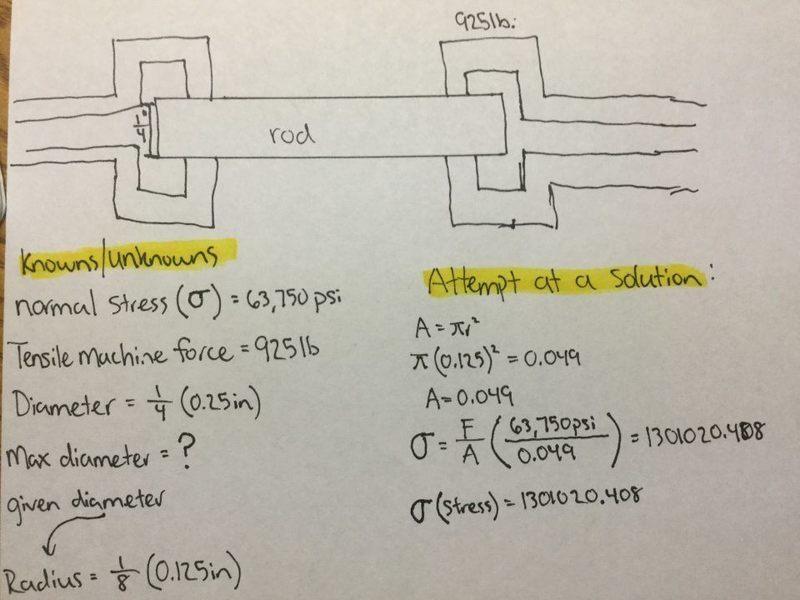
2. A ¼ in. diameter rod must be machined on a lathe to a smaller diameter for use as a specimen in a tension test. The rod mater
gladu [14]

Answer:

we use

sigma=force /area\\A=\pi r^2\\D=2*r

5 0
2 years ago
air at 600 kPa, 330 K enters a well-insulated, horizontal pipe having a diameter of 1.2 cm and exits at 120 kPa, 300 K. Applying
notsponge [240]

Answer:

a) 251.31 m/s and 55.29 m/s

b) The mass flow rate is 0.0396 kg/s

c) The rate of entropy production is 0.0144 kW/K

Explanation:

a) The steady state is:

mi = mo

\frac{A_{i}V_{i}  }{v_{i} } =\frac{A_{o}V_{o}  }{v_{o} } \\V_{i} =V_{o}(\frac{v_{i}}{v_{o}} )=V_{o}(\frac{T_{i}P_{o} }{T_{o}P_{i} } )=V_{o}(\frac{330*120}{300*600}) =0.22V_{o}

The energy balance is:

h_{i}+\frac{V_{i}^{2} }{2} =h_{2}+\frac{V_{o}^{2} }{2} \\h_{i}-h_{o}+(\frac{V_{i}^{2}-V_{o}^{2}  }{2} )=0\\V_{o}=\sqrt{\frac{2(h_{i}-h_{o})}{0.9516} } =\sqrt{\frac{2*(330.24-300.19)x10^{3} }{0.9516} } =251.31m/s

Vi = 0.22 * 251.31 = 55.29 m/s

b) The mass flow rate is:

m=\frac{A_{o}V_{o}}{v_{o}} =\frac{\pi d^{2}V_{o}P_{o} }{4RT_{o}} =\frac{\pi *(0.012^{2})*251.31*120x10^{3}  }{4*287*300} =0.0396kg/s

c) The entropy produced is equal to:

\frac{Q}{T} +S_{gen} =m(s_{2} -s_{1} )\\0+S_{gen} =m(s_{2} -s_{1} )\\S_{gen} =m(s_{2} -s_{1} )\\S_{gen}=0.0396*(c_{p} ln\frac{T_{o}}{T_{i}} -Rln\frac{P_{o}}{P_{i}} )=0.0396*(1.004ln\frac{300}{330} -0.287ln\frac{120}{600} )=0.0144kW/K

3 0
2 years ago
A railcar with an overall mass of 78,000 kg traveling with a speed vi is approaching a barrier equipped with a bumper consisting
sergij07 [2.7K]

Answer:

v₀ = 2,562 m / s  = 9.2 km/h

Explanation:

To solve this problem let's use Newton's second law

              F = m a = m dv / dt = m dv / dx dx / dt = m dv / dx v

              F dx = m v dv

We replace and integrate

            -β ∫ x³ dx = m ∫ v dv

            β x⁴/ 4 = m v² / 2

We evaluate between the lower (initial) integration limits v = v₀, x = 0 and upper limit v = 0 x = x_max

        -β (0- x_max⁴) / 4 = ½ m (v₀²2 - 0)

         x_max⁴ = 2 m /β   v₀²


Let's look for the speed that the train can have for maximum compression

         x_max = 20 cm = 0.20 m


         v₀ =√(β/2m)   x_max²

Let's calculate

          v₀ = √(640 106/2 7.8 104)    0.20²

          v₀ = 64.05  0.04

          v₀ = 2,562 m / s

          v₀ = 2,562 m / s (1lm / 1000m) (3600s / 1h)

          v₀ = 9.2 km / h

5 0
2 years ago
The ingredient weights for making 1 yd (cyd) of concrete by assuming aggregates in SSD state are given below. The volume of air
Pachacha [2.7K]

Answer:

Explanation:

Ans) Given batch weight of each component :

Cement = 700 lb

Water = 315 lb

Coarse aggregate = 1575 lb

Fine aggregate = 1100 lb

Part 1) Amount of water = 328.5 lb

Amount of water is needed to be increased if the aggregates has absorption capacity, To maintain constant water cement ratio, the mixing water is increased because some of the water is absorbed by aggregates.

Amount of water absorbed = 328.5 lb - 315 lb = 13.5 lb

Total amount of aggregates = 1575 + 1100 = 2675 lb

=> % Absorption capacity = 13.5 x 100 / 2675 = 0.5 %

Hence, new amount of Coarse aggregate = (1 - 0.005) x 1575 lb = 1567.125 lb

New amount of fine aggregate = (1 - 0.005) x 1100 = 1094.5 lb

Since, water cement ratio is maintained constant , amount of cement remains unchanged

=> Volume of water = 328.5 / 62.4 = 5.26 ft3

=> Volume of cement = 700 / (3.15 x 62.4) = 3.56 ft3

=> Volume of coarse aggregate = 1567.125 / (2.4 x 62.4) = 10.46 ft3

=> Volume of fine aggregate = 1100 / (2.4 x 62.4) = 7.34 ft3

Volume of air = 2% = 0.02 x 27 = 0.54 ft3

Total concrete volume = 5.26 + 3.56 + 10.46 + 7.34 + 0.54 \approx 27 ft3 = 1 yd3

Hence, calculated amount of each component is correct

Part 2) We know, minus sign indicated that the aggregate will absorb some moisture from concrete, hence mixing water amount needed to be corrected .

=> Amount of water absorbed by coarse aggregate = 0.01 x 1567.125 lb = 15.67 lb

=> Amount of water absorbed by fine aggregate = 0.02 x 1094.50 lb = 21.89 lb

Total amount of water absorbed = 15.67 + 21.89 = 37.56 lb

To maintain same water cement ratio, amount of mixing water is needed to be increased

=> Corrected amount of mixing water = 328.5 lb + 37.56 lb = 366 lb

=> Corrected amount of coarse aggregate = (1 - 0.01) x 1567.125 = 1551.45 lb

=> Corrected amount of fine aggregate = (1 - 0.02) x 1094.5 = 1072.6 lb

Part 3) We know,

Unit weight = Sum of weight of each material / Total volume

=> Sum of weight = 366 + 700 + 1551.45 + 1072.6 = 3690.05 lb

Total volume = 1 yd3 or 27 ft3

=> Expected Unit Weight = 3690.05 lb / 27 ft3 = 136.67 lb/ft3

Also, Concrete Yield = Weight of all components / Unit weight of concrete

=> Yield = 3690.05 / 136.67 = 27 ft3 or 1 yd3

4 0
2 years ago
Other questions:
  • 5. A typical paper clip weighs 0.59 g and consists of BCC iron. Calculate (a) the number of
    5·1 answer
  • A 12-L volume of oil is subjected to a pressure change, which produces a volume strain on the oil of -3.0 × 10⁻⁴. The bulk modu
    6·1 answer
  • Show that a chirped Gaussian pulse is compressed initially inside a single-mode fiber when ftC &lt; 0. Derive expressions for th
    12·1 answer
  • thermal energy is being added to steam at 475.8 kPa and 75% quality. determine the amount of thermal energy to be added to creat
    15·1 answer
  • The Gill Art Gallery wishes to maintain data on their customers, artists and paintings. They may have several paintings by each
    7·1 answer
  • Q5. A hypothetical metal alloy has a grain diameter of 2.4 x 10⁻² mm. After a heat treatment at 575°C for 500 min, the grain dia
    7·1 answer
  • A glycerin pump is powered by a 5-kW electric motor. The pressure differential between the outlet and the inlet of the pump at f
    13·1 answer
  • 2.24 Carbon dioxide (CO2) gas in a piston-cylinder assembly undergoes three processes in series that begin and end at the same s
    6·1 answer
  • Air ows steadily in a thermally insulated pipe with a constant diameter of 6.35 cm, and an average friction factor of 0.005. At
    5·1 answer
  • What term describes a guardrail system
    13·2 answers
Add answer
Login
Not registered? Fast signup
Signup
Login Signup
Ask question!