answer.
Ask question
Login Signup
Ask question
All categories
  • English
  • Mathematics
  • Social Studies
  • Business
  • History
  • Health
  • Geography
  • Biology
  • Physics
  • Chemistry
  • Computers and Technology
  • Arts
  • World Languages
  • Spanish
  • French
  • German
  • Advanced Placement (AP)
  • SAT
  • Medicine
  • Law
  • Engineering
Ganezh [65]
2 years ago
12

A deep drawing operation is performed in which the inside of the cylindrical cup has a diameter of 4.25 in and a height = 2.65 i

n. The stock thickness = 3/16 in, and the starting blank diameter = 7.7 in. Punch and die radii = 5/32 in. The metal has a tensile strength = 65,000 lb/in2, a yield strength = 32,000 lb/in2, and a shear strength of 40,000 lb/in2. Determine (a) drawing ratio, (b) reduction, (c) drawing force, and (d) blankholder force
Engineering
1 answer:
Softa [21]2 years ago
4 0

Answer:

drawing ratio = 1.81176

reduction = 0.4480 = 44.80 %

drawing force is = 162724.682 lb

blank holder force = 95481.10 lb

Explanation:

given data

cylindrical cup diameter = 4.25 in

cup height = 2.65 in

stock thickness = 3/16 in

blank diameter = 7.7 in

Punch and die radii = 5/32 in

so Punch diameter will be = 2 ×  5/32 in = 0.3125 in

tensile strength = 65,000 lb/in²

yield strength = 32,000 lb/in²

shear strength of 40,000 lb/in²

to find out

(a) drawing ratio, (b) reduction, (c) drawing force, and (d) blankholder force

solution

first we get drawing ratio hat is express as

drawing ratio = \frac{blank\ diameter}{cup\ diameter}     ..................1

put here value

drawing ratio = \frac{7.7}{4.25}

drawing ratio = 1.81176

and

reduction will be here

reduction = \frac{blank\ diameter - cup\ diameter}{blank\ diameter}  .................2

reduction = \frac{7.7 - 4.25}{7.7}

reduction = 0.4480 = 44.80 %

and

drawing force will be

drawing force is = k× π× cup diameter ×  stock thickness × tensile strength   ........................3

here k = 1

so put here value

drawing force is = 1 × π× 4.25 × \frac{3}{16} × 65000

drawing force is = 162724.682 lb

and

blank holder force will be here as

blank holder force = maximum punch load × \frac{1}{3}     ........................4

so here maximum punch load will be

maximum punch load = π × punch diameter × stock thickness × tensile strength × ( \frac{blank\ diameter}{punch\ diameter} - 0.7 )     .......................5

here 0.7 is correction factor

maximum punch load = π × 0.3125 × \frac{3}{16}  × 65000 × ( \frac{7.7}{0.3125} - 0.7 )

maximum punch load  = 286443.30 lb

so

blank holder force =  286443.30 × \frac{1}{3}

blank holder force = 95481.10 lb

You might be interested in
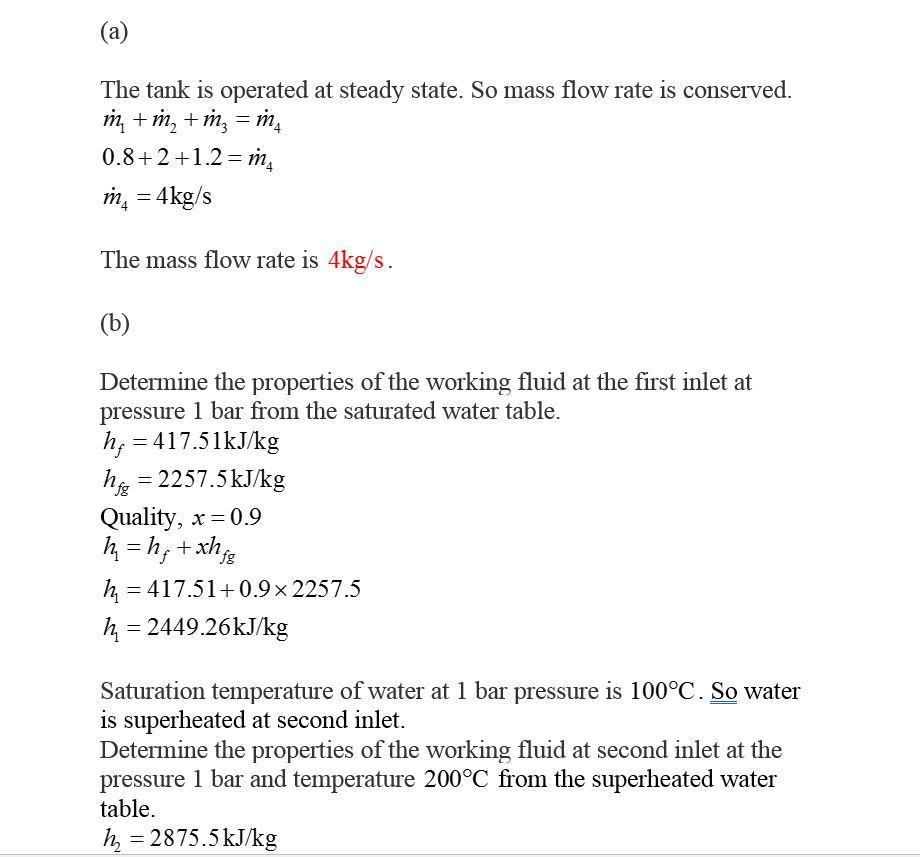
Three return steam lines in a chemical processing plant enter a collection tank operating at steady state at 1 bar. Steam enters
Papessa [141]

Answer:

a) 4 kg/s

b) 99.61 °C

Explanation:

See attached pictures.

5 0
2 years ago
A binary star system consists of two stars of masses m1m1m_1 and m2m2m_2. The stars, which gravitationally attract each other, r
d1i1m1o1n [39]

Answer:

          a_c_2=\dfrac{a_c_1\times m_1}{m_2}

Explanation:

The question is: <em>Find the magnitude of the centripetal acceleration of the star with mass m₂</em>

The <em>centripetal acceleration</em> is the quotient of the centripetal force and the mass.

                a_c=\dfrac{F_c}{m}

Thus, you can write the equations for each star:


       a_c_1=\dfrac{F_c_1}{m_1}

       a_c_2=\dfrac{F_c_2}{m_2}

As per Newton's third law, the centripetal forces are equal in magnitude. Then:

       a_c_1\times m_1=a_c_2\times m_2

Now you can clear a_c_2:

          a_c_2=\dfrac{a_c_1\times m_1}{m_2}

6 0
2 years ago
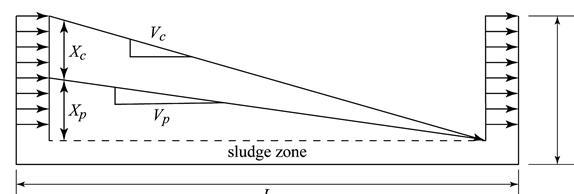
The rate of flow through an ideal clarifier is 8000m3 /d, the detention time is 1h and the depth is 3m. If a full-length movable
Fittoniya [83]

Answer:

a) 35%

b) yes it can be improved by moving the tray near the top

   Tray should be located ( 1 to 2 meters below surface )

   max removal efficiency ≈ 70%

c) The maximum removal will drop as the particle settling velocity = 0.5 m/h

Explanation:

Given data:

flow rate = 8000 m^3/d

Detention time = 1h

depth = 3m

Full length movable horizontal tray :  1m below surface

<u>a) Determine percent removal of particles having a settling velocity of 1m/h</u>

velocity of critical sized particle to be removed = Depth / Detention time

= 3 / 1 = 3m/h

The percent removal of particles having a settling velocity of 1m/h ≈ 35%

<u>b) Determine if  the removal efficiency of the clarifier can be improved by moving the tray, the location of the tray  and the maximum removal efficiency</u>

The tray should be located near the top of the tray ( i.e. 1 to 2 meters below surface ) because here the removal efficiency above the tray will be 100% but since the tank is quite small hence the

Total Maximum removal efficiency

=  percent removal_{above} + percent removal_{below}

= ( d_{a},v_{p} ) . \frac{d_{a} }{depth}  + ( d_{a},v_{p} ) . \frac{depth - d_{a} }{depth}  = 100

hence max removal efficiency ≈ 70%

<u>c) what is the effect of moving the tray would be if the particle settling velocity were equal to 0.5m/h?</u>

The maximum removal will drop as the particle settling velocity = 0.5 m/h

7 0
2 years ago
Which statement concerning symbols used on plans is true?
Zielflug [23.3K]

Answer:

The symbols are to be noted on the title sheet or other introductory sheet of the plans.

Explanation:

in able to be understood for example a map key is always on a map so the reader can use it efficently without confusion

8 0
2 years ago
In a parallel one-dimensional flow in the positive x direction, the velocity varies linearly from zero at y = 0 to 32 m/s at y =
monitta

Answer:

Ψ = 10(y^2) + c

<em><u>y = 1.067m</u></em>

Explanation:

since the flow is one dimensional in positive X direction, the only velocity component is in X, which is denoted by u

while u is a function of y

we find the u in terms of y; u varies linearly wih y

we use similiraty to find the relation

32/1.6 =<em>u/y</em>

<em><u>u = 20y</u></em>

<em><u>Ψ = ∫20ydy</u></em>

<em><u>Ψ = 10(y^2) + c</u></em>

<em><u>(b)</u></em>

<em><u>the flow is half below y = 1.6*(2/3)=1.067 m</u></em>

<em><u>this is because at two third of the height of a triangle lies the centroid of triangle. since the velocity profile forms a right angled triangle , its height is 1.6 m . the flow is halved at y = 1.067m</u></em>

3 0
2 years ago
Other questions:
  • 5. A typical paper clip weighs 0.59 g and consists of BCC iron. Calculate (a) the number of
    5·1 answer
  • Which of the following is correct regarding the principal stresses and maximum in-plane shear stresses? a. Principal stresses ca
    14·1 answer
  • Some states have osha programs, but you should always defer to the federal program.
    8·2 answers
  • Pipe (2) is supported by a pin at bracket C and by tie rod (1). The structure supports a load P at pin B. Tie rod (1) has a diam
    15·1 answer
  • Two resistors of values 7.0 and 15.0 Ω are connected in parallel. This combination in turn is hooked in series with a 3.8- Ω res
    7·1 answer
  • A spherical tank for storing gas under pressure is 25 m in diameter and is made of steel 15 mm thick. The yield point of the mat
    5·2 answers
  • An airplane in level flight at an altitude h and a uniform speed v passes directly over a radar tracking station A. Calculate th
    5·1 answer
  • Complete the following sentence.
    5·1 answer
  • Air ows steadily in a thermally insulated pipe with a constant diameter of 6.35 cm, and an average friction factor of 0.005. At
    5·1 answer
  • Mr. Ray deposited $200,000 in the Old and Third National Bank. If the bank pays 8% interest, how much will he have in the accoun
    10·2 answers
Add answer
Login
Not registered? Fast signup
Signup
Login Signup
Ask question!