answer.
Ask question
Login Signup
Ask question
All categories
  • English
  • Mathematics
  • Social Studies
  • Business
  • History
  • Health
  • Geography
  • Biology
  • Physics
  • Chemistry
  • Computers and Technology
  • Arts
  • World Languages
  • Spanish
  • French
  • German
  • Advanced Placement (AP)
  • SAT
  • Medicine
  • Law
  • Engineering
Alex73 [517]
2 years ago
6

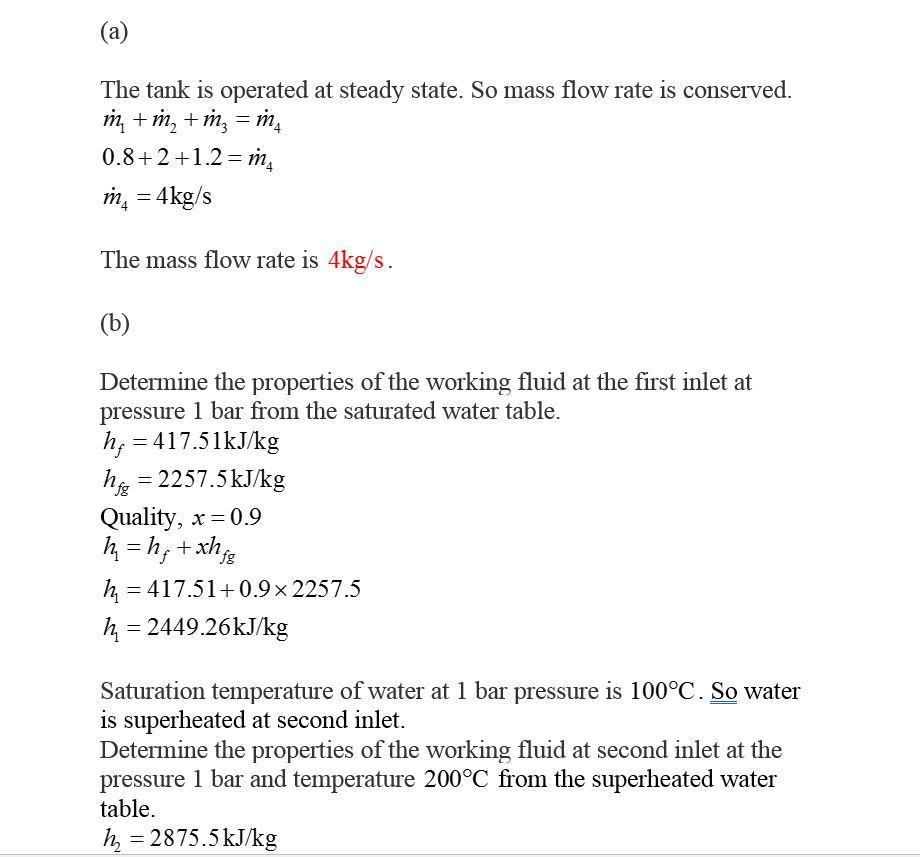
Three return steam lines in a chemical processing plant enter a collection tank operating at steady state at 1 bar. Steam enters

inlet 1 with flow rate of 0.8 kg/s and a quality of 0.9. Steam enters inlet 2 with flow rate of 2 kg/s at 200 C. Steam enters inlet 3 with flow rate of 1.2 kg/s at 95 C. Steam exits the tank at 1 bar. The rate of heat transfer from the collection tank is 40 kW. Neglecting kinetic and potential engery effects, determine for the steam exiting the tank
(a) the mass flow rate, in kg/s
(b) the temperature, in degrees C

Engineering
1 answer:
Papessa [141]2 years ago
5 0

Answer:

a) 4 kg/s

b) 99.61 °C

Explanation:

See attached pictures.

You might be interested in
A three-phase line has an impedance of 0.4 j2.7 ohms per phase. The line feeds two balanced three-phase loads that are connected
Viktor [21]

Answer:

a. The magnitude of the line source voltage is

Vs = 4160 V

b. Total real and reactive power loss in the line is

Ploss = 12 kW

Qloss = j81 kvar

Sloss = 12 + j81 kVA

c. Real power and reactive power supplied at the sending end of the line

Ss = 540.046 + j476.95 kVA

Ps = 540.046 kW

Qs = j476.95 kvar

Explanation:

a. The magnitude of the line voltage at the source end of the line.

The voltage at the source end of the line is given by

Vs = Vload + (Total current×Zline)

Complex power of first load:

S₁ = 560.1 < cos⁻¹(0.707)

S₁ = 560.1 < 45° kVA

Complex power of second load:

S₂ = P₂×1 (unity power factor)

S₂ = 132×1

S₂ = 132 kVA

S₂ = 132 < cos⁻¹(1)

S₂ = 132 < 0° kVA

Total Complex power of load is

S = S₁ + S₂

S = 560.1 < 45° + 132 < 0°

S = 660 < 36.87° kVA

Total current is

I = S*/(3×Vload)   ( * represents conjugate)

The phase voltage of load is

Vload = 3810.5/√3

Vload = 2200 V

I = 660 < -36.87°/(3×2200)

I = 100 < -36.87° A

The phase source voltage is

Vs = Vload + (Total current×Zline)

Vs = 2200 + (100 < -36.87°)×(0.4 + j2.7)

Vs = 2401.7 < 4.58° V

The magnitude of the line source voltage is

Vs = 2401.7×√3

Vs = 4160 V

b. Total real and reactive power loss in the line.

The 3-phase real power loss is given by

Ploss = 3×R×I²

Where R is the resistance of the line.

Ploss = 3×0.4×100²

Ploss = 12000 W

Ploss = 12 kW

The 3-phase reactive power loss is given by

Qloss = 3×X×I²

Where X is the reactance of the line.

Qloss = 3×j2.7×100²

Qloss = j81000 var

Qloss = j81 kvar

Sloss = Ploss + Qloss

Sloss = 12 + j81 kVA

c. Real power and reactive power supplied at the sending end of the line

The complex power at sending end of the line is

Ss = 3×Vs×I*

Ss = 3×(2401.7 < 4.58)×(100 < 36.87°)

Ss = 540.046 + j476.95 kVA

So the sending end real power is

Ps = 540.046 kW

So the sending end reactive power is

Qs = j476.95 kvar

7 0
2 years ago
The ingredient weights for making 1 yd (cyd) of concrete by assuming aggregates in SSD state are given below. The volume of air
Pachacha [2.7K]

Answer:

Explanation:

Ans) Given batch weight of each component :

Cement = 700 lb

Water = 315 lb

Coarse aggregate = 1575 lb

Fine aggregate = 1100 lb

Part 1) Amount of water = 328.5 lb

Amount of water is needed to be increased if the aggregates has absorption capacity, To maintain constant water cement ratio, the mixing water is increased because some of the water is absorbed by aggregates.

Amount of water absorbed = 328.5 lb - 315 lb = 13.5 lb

Total amount of aggregates = 1575 + 1100 = 2675 lb

=> % Absorption capacity = 13.5 x 100 / 2675 = 0.5 %

Hence, new amount of Coarse aggregate = (1 - 0.005) x 1575 lb = 1567.125 lb

New amount of fine aggregate = (1 - 0.005) x 1100 = 1094.5 lb

Since, water cement ratio is maintained constant , amount of cement remains unchanged

=> Volume of water = 328.5 / 62.4 = 5.26 ft3

=> Volume of cement = 700 / (3.15 x 62.4) = 3.56 ft3

=> Volume of coarse aggregate = 1567.125 / (2.4 x 62.4) = 10.46 ft3

=> Volume of fine aggregate = 1100 / (2.4 x 62.4) = 7.34 ft3

Volume of air = 2% = 0.02 x 27 = 0.54 ft3

Total concrete volume = 5.26 + 3.56 + 10.46 + 7.34 + 0.54 \approx 27 ft3 = 1 yd3

Hence, calculated amount of each component is correct

Part 2) We know, minus sign indicated that the aggregate will absorb some moisture from concrete, hence mixing water amount needed to be corrected .

=> Amount of water absorbed by coarse aggregate = 0.01 x 1567.125 lb = 15.67 lb

=> Amount of water absorbed by fine aggregate = 0.02 x 1094.50 lb = 21.89 lb

Total amount of water absorbed = 15.67 + 21.89 = 37.56 lb

To maintain same water cement ratio, amount of mixing water is needed to be increased

=> Corrected amount of mixing water = 328.5 lb + 37.56 lb = 366 lb

=> Corrected amount of coarse aggregate = (1 - 0.01) x 1567.125 = 1551.45 lb

=> Corrected amount of fine aggregate = (1 - 0.02) x 1094.5 = 1072.6 lb

Part 3) We know,

Unit weight = Sum of weight of each material / Total volume

=> Sum of weight = 366 + 700 + 1551.45 + 1072.6 = 3690.05 lb

Total volume = 1 yd3 or 27 ft3

=> Expected Unit Weight = 3690.05 lb / 27 ft3 = 136.67 lb/ft3

Also, Concrete Yield = Weight of all components / Unit weight of concrete

=> Yield = 3690.05 / 136.67 = 27 ft3 or 1 yd3
4 0
2 years ago
A six- lane freeway ( three lanes in each direction) in a scenic area has a measured free- flow speed of 55 mi/ h. The peak- hou
Novosadov [1.4K]

Answer:

0.867

Explanation:

The driver population factor (f_{p})can be estimated using the equation below:

f_{p} = \frac{V}{PHF*N*f_{HV}*v_{p}}

The value of the heavy vehicle factor (f_{HV}) is determined below:

The values of the E_{T} = 2 and E_{R} = 3 are gotten from the tables for the RVs, trucks and buses upgrades for passenger-car equivalents. Therefore:

f_{HV} = 1/[1+0.08(2-1)+0.06(3-1)] = 1/[1+0.08+0.12] = 1/1.2 = 0.833

Furthermore, the vp is taken as 2250 pc/(h*In) from the table of LOS criteria for lane freeway using the 15 minutes flow rate. Therefore:

f_{p} = 3900/[0.8*3*0.833*2250] = 3900/4498.2 = 0.867

6 0
2 years ago
At an impaired driver checkpoint, the time required to conduct the impairment test varies (according to an exponential distribut
professor190 [17]

Answer:

Option (d) 2 min/veh

Explanation:

Data provided in the question:

Average time required = 60 seconds

Therefore,

The maximum capacity that can be accommodated on the system, μ = 60 veh/hr

Average Arrival rate, λ = 30 vehicles per hour

Now,

The average time spent by the vehicle is given as

⇒ \frac{1}{\mu(1-\frac{\lambda}{\mu})}

thus,

on substituting the respective values, we get

Average time spent by the vehicle = \frac{1}{60(1-\frac{30}{60})}

or

Average time spent by the vehicle = \frac{1}{60(1-0.5)}

or

Average time spent by the vehicle = \frac{1}{60(0.5)}

or

Average time spent by the vehicle = \frac{1}{30} hr/veh

or

Average time spent by the vehicle = \frac{1}{30}\times60 min/veh

[ 1 hour = 60 minutes]

thus,

Average time spent by the vehicle = 2 min/veh

Hence,

Option (d) 2 min/veh

7 0
2 years ago
A dielectric material, such as Teflon®, is placed between the plates of a parallel-plate capacitor without altering the structur
Lina20 [59]

Answer: The electric field decreases because of the insertion of the Teflon.

Explanation:

If the charge on the capacitor is held fixed, the electric field as a consequence of this charge distribution (directed from the positive charged plate to the negative charged one remains unchanged.

However, as the Teflon is a dielectric material, even though doesn't allow the free movement of the electrons as an answer to an applied electric field, it allows that the electrons be displaced from the equilibrium position, leaving a local negative-charged zone close to the posiitive plate of the capacitor, and an equal but opposite charged layer close to the negative plate.

In this way, a internal electric field is created, that opposes to the external one due to the capacitor, which overall effect is diminishing the total electric field, reducing the voltage between the plates, and  increasing the capacitance proportionally to the dielectric constant of the Teflon.  

8 0
2 years ago
Other questions:
  • Radioactive wastes are temporarily stored in a spherical container, the center of which is buried a distance of 10 m below the e
    13·1 answer
  • Oil in an engine is being cooled by air in a cross-flow heat exchanger, where both fluids are unmixed. Oil (cp = 2000 J/kg. K) f
    12·1 answer
  • CHALLENGE ACTIVITY 2.8.1: Using constants in expressions. The cost to ship a package is a flat fee of 75 cents plus 25 cents per
    7·1 answer
  • A meter stick can be read to the nearest millimeter and a travelling microscope can be read to the nearest 0.1 mm. Suppose you w
    11·1 answer
  • The following passage contains a fragment. Select the correct revision. Presley took the exuberance of gospel and added the freq
    7·1 answer
  • The atomic radii of a divalent cation and a monovalent anion are 0.77 nm and 0.136 nm, respectively.1- Calculate the force of at
    11·1 answer
  • In this module you learned about searching, sorting and algorithms in C++ and how to implement these elements in your C++ progra
    6·1 answer
  • 1. A spur gear made of bronze drives a mid steel pinion with angular velocity ratio of 13 /2 : 1. Thepressure angle is 14 1/2° .
    12·1 answer
  • The molecular weight of a 10g rubber band
    12·1 answer
  • Find the largest number. The process of finding the maximum value (i.e., the largest of a group of values) is used frequently in
    6·1 answer
Add answer
Login
Not registered? Fast signup
Signup
Login Signup
Ask question!