answer.
Ask question
Login Signup
Ask question
All categories
  • English
  • Mathematics
  • Social Studies
  • Business
  • History
  • Health
  • Geography
  • Biology
  • Physics
  • Chemistry
  • Computers and Technology
  • Arts
  • World Languages
  • Spanish
  • French
  • German
  • Advanced Placement (AP)
  • SAT
  • Medicine
  • Law
  • Engineering
jenyasd209 [6]
2 years ago
15

3.51e23 atoms Fe= g Fe

Chemistry
1 answer:
lubasha [3.4K]2 years ago
7 0

Answer:

Mass of Fe = 32.55 g

Explanation:

Molar Mass of Fe atom = 55.845 g/mol

It means,

1 mole of Fe contains = 55.845 g ..............(1)

From mole concept,

<u>1 mole </u>of Fe contain = 6.022\times 10^{23} atom ..........(2)

Replace 1 mole in equation (2) by 55.845 g , it become :

55.845 g of Fe contain = 6.022\times 10^{23} atoms

Reverse the equation now

6.022\times 10^{23} atoms of Fe contain  =55.845 g

1 atom of Fe contain = \frac{55.845}{6.022\times 10^{23}} g

3.51\times 10^{23} atom contain =

\frac{55.845}{6.022\times 10^{23}}\times 3.51\times 10^{23}

on calculation,

3.51\times 10^{23} atom contain = 32.55 g of Fe

Mass of Fe = 32.55 g

You might be interested in
2. A compound with the following composition by mass: 24.0% C, 7.0% H, 38.0% F, and 31.0% P. what is the empirical formula
Svetach [21]

Answer:

C₂H₇F₂P

Explanation:

Given parameters:

Composition by mass:

                C = 24%

                H = 7%

                 F  = 38%

                 P  = 31%

Unknown:

Empirical formula of compound;

Solution :

The empirical formula is the simplest formula of a compound. To solve for this, follow the process below;

                                   C                          H                         F                   P

% composition

by mass                     24                          7                        38                  31

Molar mass                 12                           1                         19                  31

Number of

moles                       24/12                          7/1                    38/19           31/31

                                     2                               7                       2                   1

Dividing

by the

smallest                      2/1                             7/1                       2/1                1/1

                                     2                                7                        2                   1

           Empirical formula        C₂H₇F₂P

5 0
2 years ago
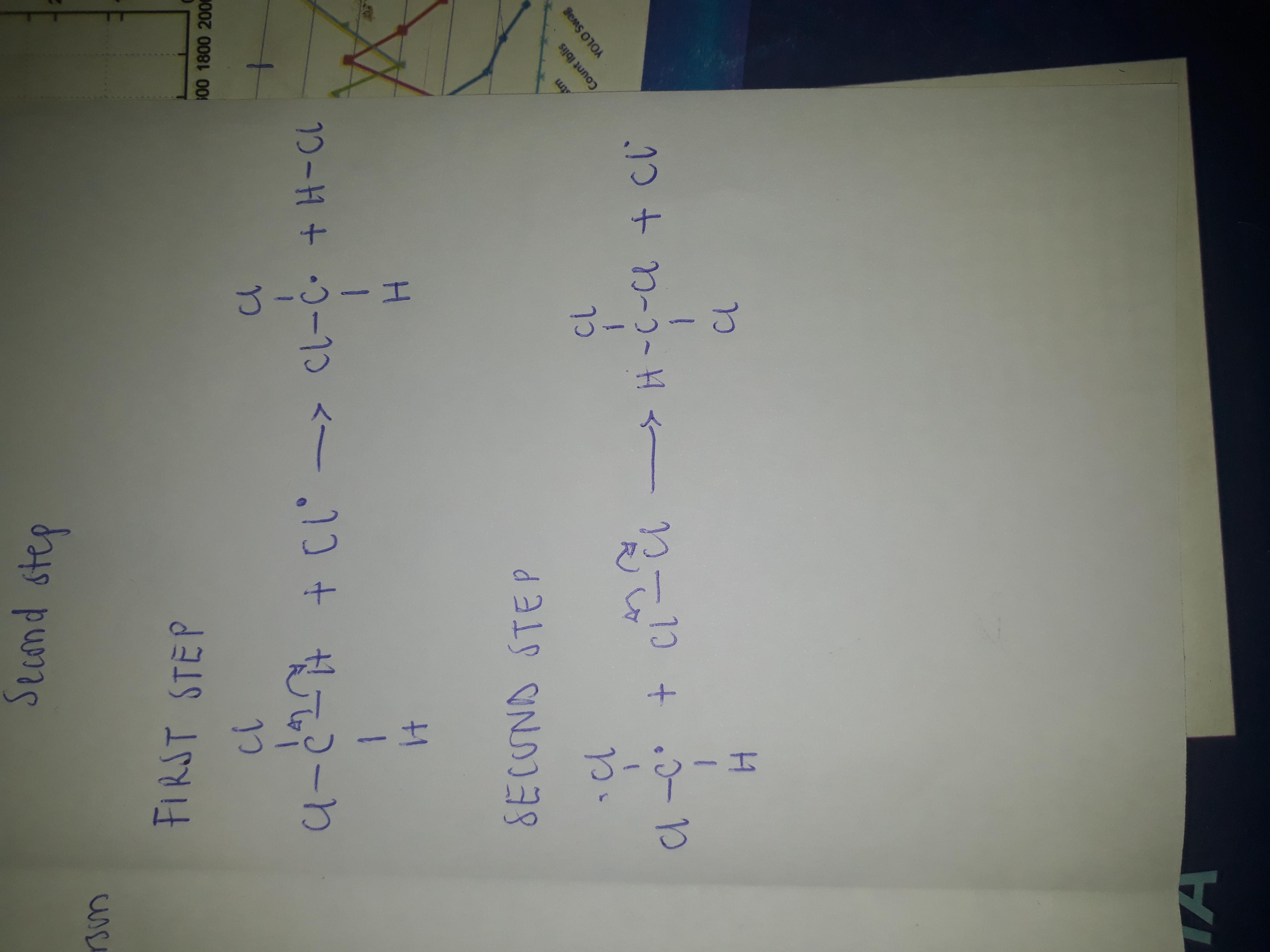
Which of the following represents a propagation step in the monochlorination of methylene chloride (CH2Cl2)?a. CHCl3 + Cl. Right
svetlana [45]

Answer:

B = CHCl2 + Cl2 --> CHCl3 + Cl

Explanation:

Free radical halogenation is a chlorination reaction on Alkane hydrocarbons. This involves the splitting of molecules into radicals/ unstable molecules in the presence of sunlight/ U.V light which ensures bonding of the molecules.

Free radical chlorination is divided into 3 steps which are:

The initiation step

The propagation step

The termination step

So in reference to the question, propagation step involves two steps.

The first step is where the molecule in this case the methylene chloride(CH2Cl2) loses a hydrogen atom and then bond with a chlorine atom radical to give a nethylwnw chloride radical and HCl.

The second step involves the reaction of this methylene chloride got in the first step with chlorine molecule to form trichloride methane and a chlorine radical.

You would find in the attachment the 2 step mechanism.

3 0
2 years ago
The highest energy occupied molecular orbital in the f-f bond of the f2 molecule is _____
Morgarella [4.7K]
The basis of finding the answer to this problem is to know the electronic configuration of Fluorine. That would be: <span>[He] 2s</span>²<span> 2p</span>⁵. The valence electrons, which are the outermost electrons of the atom, are the ones that participate in bonding. <em>Since the highest orbital for F is 2p, that means the highest energy occupied would be 2.</em>
3 0
2 years ago
A gas sample occupies 3.50 liters of volume at 20.°c. what volume will this gas occupy at 100.°c (reported to three significant
VLD [36.1K]

Explanation:

According to Charle's law, at constant pressure the volume of an ideal gas is directly proportional to the temperature.

That is,             Volume \propto Temperature

Hence, it is given that V_{1} is 3.50 liters, T_{1} is 20 degree celsius, and T_{2} is 100 degree celsius.

Therefore, calculate V_{2} as follows.

                           \frac{V_{1}}{T_{1}} = \frac{V_{2}}{T_{2}}

                           \frac{3.50 liter}{20^{o}C} = \frac{V_{2}}{100^{o}C}

                                V_{2} = 17.5 liter

Thus, we can conclude that volume of gas required at 100 degree celsius is 17.5 liter.

6 0
2 years ago
Read 2 more answers
Diborane, B2H6 a possible rocket propellant, can be made by using lithium hydride (LiH): 6 LiH+ 2 BCl2àB2H6+ 6 LiCl . If you mix
Genrish500 [490]

Answer :

(a) Limiting reactant = LiH

(b) The excess reactant = BCl_3

(c) The percent of excess reactant is, 50.87 %

(d) The percent yield of B_2H_6 or percent conversion of LiH to B_2H_6 is, 38.80 %

(e) The mass of LiCl produced is, 1066.42 lb

Explanation : Given,

Mass of LiH = 200 lb = 90718.5 g

conversion used : (1 lb = 453.592 g)

Mass of BCl_3 = 1000 lb = 453592 g

Molar mass of LiH = 7.95 g/mole

Molar mass of BCl_3 = 117.17 g/mole

Molar mass of B_2H_6 = 27.66 g/mole

Molar mass of LiCl = 42.39 g/mole

First we have to calculate the moles of LiH and BCl_3.

\text{Moles of }LiH=\frac{\text{Mass of }LiH}{\text{Molar mass of }LiH}=\frac{90718.5g}{7.95g/mole}=11411.13moles

\text{Moles of }BCl_3=\frac{\text{Mass of }BCl_3}{\text{Molar mass of }BCl_3}=\frac{453592g}{117.17g/mole}=3871.23moles

Now we have to calculate the limiting and excess reagent.

The balanced chemical reaction is,

6LiH+2BCl_3\rightarrow B_2H_6+6LiCl

From the balanced reaction we conclude that

As, 6 moles of LiH react with 1 mole of BCl_3

So, 11411.13 moles of LiH react with \frac{11411.13}{6}=1901.855 moles of BCl_3

From this we conclude that, BCl_3 is an excess reagent because the given moles are greater than the required moles and LiH is a limiting reagent and it limits the formation of product.

Moles of remaining excess reactant = 3871.23 - 1901.855 = 1969.375 moles

Total excess reactant = 3871.23 moles

Now we have to determine the percent of excess reactant (BCl_3).

\% \text{ excess reactant}=\frac{\text{Moles of remaining excess reactant}}{\text{Moles of total excess reagent}}\times 100

\% \text{ excess reactant}=\frac{1969.375}{3871.23}\times 100=50.87\%

The percent of excess reactant is, 50.87 %

Now we have to calculate the moles of B_2H_6.

As, 6 moles of LiH react to give 1 mole of B_2H_6

So, 11411.13 moles of LiH react to give \frac{11411.13}{6}=1901.855 moles of B_2H_6

Now we have to calculate the mass of B_2H_6.

\text{Mass of }B_2H_6=\text{Moles of }B_2H_6\times \text{Molar mass of }B_2H_6

\text{Mass of }B_2H_6=(1901.855mole)\times (27.66g/mole)=52605.3093g

Now we have to calculate the percent yield of B_2H_6.

\%\text{ yield of }B_2H_6=\frac{\text{Actual yield of }B_2H_6}{\text{Theoretical yield of }B_2H_6}\times 100=\frac{20411.7g}{52605.3093g}\times 100=38.80\%

The percent yield of B_2H_6 or percent conversion of LiH to B_2H_6 is, 38.80 %

Now we have to calculate the moles of LiCl.

As, 6 moles of LiH react to give 6 mole of LiCl

So, 11411.13 moles of LiH react to give 11411.13 moles of LiCl

Now we have to calculate the mass of LiCl.

\text{Mass of }LiCl=\text{Moles of }LiCl\times \text{Molar mass of }LiCl

\text{Mass of }LiCl=(11411.13mole)\times (42.39g/mole)=483717.8007g=1066.42lb

The mass of LiCl produced is, 1066.42 lb

8 0
2 years ago
Other questions:
  • What is the mass of 3.0 x 10^23 atoms of neon
    8·1 answer
  • What is the volume in mL of a 1.11 carat diamond, given the density of diamond is 3.51 g/mL? (1 carat = 200 mg). Use significant
    15·1 answer
  • A substance is highly malleable and has a shiny luster. Which of the following best explains the probable position of the substa
    5·2 answers
  • The density of concentrated ammonia, which is 28.0% w/w nh3, is 0.899 g/ml. what volume of this reagent should be diluted to 1.0
    7·1 answer
  • How many grams of Fe are produced from 65.9 g of FeO given the following reaction: 3FeO + 2Al -&gt; 3Fe +Al2O3
    6·2 answers
  • Select all the true statements. When an atom gains an electron, it becomes a cation. Anions carry a positive charge. The Cl− and
    14·1 answer
  • After recrystallization, the final weight of biphenyl is found to be 0.02 g. Assume that all steps were carried out correctly, n
    7·1 answer
  • What is the simplest formula of a compound if a sample of the compound contains 0.221 mol X, 0.442 mol Y, and 0.884 mol Z? chemP
    9·2 answers
  • A. Consider four different samples: aqueous LiI, molten LiI, aqueous AgI, and molten AgI. Current run through each sample produc
    9·1 answer
  • A laser with a wavelength of 225 nm is shown on an isolated gas-phase sodium atom. Calculate the velocity of the ejected electro
    10·1 answer
Add answer
Login
Not registered? Fast signup
Signup
Login Signup
Ask question!