answer.
Ask question
Login Signup
Ask question
All categories
  • English
  • Mathematics
  • Social Studies
  • Business
  • History
  • Health
  • Geography
  • Biology
  • Physics
  • Chemistry
  • Computers and Technology
  • Arts
  • World Languages
  • Spanish
  • French
  • German
  • Advanced Placement (AP)
  • SAT
  • Medicine
  • Law
  • Engineering
Rufina [12.5K]
2 years ago
4

Water’s heat of vaporization is 2,257 joules/gram. How much energy is released when 11.2 grams of water vapor condenses into liq

uid?
Chemistry
1 answer:
Valentin [98]2 years ago
6 0

Answer:

25278.4 j

Explanation:

Given data:

Heat of vaporization of water = 2257 j/g

Energy released by converting 11.2 g water to liquid = ?

Solution:

The heat of vaporization of water is = 2257 j/g

It means one gram of water when converted into vapors 2257 j heat is involved.

For 11.2 grams of water when  converted into liquid energy released would be:

11.2 g× 2257 j/g

25278.4 j

You might be interested in
a compound contain 8.57g of carbon and 1.43g of hydrogen. The relative formula mass is 70 calculate the empirical formula of the
yanalaym [24]

Answer:

Empirical formula: CH2

Molecular formula: C5H10

5 0
1 year ago
A gas cylinder filled with nitrogen at standard temperature and pressure has a mass of 37.289 g. The same container filled with
andrew-mc [135]

Answer:

Molar mass = 3.9236 g/mol ≅ 4 g/mol

This corresponds to Helium gas.

Explanation:

Let the moles of nitrogen gas = x moles

Moles of carbon dioxide = x moles ( As both are filled at same temperature and pressure conditions )

Given:

Mass_{Container}+Mass_{Nitrogen\ gas}=37.289\ g

Molar mass of nitrogen gas, N_2 = 28.014 g/mol

The formula for the calculation of moles is shown below:

moles = \frac{Mass\ taken}{Molar\ mass}

Thus,

x\ moles= \frac{Mass}{28.014\ g/mol}

Mass of nitrogen gas = 28.014x g

So,

Let, Mass_{Container}=y

y+28.014x=37.289

Similarly,

Mass_{Container}+Mass_{Carbon\ dioxide\ gas}=37.440\ g

Molar mass of nitrogen gas, CO_2 = 44.01 g/mol

The formula for the calculation of moles is shown below:

moles = \frac{Mass\ taken}{Molar\ mass}

Thus,

x\ moles= \frac{Mass{44.01\ g/mol}

Mass of nitrogen gas = 44.01x g

So,

y+44.01x=37.440

Solving the two equations, we get :

Mass_{Container}=y=37.025\ g

x = 0.00943 moles

Thus, Given:

Mass_{Container}+Mass_{Unknown\ gas}=37.062\ g

37.025\ g+Mass_{Unknown\ gas}=37.062\ g

Mass of the gas = 0.037 moles

Moles = 0.00943 moles

The formula for the calculation of moles is shown below:

moles = \frac{Mass\ taken}{Molar\ mass}

Thus,

0.00943\ moles= \frac{0.037\ g}Molar mass}

Molar mass = 3.9236 g/mol ≅ 4 g/mol

This corresponds to Helium gas.

7 0
2 years ago
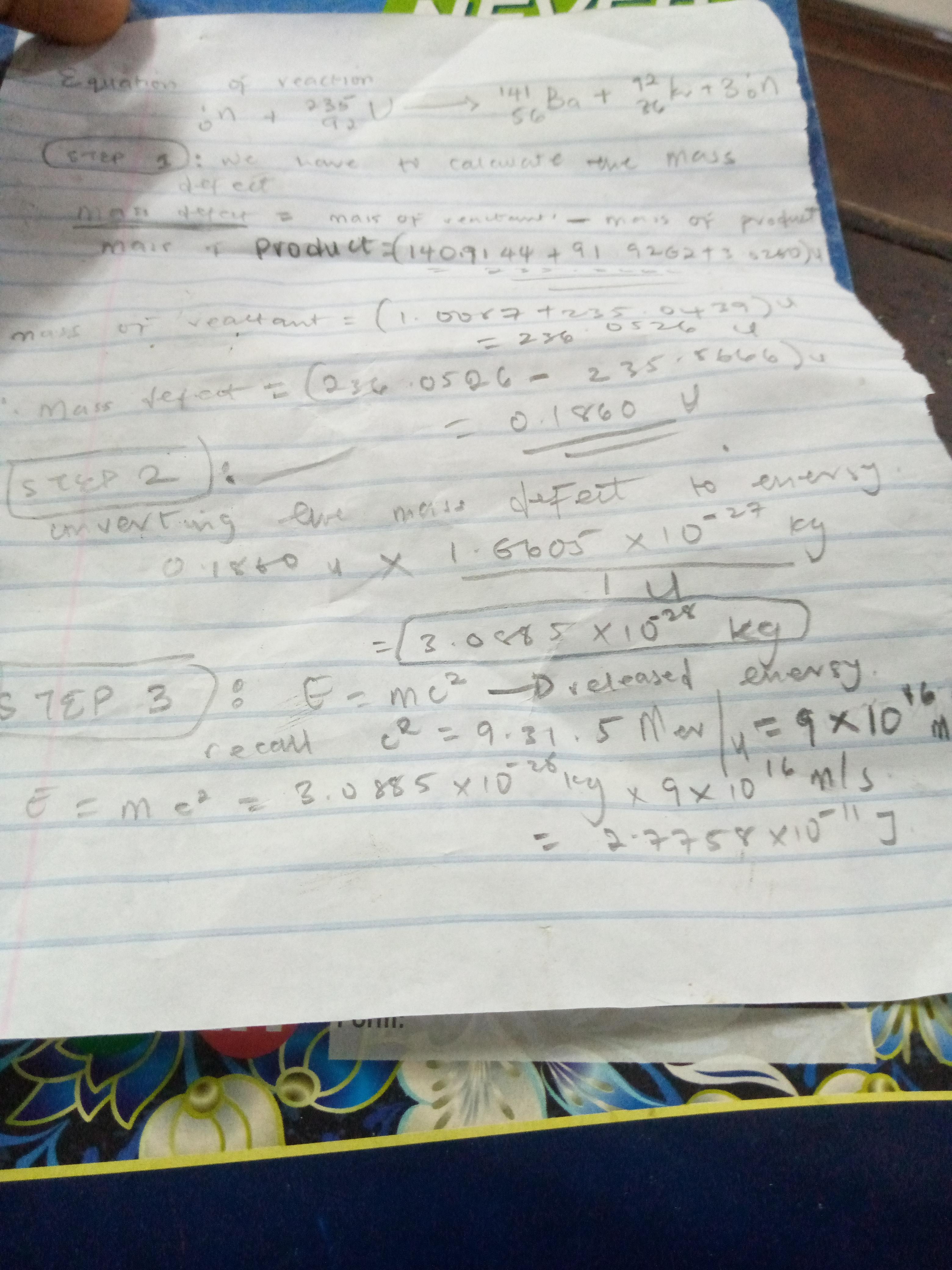
What is the reaction energy Q of this reaction? Use c2=931.5MeV/u. Express your answer in millions of electron volts to three si
emmasim [6.3K]

Answer:

Energy= 2.7758 × 10^-11 J ;

71.112×10^-6 kJ.

Mass defect in Kilogram= 3.0885×10^-28 kg.

That is; 3.1×10^-28 kg(to two significant figure).

Explanation:

(Note: Check equation of reaction in the attached file/picture).

STEP ONE: we have to calculate the Mass defect.

Mass defect= Mass of reactants -- Mass of products.

Mass of the products: (140.9144+91.9262+3.060) u.

= 235.8666 u.

Mass of reactants: (1.0087+235.0439) u= 236.0526 u.

Therefore, the Mass defect= (236.0526 -- 235.8666) u

= 0.1860 u.

STEP TWO: Converting the Mass defect to energy;

0.18860 × 1.6605 × 10^27 kg

= 3.0885× 10^-28 kg

STEP THREE: Calculating energy released . Recall(from the question) c^2= 931.5 Mev/u. This is also equals to 9×10^16 m/s.

E=Mc^2.

Where E= energy released, c= speed of light, M= Mass.

Slotting in the values;

E= 3.0885×10^-28 kg × 9×10^16 m/s.

E=2.7758 × 10^-11 J.

Know that;( 1g of uranium × 1 mol of uranium ÷ 235.0439 g of uranium) × (6.002×10^23 atom of uranium/ 1 mol of uranium) × 2.7758× 10^-11.

=7.1112×10^-10 J

= 71.112×10^6 kJ.

3 0
2 years ago
Oil is a fossil fuel used to run cars, heat up homes, and produce electricity. Oil can be removed from the bottom of the ocean t
Crazy boy [7]
The answers would be organisms in water, water, and air.
8 0
2 years ago
Read 3 more answers
An electron is on a -2.5 eV energy level. The electron is struck by a 2.5 eV photon. What will most likely happen?
kati45 [8]
The correct answer would be C
5 0
2 years ago
Other questions:
  • A 5 mole sample of liquid acetone is converted to a gas at 75.0°C. If 628 J are required to raise the temperature of the liquid
    12·1 answer
  • A chemist mixes 500 g of lead at 500°c with 1,200 g of water at 20°c. she then mixes 500 g of copper at 500°c with 1,200 g of wa
    7·1 answer
  • A stone of mass 0.55 kilograms is released and falls to the ground. Measurements show that the stone has a kinetic energy of 9.8
    6·2 answers
  • A sample from solution a and solution b were each tested with blue colored glucose indicator solution before the solutions were
    14·1 answer
  • Write the lewis structure for ch2clcoo−. assign a formal charge for any atom with a non-zero formal charge.
    15·1 answer
  • a student uses universal pH paper to find the pH of three solutions . solution A has a pH of 5 solution B has a pH of 11 and sol
    12·1 answer
  • Write a hypothesis about the pH level of common household solutions based on what you know about their physical and chemical pro
    8·2 answers
  • A hydrochloric (HCI) solution has a molar concentration of 0.0045 M, calculate the [H3O+], [OH-] and pH of the solution. Remembe
    15·1 answer
  • Which best protects animal species that are endangered due to overhunting?
    7·2 answers
  • What geologic processes helped to form gold ore, oil, and aquifers?
    12·1 answer
Add answer
Login
Not registered? Fast signup
Signup
Login Signup
Ask question!