answer.
Ask question
Login Signup
Ask question
All categories
  • English
  • Mathematics
  • Social Studies
  • Business
  • History
  • Health
  • Geography
  • Biology
  • Physics
  • Chemistry
  • Computers and Technology
  • Arts
  • World Languages
  • Spanish
  • French
  • German
  • Advanced Placement (AP)
  • SAT
  • Medicine
  • Law
  • Engineering
xxTIMURxx [149]
2 years ago
11

Two pure elements react to form a compound. One element is an alkali metal, X, and the other element is a halogen, Z. Which of t

he following is the most valid scientific claim that can be made about the compound?a. It has the formula XZ2
b. It does not dissolve in water.
c. It contains ionic bonds.
d. It contains covalent bonds.
Chemistry
2 answers:
OLEGan [10]2 years ago
6 0

Answer: C. It contains ionic bonds.

Explanation: Ionic bonds are formed as a result of electrostatic force of attraction between a positively charged ion (cation) and a negatively charged ion (anion).

An alkali metal is a member of the group one elements such as lithium, sodium and potassium which have one electron in their outermost shell while a halogen is a member of group seven elements such as fluorine, chlorine and bromine which have seven electrons in their outermost shell. X will lose its valence electron in order to attain a stable octet or duplet structure thus becoming positively charged while X will gain the electron lost by X in order to attain a stable octet structure thus becoming negatively charged.

Lelechka [254]2 years ago
4 0

Answer:

Option c. It contians ionic bonds

Explanation:

Let's take as an example NaCl

An element from group 1 (alkali) with an halogen.

Elements from group 1 form cations with +1 (charge)

This ionic salt, can't never has the formula XZ₂

Ionic salts, also can be dissolved in water, and they don't contain covalent bonds.

You might be interested in
in the early studies of chemistry, scientists used properties and changed to help identify compounds. this is still done today.
Kaylis [27]
The salt water is a mixture because the salt and the water can be separated from each other. The dissolution of salt inside water is a physical change.  At the same time, the salt water is an electrolyte, because it conducts electricity. The electricity that was pass through the water led to the decomposition of the water; those bubbles that form inside the water represent oxygen gas which is a product of decomposition of water, therefore the electricity that was passed through the salt water has caused chemical change to occur inside the salt water.<span />
6 0
2 years ago
A mysterious white powder could be powdered sugar (C12H22O11), cocaine (C17H21NO4), codeine (C18H21NO3), norfenefrine (C8H11NO2)
rodikova [14]

Norfenefrine (C₈H₁₁NO₂).

<h3>Further explanation</h3>

We will solve a case related to one of the colligative properties, namely freezing point depression.

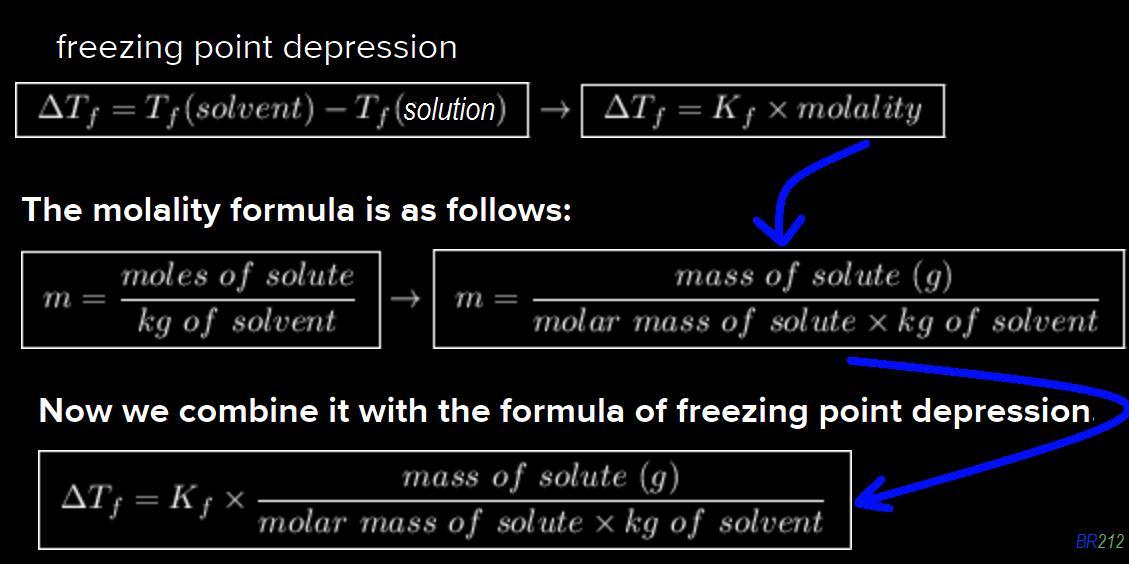
The freezing point of the solution is the temperature at which the solution begins to freeze. The difference between the freezing point of the solvent and the freezing point of the solution is called freezing point depression.

\boxed{ \ \Delta T_f = T_f(solvent) - T_f(solution) \ } \rightarrow \boxed{ \ \Delta T_f = K_f \times molality \ }

<u>Given:</u>

A mysterious white powder could be,

  • powdered sugar (C₁₂H₂₂O₁₁) with a molar mass of 342.30 g/moles,
  • cocaine (C₁₇H₂₁NO₄) with a molar mass of 303.35 g/moles,
  • codeine (C₁₈H₂₁NO₃) with a molar mass of 299.36 g/moles,
  • norfenefrine (C₈H₁₁NO₂) with a molar mass of 153.18 g/moles, or
  • fructose (C₆H₁₂O₆) with a molar mass of 180.16 g/moles.

When 82 mg of the powder is dissolved in 1.50 mL of ethanol (density = 0.789 g/cm³, normal freezing point −114.6°C, Kf = 1.99°C/m), the freezing point is lowered to −115.5°C.

<u>Question: </u>What is the identity of the white powder?

<u>The Process:</u>

Let us identify the solute, the solvent, initial, and final temperatures.

  • The solute = the powder
  • The solvent = ethanol
  • The freezing point of the solvent = −114.6°C
  • The freezing point of the solution = −115.5°C

Prepare masses of solutes and solvents.

  • Mass of solute = 82 mg = 0.082 g
  • Mass of solvent = density x volume, i.e., \boxed{ \ 0.789 \ \frac{g}{cm^3} \times 1.50 \ cm^3 = 1.1835 \ g = 0.00118 \ kg  \ }

We must prepare the solvent mass unit in kg because the unit of molality is the mole of the solute divided by the mass of the solvent in kg.

The molality formula is as follows:

\boxed{ \ m = \frac{moles \ of \ solute}{kg \ of \ solvent} \ } \rightarrow \boxed{ \ m = \frac{mass \ of \ solute \ (g)}{molar \ mass \ of \ solute \times kg \ of \ solvent} \ }

Now we combine it with the formula of freezing point depression.

\boxed{ \ \Delta T_f =  K_f \times \frac{mass \ of \ solute \ (g)}{molar \ mass \ of \ solute \times kg \ of \ solvent} \ }

It is clear that we will determine the molar mass of the solute (denoted by Mr).

We enter all data into the formula.

\boxed{ \ -114.6^0C - (-115.5^0C) = 1.99 \frac{^0C}{m} \times \frac{0.082 \ g}{Mr \times 0.00118 \ kg} \ }

\boxed{ \ 0.9 = \frac{1.99 \times 0.082}{Mr \times 0.00118} \ }

\boxed{ \ Mr = \frac{0.16318}{0.9 \times 0.00118} \ }

We get \boxed{ \ Mr = 153.65 \ }

These results are very close to the molar mass of norfenefrine which is 153.18 g/mol. Thus the white powder is norfenefrine.

<h3>Learn more</h3>
  1. The molality and mole fraction of water brainly.com/question/10861444
  2. About the mass and density of ethylene glycol as an  antifreeze brainly.com/question/4053884
  3. About the solution as a homogeneous mixture  brainly.com/question/637791

Keywords: a mysterious white powder, sugar, cocaine, codeine, norfenefrine, fructose, the solute, the solvent, dissolved, ethanol, normal freezing point, the freezing point depression, the identity


7 0
2 years ago
Read 2 more answers
What are the answers to these questions
Virty [35]

Answer:

Explanation:

So basically it just asking you question about that surtain subject .

5 0
2 years ago
Brian's aunt has cats. When Brian recently visited her, he started sneezing badly and believes that it was because
kifflom [539]

Answer:

By visiting other households with cats.

Explanation:

This will give Brian a variety of other houses and determine if it is truly cats or just alleries from other items. This is the most direct way to get Brian the answer he is looking for.

4 0
2 years ago
In science class, Blaine’s teacher puts one glow stick in a cup of hot water and another glow stick in a cup of cold water. She
timofeeve [1]

Answer:

The glow stick in hot water will be brighter

Explanation:

The glow stick in hot water will be brighter than the glow stick in cold water because the heat from the hot water will cause the molecules in the glow stick to move faster. The faster the molecules move in the glow stick, the sooner and brighter the reaction will be. The cold water will cause molecules to move slowly and it will take longer for the reaction to occur, which will also make it less bright.

3 0
2 years ago
Read 2 more answers
Other questions:
  • Uranium–232 has a half–life of 68.9 years. A sample from 206.7 years ago contains 1.40 g of uranium–232. How much uranium was or
    12·2 answers
  • If you pump air into cycle tyre a slight warming effect is noticed at valve stem why
    8·1 answer
  • Students working in lab accidentally spilled 17 l of 3.0 m h2so4 solution. they find a large container of acid neutralizer that
    14·1 answer
  • A 100 mL reaction vessel initially contains 2.60×10^-2 moles of NO and 1.30×10^-2 moles of H2. At equilibrium the concentration
    13·1 answer
  • Nickel can be plated from aqueous solution according to the following half reaction. How long would it take (in min) to plate 29
    14·1 answer
  • A sample of an unknown compound was decomposed and found to be composed of 1.36 mol oxygen, 4.10 mol hydrogen, and 2.05 mol carb
    9·1 answer
  • Which is not the purpose of using a paper towel to dab off your metal?
    10·1 answer
  • Based on the bond energies for the reaction below, what is the enthalpy of the reaction?HC≡CH (g) + 5/2 O₂ (g) → 2 CO₂ (g) + H₂O
    14·1 answer
  • During the analysis, 0.00905 mol H2O is formed. Calculate the amount (mol) H in 0.00905 mol H2O.
    11·1 answer
  • The molecules that make up soap have a region that contains polar covalent bonds and a region that contains nonpolar covalent bo
    11·1 answer
Add answer
Login
Not registered? Fast signup
Signup
Login Signup
Ask question!