answer.
Ask question
Login Signup
Ask question
All categories
  • English
  • Mathematics
  • Social Studies
  • Business
  • History
  • Health
  • Geography
  • Biology
  • Physics
  • Chemistry
  • Computers and Technology
  • Arts
  • World Languages
  • Spanish
  • French
  • German
  • Advanced Placement (AP)
  • SAT
  • Medicine
  • Law
  • Engineering
Arte-miy333 [17]
2 years ago
13

At 298 K and 1 atm, bromine is a liquid with a high vapor pressure, whereas chlorine is a gas. This provides evidence that, unde

r these conditions, the forces among Br2 molecules are _______ than those among Cl2 molecules
Chemistry
1 answer:
Galina-37 [17]2 years ago
3 0

Explanation:

In liquids, the molecules are held by less strong intermolecular forces of attraction as compared to solids. Due to which they are able to slide past each other. Hence, they have medium kinetic energy.

In gases, the molecules are held by weak Vander waal forces. Hence, they have high kinetic energy due to which they move rapidly from one place to another leading to more number of collisions.

So, when at 298 K and 1 atm Br_{2} exists in liquid state and Cl_{2} exists as a gas then it means there occurs strong force of attraction between the molecules of Br_{2} due to which it exists in liquid form.

Thus, we can conclude that at 298 K and 1 atm, bromine is a liquid with a high vapor pressure, whereas chlorine is a gas. This provides evidence that, under these conditions, the forces among Br_2 molecules are greater than those among Cl_2 molecules.

You might be interested in
An air sample consists of oxygen and nitrogen gas as major components. It also contains carbon dioxide and traces of some rare g
jekas [21]

Explanation:

A mixture is defined as the substance that contains two or more different number of substances that are physically mixed together.

For example, a mixture of air which contains oxygen, nitrogen and other gases.

A mixture in which solute particles are unevenly distributed into the solvent then it is known as a heterogeneous mixture.

For example, sand in water is a heterogeneous mixture.

A homogeneous mixture is defined as the mixture in which solute particles are evenly distributed in a solvent.

A homogeneous mixture is a clear solution.

For example, salt dissolved in water is a homogeneous mixture.

A solution is defined as the substance in which two or more substances are mixed together.

A compound is defined as the substance that contains two or more different elements that chemically combined together in a fixed ratio by mass.

A element is defined as the substance that contains only one type of atoms.

For example, a piece of sodium element will contain only atoms of sodium.

Whereas a pure substance is defined as the substance which contains only one type of molecule or one type of atom.

For example, O_{2}, N_{2} etc are pure substances.

Thus, we can conclude that the terms which could be used to describe the given sample of air is as follows.


  • pure chemical substance.
  • heterogenous mixture.
  • mixture.
4 0
2 years ago
Describe a single measurement that you could make that shows that a kettle is less than 100% efficient (providing evidence that
alexgriva [62]

Answer:

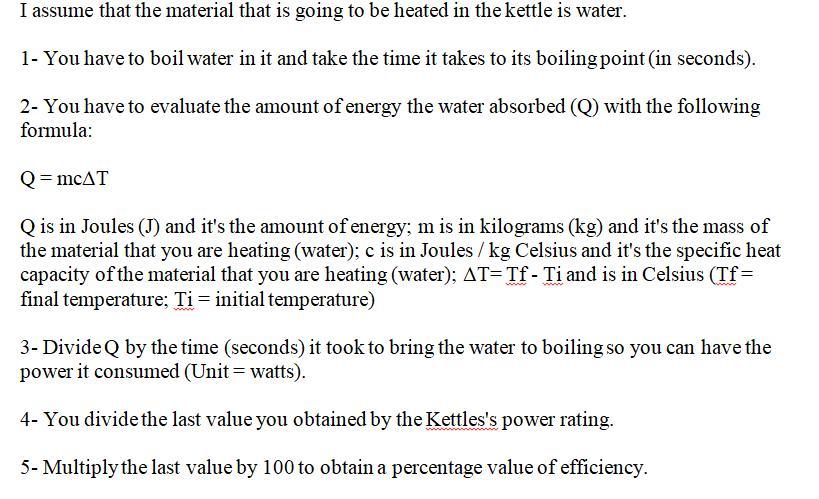
As you haven't explained what measurements you took before solving this problem, I will explain the general procedure to evaluate the efficiency of a kettle. I hope it helps you. I´ll send an attachement file with the full answer, since I couldn't write it here.

I assume that the material that is going to be heated in the kettle is water.

1- You have to boil water in it and take the time it takes to its boiling point (in seconds).  

2- You have to evaluate the amount of energy the water absorbed Q with the efficiency formula which I explain in the attachement file.

3- Divide Q by the time it took to bring the water to boiling so you can have the power it consumed.

4- You divide the last value you obtained by the Kettles's power rating.  

5- Multiply the last value by 100 to obtain a percentage value of efficiency.

Explanation:

Efficiency is the ration of a machine's useful work, in this case how much energy the water absorbed to get to its boiling point divided by the time it took to get to this point, and the total energy expended, in this case the kettles's power rating.

7 0
2 years ago
A 1.87 L aqueous solution of KOH contains 155 g of KOH . The solution has a density of 1.29 g/mL . Calculate the molarity ( M ),
lbvjy [14]

Answer:

[KOH] = 1.47 M

[KOH] = 1.22 m

KOH = 6.86 % m/m

Explanation:

Let's analyse the data

1.87 L is the volume of solution

Density is 1.29 g/mL → Solution density

155 g of KOH → Mass of solute

Moles of solute is (mass / molar mass) = 2.76 moles.

Molarity is mol/L → 2.76 mol / 1.87 L = 1.47 M

Let's determine, the mass of solvent.

Molality is mol of solute / 1kg of solvent

We can use density to find out the mass of solution

Mass of solution - Mass of solute = Mass of solvent

Density = Mass / volume

1.29 g/mL = Mass / 1870 mL

Notice, we had to convert L to mL, cause the units of density.

1.29 g/mL . 1870 mL = Mass → 2412.3 g

2412.3 g - 155 g = 2257.3 g of solvent

Let's convert the mass of solvent to kg

2257.3 g / 1000 = 2.25kg

2.76 mol / 2.25kg = 1.22 m (molality)

% percent by mass = mass of solute in 100g of solution.

(155 g / 2257.3 g) . 100g = 6.86 % m/m

5 0
2 years ago
6K + B2O3 → 3K2O + 2B
atroni [7]

Answer:

104.84 moles

Explanation:

Given data:

Moles of Boron produced = ?

Mass of B₂O₃ = 3650 g

Solution:

Chemical equation:

6K + B₂O₃    →    3K₂O + 2B

Number of moles of B₂O₃:

Number of moles = mass/ molar mass

Number of moles = 3650 g/ 69.63 g/mol

Number of moles = 52.42 mol

Now we will compare the moles of  B₂O₃ with B from balance chemical equation:

                 B₂O₃          :          B

                    1              :          2

                52.42         :        2×52.42 = 104.84

Thus from 3650 g of  B₂O₃  104.84 moles of boron will produced.

6 0
2 years ago
What is the mass of 22.4 L of H2 at STP?
Vanyuwa [196]

A. 1.01 is the right answer

Since

The formula is Pv= nRT

P=1 atm

V= 22.4 L

N= x

r= 0.0821

t = 273 k (bc it’s standard temperature)

So (1)(22.4)=(x)(0.0821)(273)

X= 1.001

7 0
2 years ago
Read 2 more answers
Other questions:
  • How many molecules of ascorbic acid (vitamin c, c6h8o6) are in a 500 mg tablet?
    14·2 answers
  • Draw the condensed structural formula in the equation for the saponification of trimyristin with koh
    13·2 answers
  • Of the elements: b, c, f, li, and na. the element with the highest ionization energy is
    5·1 answer
  • To neutralize 1.65g LiOH, how much .150 M HCl would be needed?
    6·1 answer
  • How many grams of Fe are produced from 65.9 g of FeO given the following reaction: 3FeO + 2Al -> 3Fe +Al2O3
    6·2 answers
  • Identify product A from the given 1H NMR data. Treatment of CH2═CHCOCH3 with one equivalent of HCl forms compound A. A exhibits
    14·1 answer
  • For each of the following substituents, indicate whether it withdraws electrons inductively, donates electrons by hyperconjugati
    9·1 answer
  • In hypothetical element, two energy levels are separated by an energy of 282 kj/mol. what wavelength of light (in nm) is involve
    7·1 answer
  • An experimenter studying the oxidation of fatty acids in extracts of liver found that when palmitate (16:0) was provided as subs
    9·1 answer
  • The heat capacity of solid iron is 0.447 J/gËC. If the same quantity of energy were transferred to a 450 g chunk of iron at 20ËC
    7·1 answer
Add answer
Login
Not registered? Fast signup
Signup
Login Signup
Ask question!