answer.
Ask question
Login Signup
Ask question
All categories
  • English
  • Mathematics
  • Social Studies
  • Business
  • History
  • Health
  • Geography
  • Biology
  • Physics
  • Chemistry
  • Computers and Technology
  • Arts
  • World Languages
  • Spanish
  • French
  • German
  • Advanced Placement (AP)
  • SAT
  • Medicine
  • Law
  • Engineering
Mariana [72]
2 years ago
13

The multi-link mechanism in the Variable Compression Turbo Engine _____, thus varying the compression ratio.

Physics
1 answer:
Fittoniya [83]2 years ago
5 0

Answer:

A. Adjusts how far down the piston travels

Explanation:

This type of engine changes the possition of the piston in order to modify the compression chamber volume and therefore the compression ratio of the engine. The volume of the chamber is proportional to the run of the piston (how far down the piston travels)

This engine is used to achive the optimal compression rate in each individual stage.

You might be interested in
In which of the following examples does the object have both kinetic and potential energy? Select all that apply.
Andru [333]

Objects having both kinetic and potential energy:

water flowing downstream

a child swinging on a swing

a bouncing ball

a plane in flight at 30,000 feet

Explanation:

The kinetic energy of an object is the energy possessed by the object due to its motion. It is given by

KE=\frac{1}{2}mv^2

where

m is the mass of the object

v is its speed

Therefore, an object has kinetic energy when its speed is non-zero (so, whenever it is moving).

The potential energy of an object is the energy possessed by the object due to its position in the gravitational field. It is given by

PE=mgh

where

m is the mass

g is the acceleration of gravity

h is the heigth of the object relative to the ground

Therefore, an object has potential energy whenever it is located at a certain height above the ground.

So in this problem, the objects that have both kinetic and potential energy are:

a rock at the edge of a cliff  --> NO, because the rock is at rest (so KE = 0)

water flowing downstream  --> YES, because the water is moving AND it is at a certain height above the ground

a child swinging on a swing  --> YES, because the child is moving AND it is at a certain height above the ground

a bouncing ball  --> YES, because the ball is moving AND it is at a certain height above the ground

water behind a dam  --> NO, because the water is at rest (so KE=0)

a car moving on a level road  --> NO, because the car is at ground level (so PE=0)

a plane in flight at 30,000 feet   --> YES, because the plane is moving AND it is at a certain height above the ground

a compressed spring --> NO, because the spring is at rest (so KE=0)

Learn more about kinetic and potential energy:

brainly.com/question/6536722

brainly.com/question/1198647

brainly.com/question/10770261

#LearnwithBrainly

8 0
2 years ago
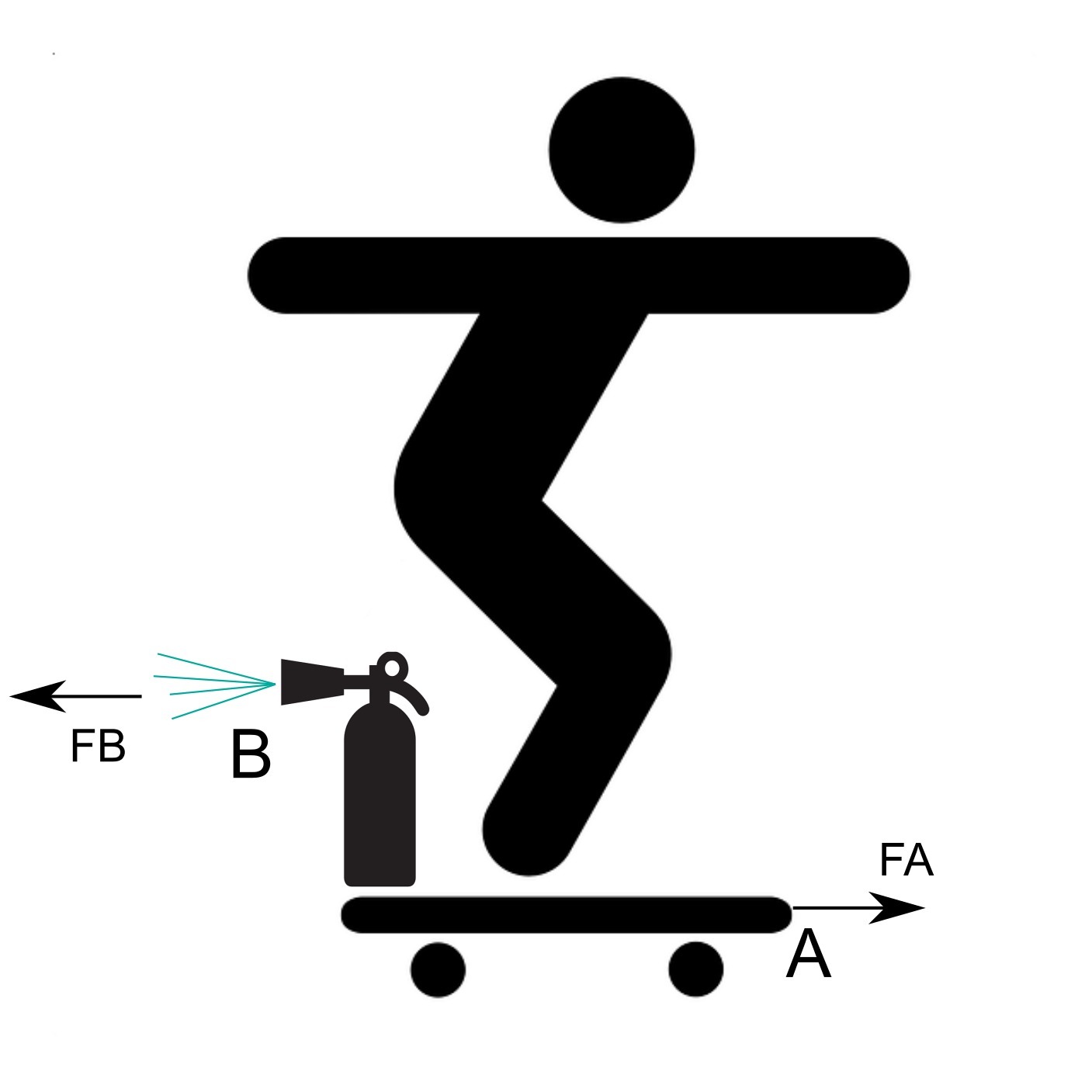
Nikolas had an idea that he could use the compressed carbon dioxide in a fire extinguisher to propel him on his skateboard.
Vikentia [17]
The Newton’s law Nikolas would use to come up with this idea is the <span>Third law that states:

</span><span>When one body exerts a force on a second body, the second body simultaneously exerts a force equal in magnitude and opposite in direction on the first body.
</span>
So, in this case, let's name the first Body A which is the skateboard and the second body B which is <span>the compressed carbon dioxide in a fire extinguisher. Then, as shown in the figure below, according to the Third law:

</span>FA = -FB<span>

</span>

8 0
2 years ago
Read 2 more answers
Two billiard balls move toward each other on a table. The mass of the number three ball, m1, is 5 g with a velocity of 3 m/s. Th
Stels [109]

This question deals with the law of conservation of momentum, which basically says that the total momentum in a system must stay the same, provided there are no outside forces. Since you were given the mass and velocity of the two objects you can find the momentum (p=mv) of each and then add them together to find the total momentum of the system before they collide. This total momentum must be the same after they collide.  Since you have the mass and velocity of one of the objects after the collision you can find the its momentum after.  Subtract this from the the system total and you will have the momentum of the other object after the collision.  Now that you know the momentum of the other object you can find its velocity using p=mv and its mass from before.

Be careful with the velocities.  They are vectors, so direction matters.  Typically moving to the right is positive (+) and moving to the left is negative (-).  It is not clear from your question which direction the objects are moving before and after the collision.

6 0
2 years ago
Read 2 more answers
A girl and a boy are riding on a merry-go-round that is turning at a constant rate. the girl is near the outer edge, and the boy
lutik1710 [3]
In order to clearly qualify this problem, we use relationships between linear displacement (x) and angular displacement (theta). The relationship would be, x= r*theta, where r is the radius. From here, you can deduce that the smaller the radius, the larger the angular displacement. Hence, the boy that is closer to the center would experience greater angular displacement.
5 0
2 years ago
Read 2 more answers
A rod 14.0 cm long is uniformly charged and has a total charge of -22.0 μC. Determine the magnitude and direction of the net ele
lesya692 [45]

Explanation:

It is given that,

Length of the rod, l = 14 cm = 0.14 m

Charge on the rod, q=-22\ \mu C=-22\times 10^{-6}\ C

We need to find the magnitude and direction of the net electric field produced by the charged rod at a point 36.0 cm to the right of its center along the axis of the rod, z = 36 cm = 0.36 m

Electric field at the axis of the rod is given by :

E=\dfrac{\lambda}{2\pi \epsilon_o z}

Where

\lambda is the linear charge density of the rod,

\lambda=\dfrac{q}{l}=\dfrac{-22\times 10^{-6}\ C}{0.14\ m}=-0.00015\ C/m

E=\dfrac{-0.00015}{2\pi\times 8.85\times 10^{-12}\times 0.36}

E = -7493170.57 N/C

or

E=-7.49\times 10^6\ N/C

Negative sign shows that the electric field is acting in inwards direction. Hence, this is the required solution.

4 0
2 years ago
Other questions:
  • What is the least possible initial kinetic energy in the oxygen atom could have and still excite the cesium atom?
    12·1 answer
  • A rock of mass m is thrown horizontally off a building from a height h. the speed of the rock as it leaves the thrower's hand at
    10·1 answer
  • If 500 J of energy were added to 1 kg of each of these samples, which would experience the LEAST temperature increase? aluminum,
    6·2 answers
  • A box rests on the (horizontal) back of a truck. The coefficient of static friction between the box and the surface on which it
    10·1 answer
  • Assume that you stay on the Earth's surface. What is the ratio of the sun's gravitational force on you to the earth's gravitatio
    9·1 answer
  • By standard convention, both the electric potential and the the electric potential energy between two charges is taken to be zer
    7·1 answer
  • Use the ratio version of Kepler’s third law and the orbital information of Mars to determine Earth’s distance from the Sun. Mars
    5·2 answers
  • A truck drives to a rock quarry at a speed of 20 m/s. The truck takes on a load of rocks, which doubles its mass, and leaves at
    5·1 answer
  • You are piloting a helicopter which is rising vertically at a uniform velocity of 14.70 m/s. When you reach 196.00 m, you see Ba
    14·1 answer
  • A wooden piece is made in different shapes take length (l) = radius (r) = 2m Calculate its volume as a:
    11·1 answer
Add answer
Login
Not registered? Fast signup
Signup
Login Signup
Ask question!