answer.
Ask question
Login Signup
Ask question
All categories
  • English
  • Mathematics
  • Social Studies
  • Business
  • History
  • Health
  • Geography
  • Biology
  • Physics
  • Chemistry
  • Computers and Technology
  • Arts
  • World Languages
  • Spanish
  • French
  • German
  • Advanced Placement (AP)
  • SAT
  • Medicine
  • Law
  • Engineering
lisov135 [29]
2 years ago
3

The gas-phase decomposition of NOBr has a k= 0.810 M-1 s-1 at 10°C. NOBr(g) → NO(g) + ½ Br2 (g) rate = k[NOBr]2 We start with 0.

00200 M NOBr in a flask at 10°C. (a) How many minutes does it take to use up 0.00050 M of this NOBr? (b) If we start with 0.000500 M NOBr, what concentration of NOBr with remain after 5.00 minutes of reaction? (c) How much of the NO is produced after 5 min when the reaction started with 0.000500 M NOBr?
Chemistry
1 answer:
postnew [5]2 years ago
4 0

Answer:

a) 2.57 min

b) 6.075x10⁻⁵ M

c) 4.3925x10⁻⁴ M

Explanation:

a) The rate determines how the concentration of NOBr decays at each second (M/s), thus, if the initial concetrations is [NOBr] = 0.00200, thus the rate is:

rate = 0.810*(0.002)²

rate = 3.24x10⁻⁶ M/s

So, at each second, 3.24x10⁻⁶ M is used, thus, the time to use up 0.00050 M is:

t = 0.00050/3.24x10⁻⁶

t = 154.32 s

t = 2.57 min

b) Know the rate will be calculated with [NOBr] = 0.00050 M, so:

rate = 0.810*(0.00050)²

rate = 2.025x10⁻⁷ M/s

So, after 5 minutes = 300s, the concentration decays to:

2.025x10⁻⁷ M/s * 300s = 6.075x10⁻⁵ M

c) If remains 6.075x10⁻⁵ M of NOBr, than it was consumed:

0.00050 - 6.075x10⁻⁵ = 4.3925x10⁻⁴ M

The stoichiometry of the reaction is 1 mole of NOBr to 1 mole of NO, so it is formed  4.3925x10⁻⁴ M of NO.

You might be interested in
A 226.4-l cylinder contains 65.5% he(g) and 34.5% kr(g) by mass at 27.0°c and 1.40 atm total pressure. what is the mass of he in
Vadim26 [7]
First, we determine the number of moles of gas present using the ideal gas equation.

PV = nRT
n = PV / RT
n = (1.4 * 226.4) / (0.082 *(27 + 273.15))
n = 12.88

Next, we use the given percentages to find the moles of helium present
Moles of helium = 0.655 * 12.88
Moles of helium = 8.44

Next, we use the formula:
Mass = moles * molar mass

Mass of helium = 8.44 * 4

Mass of helium = 33.76 grams
5 0
2 years ago
Read 2 more answers
How many cycles of the synthesis pathway are needed to produce myristic acid, c13h27cooh?
Alenkasestr [34]
The primary cycle of fatty acid synthesis produces a four-carbon acyl group. Every following cycle adds a three-carbon malonyl group, which stretches off one molecule of CO2 (one carbon atom) in a condensation response. Thus, the net number of carbon atoms additional by each following cycle is two. For the reason that the first cycle makes a four-carbon chain, and each added cycle extends the chain by two carbon atoms, the second cycle fallouts in a six-carbon chain, the third cycle fallouts in an eight-carbon chain, and so on. And so, the synthesis of the 14-carbon myristic acid necessitates six repetitions.
7 0
2 years ago
Atorvastatin is sold under the trade name Lipitor and is used for lowering cholesterol. Annual global sales of this compound exc
kotegsom [21]

Answer:

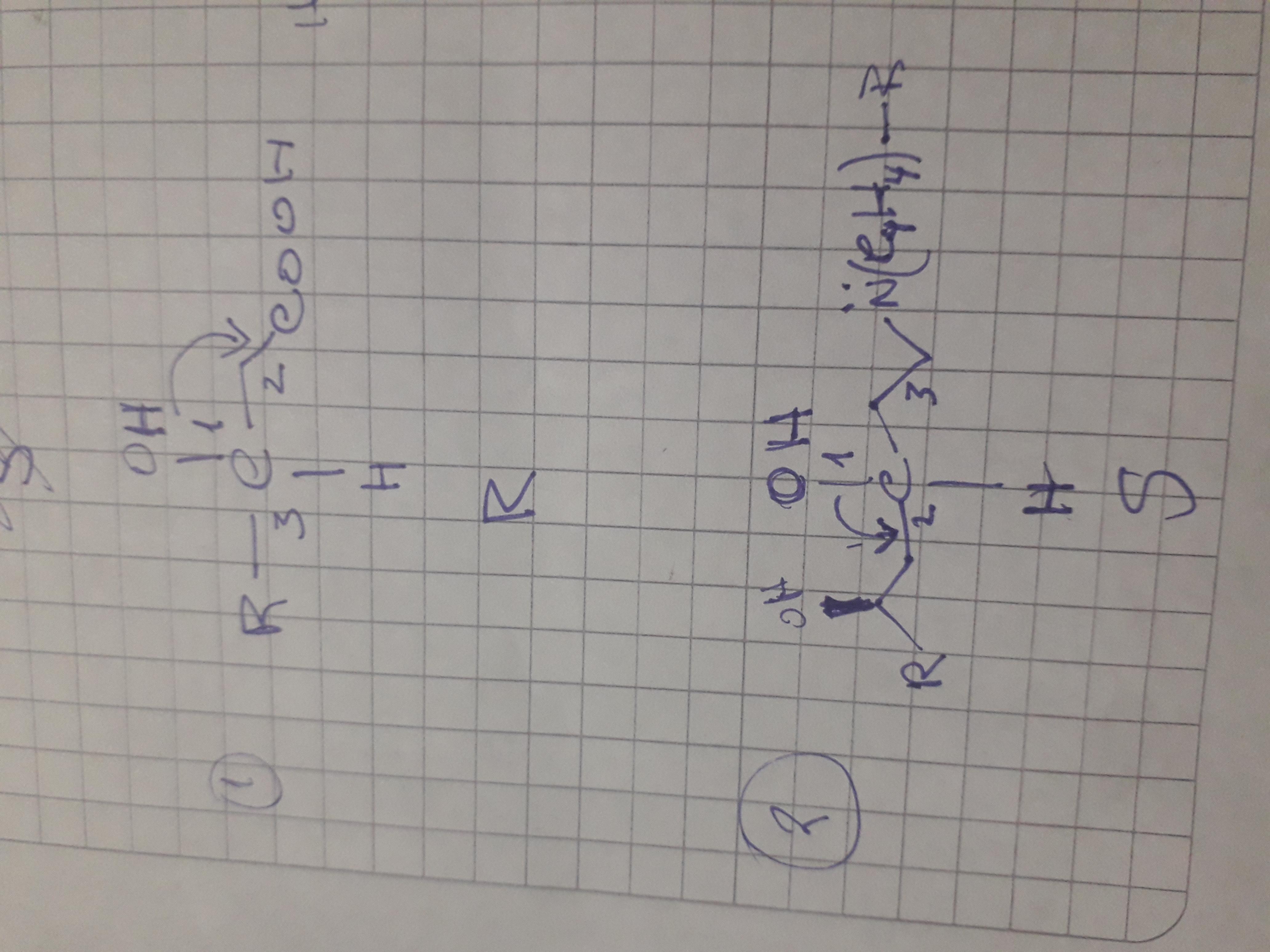
Atorvastatin has two chiral centers. The question doesn't include the box where have to answer but I can show you in an image where are located and their configuration.

Explanation:

The first image shows the chemical structure of atorvastatin and their chiral centers identified as 1 and 2 respectively.

The second image shows the Fischer projections corresponding to every chiral carbon 1 and 2. I wrote R so suggest that there are more carbon atoms forward but not only corresponds to carbon atoms.

You can see that the chiral carbon 1 has R configuration due to the direction from the main substituent to the second follow the clockwise.

The chiral carbon 2 has S configuration due to the direction from the main substituent to the second one go anticlockwise.

4 0
2 years ago
Which of these tasks falls under the responsibility of a forensic scientist?
Varvara68 [4.7K]

Answer:

Training officers in how to properly collect evidence

Explanation:

Forensic science is an interesting branch of science that involves the use of scientific procedures to solve a crime case. It encompasses collection of physical evidence from the crime scene and analyzing it in a laboratory using scientific means.

A forensic scientist is the individual in charge of performing these scientific procedures. His/her major role is to run the scientific analysis of the physical evidence brought in by the officers, however, he/she can also perform the task of training officers in how to properly collect evidence, in order not to damage the evidence or render it invalid for use.

8 0
2 years ago
Consider four sealed, rigid containers with the following volumes: 50 mL, 100 mL, 250 mL, and 500 mL. If each of these contains
dsp73
First, we assume that helium behaves as an ideal gas such that the ideal gas law is applicable.
                                     PV = nRT
where P is pressure, V is volume, n is number of moles, R is universal gas constant, and T is temperature. From the equation, if n, R, and T are constant, there is an inverse relationship between P and V. From the given choices, the container with the greatest pressure would be the 50 mL. 
5 0
2 years ago
Other questions:
  • Which equilibrium expression represents the ionization of water?
    12·2 answers
  • The population of rabbits in a forest is decreasing. Foxes in that region are now competing with each other for the limited numb
    12·2 answers
  • What mass of calcium carbonate (in grams) can be dissolved by 4.0 g of hcl? (hint: begin by writing a balanced equation for the
    14·2 answers
  • How many atoms of hydrogen are in 210 g of hydrogen peroxide (h2o2)?
    8·2 answers
  • What is the concentration of an alcl3 solution if 150. ml of the solution contains 550. mg of cl- ion?
    15·1 answer
  • Harmful chemicals released directly into the atmosphere due to either human activities or natural processes are ___ air pollutan
    7·1 answer
  • A car uses 12.5 L of gasoline to travel a distance of 275 km. Convert this into units of miles per gallon (mi/gal).
    14·1 answer
  • If 10.0 liters of h2(g) at STP is heated to a temperature of 546 K, pressure remaining constant, the new volume of the gas will
    7·1 answer
  • How many chiral centers does clavulanic acid have?
    5·1 answer
  • Emma wants to go swimming the first day the pool opens in May, but she is worried it will be too cold since summer only just sta
    14·1 answer
Add answer
Login
Not registered? Fast signup
Signup
Login Signup
Ask question!