answer.
Ask question
Login Signup
Ask question
All categories
  • English
  • Mathematics
  • Social Studies
  • Business
  • History
  • Health
  • Geography
  • Biology
  • Physics
  • Chemistry
  • Computers and Technology
  • Arts
  • World Languages
  • Spanish
  • French
  • German
  • Advanced Placement (AP)
  • SAT
  • Medicine
  • Law
  • Engineering
Mrac [35]
2 years ago
13

A 226.4-l cylinder contains 65.5% he(g) and 34.5% kr(g) by mass at 27.0°c and 1.40 atm total pressure. what is the mass of he in

this container?
Chemistry
2 answers:
galben [10]2 years ago
8 0

Answer : The mass of helium (He) in this container is, 0.2 grams

Solution :

First we have to calculate the moles of gas present in the container.

Using ideal gas equation,

PV=nRT\\\\n=\frac{RT}{PV}

where,

P = pressure of the gas present in the container = 1.40 atm

V = volume of the gas present in the container = 226.4 L

R = gas constant = 0.0821 Latm/moleK

T = temperature of the gas = 27^oC=273+27=300K

n = moles of gas present in the container = ?

Now put all the given values in the above equation, we get the moles of gas present in the container.

n=\frac{(0.0821Latm/moleK)\times (300K)}{(226.4L)\times (1.40atm)}=0.077moles

Now we have to calculate the moles of helium.

\text{Moles of helium}=0.077\times \frac{65.5}{100}=0.050mole

Now we have to calculate the mass of helium present in the container.

\text{Mass of helium}=\text{Moles of helium}\times \text{Molar mass of helium}=0.050moles\times 4g/mole=0.2g

Therefore, the mass of helium (He) in this container is, 0.2 grams

Vadim26 [7]2 years ago
5 0
First, we determine the number of moles of gas present using the ideal gas equation.

PV = nRT
n = PV / RT
n = (1.4 * 226.4) / (0.082 *(27 + 273.15))
n = 12.88

Next, we use the given percentages to find the moles of helium present
Moles of helium = 0.655 * 12.88
Moles of helium = 8.44

Next, we use the formula:
Mass = moles * molar mass

Mass of helium = 8.44 * 4

Mass of helium = 33.76 grams
You might be interested in
A copper rod that has a mass of 200.0 g has an initial temperature of 20.0°C and is heated to 40.0°C. If 1,540 J of heat are nee
Romashka [77]

Heat gained in a system can be calculated by multiplying the given mass to the specific heat capacity of the substance and the temperature difference. It is expressed as follows:<span>

Heat = mC(T2-T1)</span>

1540 = 200.0 (C)(40 - 20)

<span> <span>C = 0.385 J / g C</span></span>

<span><span>
</span></span>

<span><span>Hope this answers the question. Have a nice day.</span></span>

8 0
2 years ago
Read 2 more answers
Chlorine gas was first prepared in 1774 by the oxidation of NaCl with MnO2:
irina1246 [14]

Answer:

0.5

Explanation:

2NaCl(s) + 2H2SO4(l) + MnO2(s) → Na2SO4(s) + MnSO4(s) + 2H2O(g) + Cl2(g)

Using ideal gas equation,

PV = nRT

28.7torr

Converting torr to atm,

= 0.0378atm

V = 0.597L

T = 27 °C

= 300 K

a) PV = nRT

(0.0378atm) * (0.597L) = n(0.0821) * (300k)

= 0.000915 mol

moles of water and chlorine = 0.000915 mol

From the above equation, the ratio of water to chlorine = 1 : 2

Therefore, mole of chlorine = 0.000915/2

= 0.000458 mol

mole fraction = moles of specie/moles of all the species present

= 0.000458/0.000915

= 0.5

5 0
2 years ago
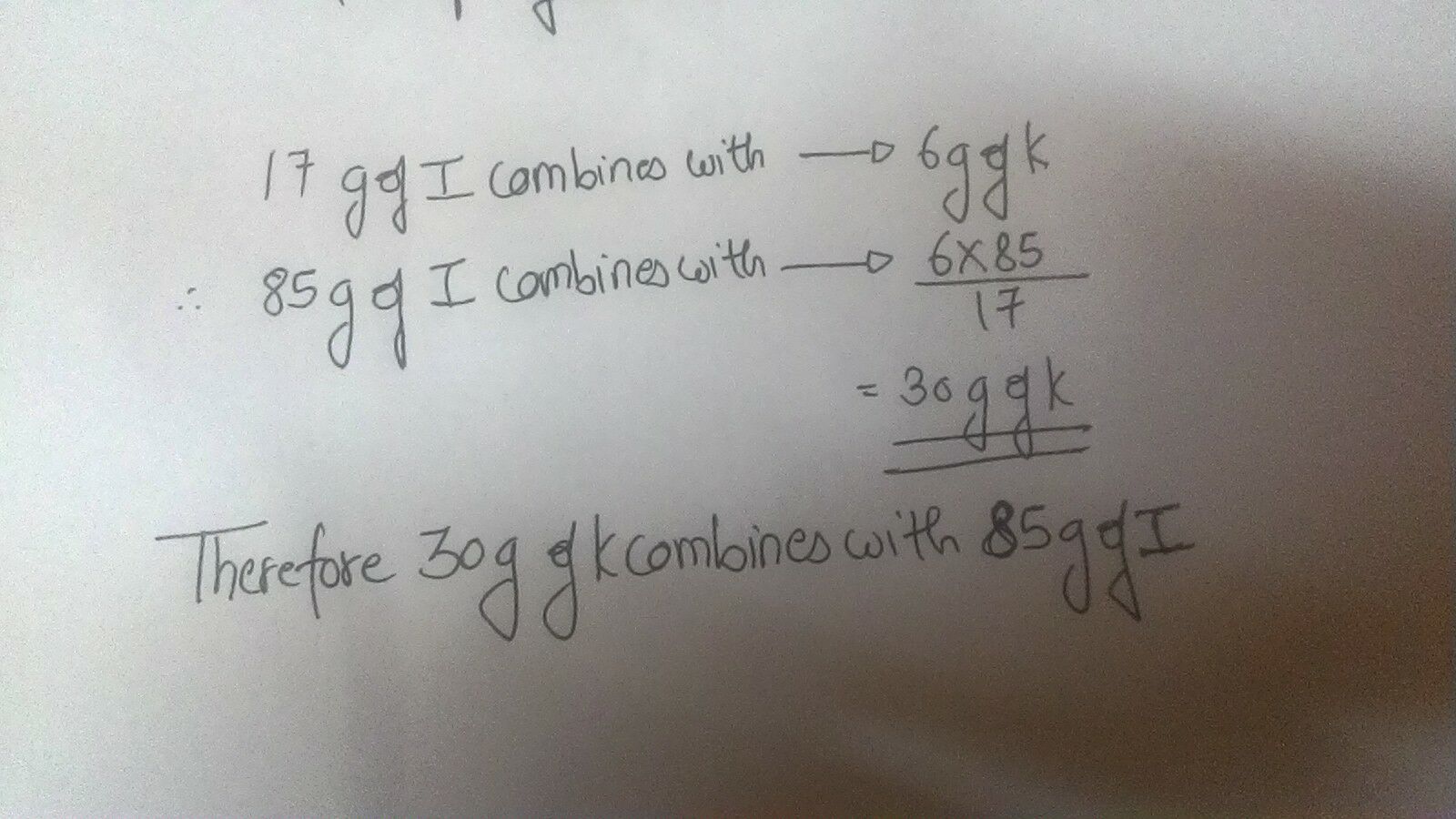
If 6 g of element k combine with 17 g of element l, how many grams of element k combine with 85 g of element l?
Ede4ka [16]
Hope this helps you.

5 0
2 years ago
A sample of ammonia has a mass of 82.9 g. how many molecules are in this sample?
alina1380 [7]
The chemical formula for ammonia is NH3. So first, you need to find the molar mass of ammonia (how many grams in one mole).
N=14g
H3=3g
So one mole of NH3 is 17 grams, you can divide 82.9 grams by 17 grams to find the number of molecules. The answer should be 4.876 moles (molecules) of ammonia. Hope this helps!
8 0
2 years ago
Read 2 more answers
SEP Use Models Why does the number of electrons in each principal energy shell increase as the number of the shell increases?
zlopas [31]

Answer:

See explanation

Explanation:

The number of electrons in each principal energy shell increases as the number of shells increases because more electronic orbitals become available to accommodate the electrons.

For instance, the n= 2 level only accommodates eight electrons in the s and p orbitals whereas the n=3 level accommodates 18 electrons in s, p and d orbitals respectively.

Each principal level accommodates 2n^2 electrons where n= the principal energy shell.

4 0
1 year ago
Other questions:
  • A solution contains cr3+ ions. the addition of 0.063 l of 1.50 m naf solution was needed to completely precipitate the chromium
    14·1 answer
  • Which of the following distinguishes the isotope mercury-196 from the isotope mercury-199?
    14·1 answer
  • List the following compounds in decreasing electronegativity difference. cl2 hcl nacl
    13·1 answer
  • The side chain (r group) of the amino acid serine is ch2oh. The side chain of the amino acid leucine is ch2ch(ch3)2. Where would
    8·1 answer
  • How many atoms of Mg are present in 97.22 grams of Mg?
    8·1 answer
  • Be sure to answer all parts. one of the most important industrial sources of ethanol is the reaction of steam with ethene derive
    8·1 answer
  • Glycolic acid, which is a monoprotic acid and a constituent in sugar cane, has a pKa of 3.9. A 25.0 mL solution of glycolic acid
    6·1 answer
  • Which of the following statements concerning the process of spontaneous folding of proteins is false?
    10·2 answers
  • A white powder is known to be a mixture of magnesium oxide and aluminum oxide. 100cm3 of 2moldm-3 NaOH(aq) is just sufficient to
    7·1 answer
  • Alveolar air (a mixture of nitrogen, oxygen, and carbon dioxide) has a total pressure of 0.998 atm. If the partial pressure of o
    13·1 answer
Add answer
Login
Not registered? Fast signup
Signup
Login Signup
Ask question!