answer.
Ask question
Login Signup
Ask question
All categories
  • English
  • Mathematics
  • Social Studies
  • Business
  • History
  • Health
  • Geography
  • Biology
  • Physics
  • Chemistry
  • Computers and Technology
  • Arts
  • World Languages
  • Spanish
  • French
  • German
  • Advanced Placement (AP)
  • SAT
  • Medicine
  • Law
  • Engineering
Shalnov [3]
2 years ago
15

Some instant cold packs contain ammonium nitrate and a separate pouch of water. When the pack is activated by squeezing to break

the water pouch, the ammonium nitrate dissolves in water and the pack gets cold. The heat of solution for ammonium nitrate is 25.4 kJ/mol.
a. Is the dissolution of ammonium nitrate endothermic or exothermic?

b. A cold pack contains 135.0 g of water and 50.0 g of ammonium nitrate. What will be the final temperature of the activated cold pack, if the initial temperature is 25.0 degree C? (Assume that the specific heat of the solution is the same as that for water, 4.184 J/g degree C and no heat is lost).
Chemistry
1 answer:
KIM [24]2 years ago
5 0

Answer:

a) Endothermic

b) T₂ = 53.1 ºC

Explanation:

a) We are told that when the ammonium nitrate dissolves in water the pack gets cold so the system is absorbing heat from the surroundings and by definition it  is an endothermic process.

b) Recall that the heat, Q, is given by the formula:

Q = mcΔT    where  m is the mass of water,

                                 c is the specific heat of water, and

                                 ΔT is the change in temperature

We can determine the value for Q since we are given the heat of solution for the ammonium nitrate. From there we can calculate ΔT and finally answer our question.

Molar mass NH₄NO₃ = 80.04 g/mol

moles NH₄NO₃ = 50.0 g/ 80.04 g/mol = 0.62 mol

Q = 25.4 kJ/mol x 0.62 mol = 15.87 kJ = 15.87 kJ x 1000 J = 1.59 x 10⁴ J

Q = mcΔT ⇒ ΔT = Q/mc

ΔT = 1.59 x 10⁴ J/ (135 g x 4.184 J/gºC ) = 28.1 ºC

T₂- T₁ = ΔT ⇒ T₂ = ΔT  + T₁  = 28.1 ºC +25.0 ºC = 53.1 ºC

You might be interested in
For a ternary solution at constant T and P, the composition dependence of molar property M is given by: M = x1M1 + x2M2 + x3M3 +
AveGali [126]

Answer:

M_{i} = M_{i} + C_{xjxk} (1-2x_{i}) ...1

M^{\alpha } = M_{i} + CX_{xjxk}          ...2

Explanation:

The ternary constant is given by the following equation:

The symbol XiXi, where XX is an extensive property of a homogeneous mixture and the subscript ii identifies a constituent species of the mixture, denotes the partial molar quantity of species ii defined by

M_{i}  = [\frac{d(nM)}{dn_{i} }]_{P,t,n,j}

This is the rate at which property  X  changes with the amount of species  i  added to the mixture as the temperature, the pressure, and the amounts of all other species are kept constant.  A partial molar quantity is an intensive state function.  Its value depends on the temperature, pressure, and composition of the mixture.

In a multi phase system (in this case, a ternary system), the components resolved give:

M_{i} = M_{i} + C_{xjxk} (1-2x_{i})

and M^{\alpha } = M_{i} + CX_{xjxk}

5 0
2 years ago
Consider the reaction. X ( g ) + Y ( g ) − ⇀ ↽ − Z ( g ) K p = 1.00 at 300 K In which direction will the net reaction proceed fo
marta [7]

Answer:

Explanation:

We have in this question the equilibrium

X ( g ) + Y ( g ) ⇆  Z ( g )

With the equilibrium contant Kp = pZ/(pX x pY)

The moment we change the concentration of Y, we are changing effectively the partial pressure of Y since pressure and concentration are directly proportional

pV = nRT ⇒ p = nRT/V and n/V is molarity.

Therefore we can calculate the reaction quotient Q

Qp = pZ/(pX x pY) = 1/ 1  x 0.5 atm = 2

Since Qp is greater than Kp the system proceeds from right to left.

We could also arrive to the same conclusion by applying LeChatelier´s principle which states that any disturbance in the equilibrium, the system will react in such a way to counteract the change to restore the equilibrium. Therefore, by having reduced the pressure of Y the system will react favoring the reactants side increasing some of the y pressure until restoring the equilibrium Kp = 1.

4 0
2 years ago
A turtle moves at a speed of 1.0km/h. How fast is the turtle moving in meter per second (m/s)?
ahrayia [7]

Answer:

0.28m/s

Explanation:

Speed is defined as the distance travelled per unit of time. The speed of the turtle is 1.0km/h. Thus, to find the speed in m/s, we need to convert km to m (1km is 1000m), and h to s (1h = 3600s).

<em>Converting units:</em>

1.0km/h * (1000m / 1km) * (1h / 3600s) = 0.28m/s.

The speed of the turtle in meter per second is 0.28m/s

7 0
2 years ago
If your lungs were filled with air containing this level of lead, how many lead atoms would be in your lungs? (Assume a total lu
kolbaska11 [484]

Answer:

1.505×10^23 atoms of lead

Explanation:

Volume of lead in the lungs = total volume of lungs = 5.60L

1 mole = 22.4L

5.6L of lead = 5.6/22.4 = 0.25 mole

From Avogadro's law

1 mole of lead contains 6.02×10^23 atoms of lead

0.25 mole of lead = 0.25×6.02×10^23 = 1.505×10^23 atoms of lead

6 0
2 years ago
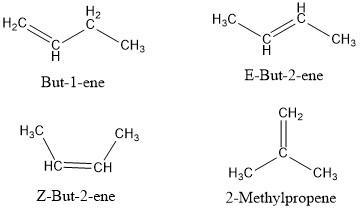
Identify structure(s) for all constitutional isomers with the molecular formula C4H8 that have one double bond. Select all that
Alchen [17]

Answer:

a) But-1-ene

b) E-But-2-ene

c) Z-But-2-ene

d) 2-Methylpropene

Explanation:

In this case, if we want to draw the <u>isomers</u>, we have to check the<u> formula </u>C_4_H8 in this formula we can start with a linear structure with 4 carbons. We also know that we have a double bond, so we can put this double bond between carbons 1 and 2 and we will obtain <u>But-1-ene.</u>

<u />

For the next isomer, we can move the double bond to carbons 2 and 3. When we do this can have two structures. When the methyl groups are placed on the same side we will obtain <u>Z-But-2-ene</u>. When the methyls groups are placed on opposite sides we will obtain <u>E-But-2-ene.</u>

<u />

Finally, we can use a linear structure of three carbons with a methyl group in the middle with a double bond, and we will obtain <u>2-Methylpropene.</u>

<u />

See figure 1 to further explanations.

I hope it helps!

<u />

<u />

8 0
2 years ago
Other questions:
  • In the Gabriel synthesis of primary amines, N-potassiophthalimide is used as a source of the nitrogen atom. Complete the synthes
    8·1 answer
  • A balloon contains 7.36 g of oxygen gas (O2). How many oxygen molecules are in the balloon?
    8·1 answer
  • What mass of solid NaOH (97.0 % by mass) is required to prepare 1.00 L of a 10.0% solution of NaOH by mass? The density of the 1
    10·1 answer
  • H2PO4-(aq) ⇆ H+(aq) + HPO42-( which ion plays the role of hydrogen ion donor and which one plays the hydrogen ion acceptor in BP
    14·1 answer
  • A protein subunit from an enzyme is part of a research study and needs to be characterized. A total of 0.145 g of this subunit w
    8·1 answer
  • A sample of solid sodium hydroxide, weighing 13.20 grams is dissolved in deionized water to make a solution. What volume in mL o
    8·1 answer
  • When 0.40 mol Al is mixed with 0.40 mol Br2, the following reaction occurs: 2Al(s) + 3Br2(l) → 2AlBr3(s) Identify the limiting r
    13·1 answer
  • When filling a burette for a titration, adjust the burette so that______, preferably over a sink. Then,_______to add the titrant
    10·1 answer
  • The average distance between nitrogen and oxygen atoms is 115 pm in a compound called nitric oxide. What is this distance in mil
    14·1 answer
  • 5. A Dumas bulb is filled with chlorine gas at the ambient pressure and is found to contain 7.1 g of chlorine when the temperatu
    12·1 answer
Add answer
Login
Not registered? Fast signup
Signup
Login Signup
Ask question!