answer.
Ask question
Login Signup
Ask question
All categories
  • English
  • Mathematics
  • Social Studies
  • Business
  • History
  • Health
  • Geography
  • Biology
  • Physics
  • Chemistry
  • Computers and Technology
  • Arts
  • World Languages
  • Spanish
  • French
  • German
  • Advanced Placement (AP)
  • SAT
  • Medicine
  • Law
  • Engineering
Sveta_85 [38]
2 years ago
9

Which of the following statements is true? I. Carbon forms covalent rather than ionic bonds. II. Carbon has an electronegativity

value that is midway between that of the most metallic element and the most nonmetallic element. III. Carbon forms four bonds in virtually all its compounds. IV. A Si-Si bond is much stronger than a C-C bond. V. Relatively little heat is released when a C chain reacts and one bond replaces the other. Group of answer choices I, II, II, V I only II only III only IV only V only I and II I and III I and IV I and V II and III II and IV II and V III and IV III and V
Chemistry
1 answer:
Anni [7]2 years ago
4 0

Explanation:

Atomic number of carbon is 6 and its electronic distribution is 2, 4. As there are 4 valence electrons present in a carbon atom. Hence, it belongs to group 14 of the periodic table.

So, being a non-metal carbon atom tends to form covalent bonds. Also, the electronegativity value of carbon atom is mid-way between those of metals and non-metals.

In order to complete its octet, carbon atom tends to gain or share its 4 valence electrons. Therefore, it forms four bonds in all its compounds.

The Si-Si bond will be less stronger than C-C bond due to the larger size of silicon atom. As a result, there will be less overlapping between the silicon atoms due to which the bond formed will be weak in nature.

Whereas C-C bond is more stronger as a carbon atom is smaller in size as compared to silicon atom. As a result, more will be the overlapping between the carbon atoms. Hence, more stronger will be C-C bond than Si-Si bond.

As there will be covalent bonds present in a carbon chain and these bonds are weak as compared to ionic bonds. Hence, relatively little heat is released when a C chain reacts and one bond replaces the other.

Thus, we can conclude that out of the given options statements of I, II, III and V are true.

You might be interested in
Which of the following correctly describes a compound? (4 points)
wariber [46]

Explanation:

The atoms are chemically bonded together, and they retain their individual physical and chemical properties.

8 0
2 years ago
A sample of gas contains 0.1800 mol of CO(g) and 0.1800 mol of NO(g) and occupies a volume of 23.2 L. The following reaction tak
baherus [9]

Answer:

The volume of the sample is 17.4L

Explanation:

The reaction that occurs requires the same amount of CO and NO. As the moles added of both reactants are the same you don't have any limiting reactant. The only thing we need is the reaction where 4 moles of gases (2mol CO + 2mol NO) produce 3 moles of gases (2mol CO2 + 1mol N2). The moles produced are:

0.1800mol + 0.1800mol reactants =

0.3600mol reactant * (3mol products / 4mol reactants) = 0.2700 moles products.

Using Avogadro's law (States the moles of a gas are directly proportional to its pressure under constant temperature and pressure) we can find the volume of the products:

V1n2 = V2n1

<em>Where V is volume and n moles of 1, initial state and 2, final state of the gas</em>

Replacing:

V1 = 23.2L

n2 = 0.2700 moles

V2 = ??

n1 = 0.3600 moles

23.2L*0.2700mol = V2*0.3600moles

17.4L = V2

<h3>The volume of the sample is 17.4L</h3>
8 0
1 year ago
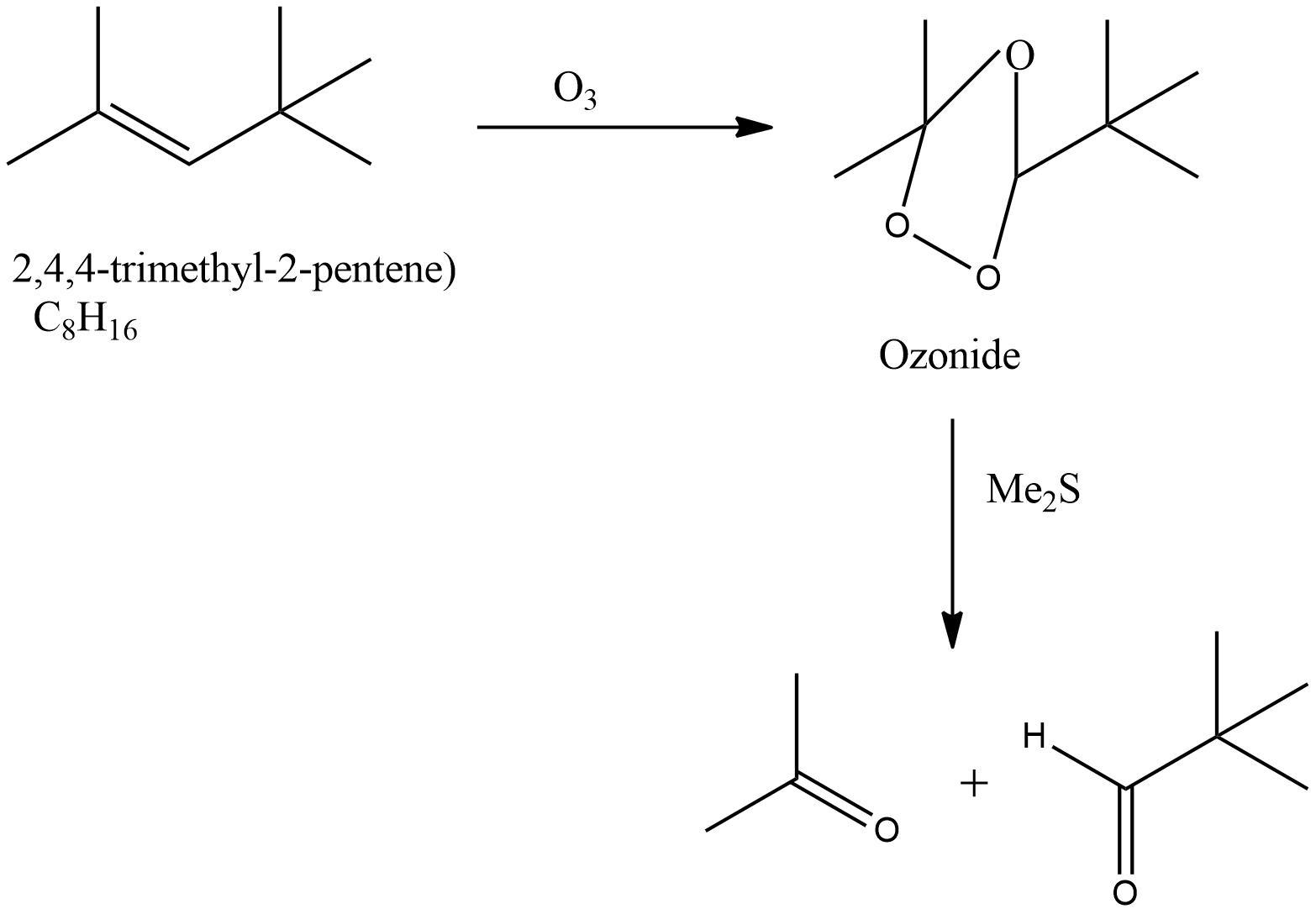
An alkene with the molecular formula C8H16 undergoes ozonolysis to yield a mixture of (CH3)2C=O and (CH3)3CCHO. The alkene is:
aalyn [17]

Answer:

2,4,4-trimethyl-2-pentene yields mixture of (CH_{3})_{2}C=O and (CH_{3})_{3}CHO

Explanation:

In ozonolysis (hydrolysis step involve a reducing agent such as Zn, Me_{2}S etc.), a pi bond is broken to form ketone/aldehyde.

Ketone is formed from di-substituted side of double bond and aldehyde is formed from mono-substituted side of double bond.

Ozoznolysis involves two consecutive steps : (1) formation of ozonide, (2) hydrolysis of ozonide.

Hydrolysis can be done with/without using reducing agent. Carboxylic acid/carbon dioxide/ketone is produced when hydrolysis is done without using reducing agent.

Here, 2,4,4-trimethyl-2-pentene yields mixture of (CH_{3})_{2}C=O and (CH_{3})_{3}CHO

Reaction steps are shown below.

8 0
2 years ago
One of the most important chemical reactions is the Haber process, in which N2 and H2 are converted to ammonia which is used in
Lera25 [3.4K]

Answer:

c) 22

Explanation:

Let's consider the following balanced equation.

N₂(g) + 3 H₂(g) ----> 2 NH₃(l)

According to the balanced equation, 34.0 g of NH₃ are produced by 1 mol of N₂. For 170 g of NH₃:

170gNH_{3}.\frac{1molN_{2}}{34.0gNH_{3}} =5.00molN_{2}

According to the balanced equation, 34.0 g of NH₃ are produced by 3 moles of H₂. For 170 g of NH₃:

170gNH_{3}.\frac{3molH_{2}}{34.0gNH_{3}} =15.0molH_{2}

The total gaseous moles before the reaction were 5.00 mol + 15.0 mol = 20.0 mol.

We can calculate the pressure (P) using the ideal gas equation.

P.V = n.R.T

where

V is the volume (50.0 L)

n is the number of moles (20.0 mol)

R is the ideal gas constant (0.08206atm.L/mol.K)

T is the absolute temperature (400.0 + 273.15 = 673.2K)

P=\frac{n.R.T}{V} =\frac{20.0mol\times (0.08206atm.L/mol.K)\times 673.2K ) }{50.0L} =22.0atm

7 0
2 years ago
Eddie is going to do an experiment to find out which freezes more easily—distilled water or salt water. In what order should he
mel-nik [20]

1. Make a Prediction

2. Fill both beakers with water

3. Dissolve salt in one of the beakers

4. Place both in the freezer and observe

5. Write a report

(Always make the prediction first! That's a hypothesis!)

4 0
2 years ago
Read 2 more answers
Other questions:
  • Physical properties of glass bottle
    9·1 answer
  • How many molecules of water are needed to completely hydrolyze a polymer that is 11 monomers long?
    9·1 answer
  • A solid mixture weighs 0.6813 g. It contains gallium bromide (GaBr3) and other inert impurities. When the solid mixture was diss
    9·2 answers
  • The bond enthalpy of the C―N bond in the amide group of proteins can be treated as an average of C―N (276 kJ/mol) and C═N (615 k
    14·1 answer
  • A student prepared an unknown sample by making a dilute solution of the unknown sample. The dilute sample was prepared by adding
    12·1 answer
  • What we call "tin cans" are really iron cans coated with a thin layer of tin. The anode is a bar of tin and the cathode is the i
    13·1 answer
  • When 0.40 mol Al is mixed with 0.40 mol Br2, the following reaction occurs: 2Al(s) + 3Br2(l) → 2AlBr3(s) Identify the limiting r
    13·1 answer
  • What mass of carbon monoxide is produced when 1.50 moles of oxygen react completely in the following equation? 2C + O₂ → 2CO
    9·1 answer
  • How much energy is required to vaporize 1.5 KG of aluminum
    8·1 answer
  • Which statements describe lattice energy?
    7·1 answer
Add answer
Login
Not registered? Fast signup
Signup
Login Signup
Ask question!