answer.
Ask question
Login Signup
Ask question
All categories
  • English
  • Mathematics
  • Social Studies
  • Business
  • History
  • Health
  • Geography
  • Biology
  • Physics
  • Chemistry
  • Computers and Technology
  • Arts
  • World Languages
  • Spanish
  • French
  • German
  • Advanced Placement (AP)
  • SAT
  • Medicine
  • Law
  • Engineering
Nikitich [7]
2 years ago
8

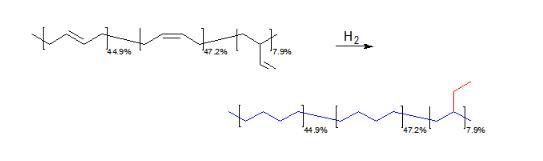
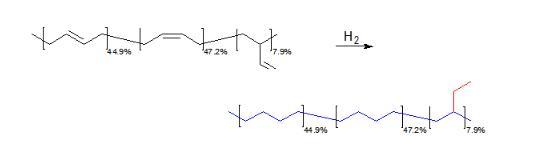
Hydrogenation of poly(butadiene) converts both cis and trans isomers to the same linear structure, and vinyl groups to ethyl bra

nches. A poly(butadiene) sample of molecular weight 168,000 g/mol was found by infrared spectroscopy to contain double bonds consisting of 47.2% cis, 44.9% trans, and 7.9% vinyl.
After hydrogenation, what is the average number of backbone carbon atoms between ethyl side chains?

Chemistry
1 answer:
Alexeev081 [22]2 years ago
7 0

Answer:

The average number is given as 48.6

Explanation:

From the question we see that the

                    Percentage of cis = 47.2%

                    Percentage of trans = 44.9%

                    Percentage of  vinyl = 7.9%

The chemical  reaction equation for the hydrogenation of polybutadiene is shown on the first uploaded image

    To obtain the average number of  backbone carbon between the ethyl side chains ,we divide the total number of carbon on the backbone by the total number of ethyl group

              That is

                             = (44.9% × 4 + 47.2% ×4 + 7.9% × 2) ÷(7.9% × 1)

                             = (384.2%/7.7%)

                              = 48.6

Note :  The percentage will cancel out

You might be interested in
The number of sp2 hybrid orbitals on the carbon atom in CO32– is
Vladimir79 [104]
The number of sp2 hybrid orbitals on the carbon atom in CO32– is 3. Because hybrids = combination of 2 different types of orbitals
sp2 = 1/3 s character + 2/3 p character
7 0
2 years ago
Read 2 more answers
2 physical changes that happen in aquaponics
maks197457 [2]

Answer:

The physical and chemical change that occurs in the aquaponics are given below.

Explanation:

The plants and animals grow in size and decrease the mass of plant due to eating by the fishes is a physical changes which occurs in aquaponics. The sunlight has a heat energy which is absorb by the plants present in aquaponics which is a type of endothermic reaction. In aquaponics, the ammonia present in water is converted into nitrates which is used by the plants as a nutrients. When the mass is converted into energy, it increases the temperature of the ecosystem and also the earth surface. For example, if a wood is burn, it change into heat energy which increases the temperature and cause the global warming on the earth surface.

3 0
2 years ago
A sixth grade teacher takes students on a field trip to the beach. One student finds several pebbles that have a rounded shape a
Fittoniya [83]

Answer:

C: The shape of the pebbles is a result of weathering and deposition

Explanation:

For the several pebbles to have a rounded shape and smooth to the touch, it will undergo weathering and deposition. This is because weathering involves breaking down of rocks and creating new sediments. This weathering could be either chemical weathering or physical weathering where Chemical weathering is the decomposition of rocks which are caused by chemical reactions and which result in formation of new compound while physical weathering is the breakdown of rocks into smaller pieces. On the other hand, deposition occurs when the agents of erosion such as wind or water deposit sediments from one spot to another which in turn changes the shape of the land.

Thus, the shape of the pebbles are as a result weathering of the parent rocks and from deposition.

7 0
2 years ago
Which correctly lists the three methods of heat transfer?
dalvyx [7]
Answer: conduction, convection, radiation

explanation: heats transferred using these three methods and all of them are used in different ways, convection is heat through solids, conduction being used as liquid/gas, radiation being used as electromagnetic waves.

hope this helped!!
7 0
2 years ago
Read 2 more answers
20 PTS!!! What is the volume of a gas at 90.0°C, if it occupies 1.41 L at 170°C?
Margarita [4]

Answer:

1.72 L

Explanation:

Initial Temperature of the gas T =90°+273= 363 K

Initial Volume of the gas V1= 1.41 L

Final temperature of the gas T2= 170°c +273= 443 K

Final volume of the gas V2= ????

Using Charles law;

V1/T1 = V2/T2

V1T2= V2T1

V2= V1T2/T1

V2= 1.41×443/363

V2= 1.72 L

3 0
2 years ago
Read 2 more answers
Other questions:
  • How many grams are in 3.3 moles of potassium sulfide , k2s
    15·1 answer
  • What is the mass in grams of 6.022×10²³ atoms of mass 16.00 amu?
    10·1 answer
  • Vinegar is an aqueous solution of acetic acid, ch3cooh. a 5.00 ml sample of a particular vinegar requires 26.90 ml of 0.175 m na
    13·1 answer
  • In the manufacture of paper, logs are cut into small chips, which are stirred into an alkaline solution that dissolves several o
    8·2 answers
  • Explain how the lines seen in the spectroscope relate to the position of electrons in the metal atom?
    15·1 answer
  • Boris is interested in conducting his first "real" scientific research. However, he is a bit overwhelmed with all of the possibl
    11·1 answer
  • A mixture of gases containing 0.20 mol of SO2 and 0.20 mol of O2 in a 4.0 L flask reacts to form SO3. If the temperature is 25ºC
    11·1 answer
  • 400 mL of hydrogen are collected over water at 18 C and a total pressure of 740 mm of mercury. (Vapor pressure of H2O at 18 C=15
    8·1 answer
  • When collecting temperature as a function of time for the reaction of KOH with HCL, which time is most significant
    8·1 answer
  • An organelle that is not found in this illustration of a cell would be
    14·2 answers
Add answer
Login
Not registered? Fast signup
Signup
Login Signup
Ask question!