answer.
Ask question
Login Signup
Ask question
All categories
  • English
  • Mathematics
  • Social Studies
  • Business
  • History
  • Health
  • Geography
  • Biology
  • Physics
  • Chemistry
  • Computers and Technology
  • Arts
  • World Languages
  • Spanish
  • French
  • German
  • Advanced Placement (AP)
  • SAT
  • Medicine
  • Law
  • Engineering
natima [27]
2 years ago
11

Complete and balance the molecular equation for the reaction of aqueous sodium carbonate, Na 2 CO 3 Na2CO3 , and aqueous nickel(

II) chloride, NiCl 2 NiCl2 . Include physical states. molecular equation:
Na 2 CO 3 ( aq ) + NiCl 2 ( aq ) ⟶ 2 NaCl ( aq ) + NiCO 3 ( s ) Na2CO3(aq)+NiCl2(aq)⟶2NaCl(aq)+NiCO3(s) Enter the balanced net ionic equation for this reaction. Include physical states. net ionic equation:
Chemistry
1 answer:
antoniya [11.8K]2 years ago
3 0

<u>Answer:</u> The net ionic equation is written below.

<u>Explanation:</u>

Net ionic equation of any reaction does not include any spectator ions.

Spectator ions are defined as the ions which does not get involved in a chemical equation. They are found on both the sides of the chemical reaction when it is present in ionic form.

The chemical equation for the reaction of sodium carbonate and nickel (II) chloride is given as:

Na_2CO_3(aq.)+NiCl_2(aq.)\rightarrow 2NaCl(aq.)+NiCO_3(s)

Ionic form of the above equation follows:

2Na^{+}(aq.)+CO_3^{2-}(aq.)+Ni^{2+}(aq.)+2Cl^{-}(aq.)\rightarrow NiCO_3(s)+2Na^+(aq.)+2Cl^-(aq.)

As, sodium and chloride ions are present on both the sides of the reaction. Thus, it will not be present in the net ionic equation and are spectator ions.

The net ionic equation for the above reaction follows:

Ni^{2+}(aq.)+CO_3^{2-}(aq.)\rightarrow NiCO_3(s)

Hence, the net ionic equation is written above.

You might be interested in
The chlorination of methane occurs in a number of steps that results in the formation of chloromethane and hydrogen chloride. Th
kenny6666 [7]

Answer:

Total pressure = 0,806 atm

Partial pressure of CH₄: 0,037 atm

Partial pressure of Cl₂: 0,396 atm

Partial pressure of CH₃Cl: 0,125 atm

Partial pressure of HCl: 0,125 atm

Partial pressure of Cl⁻: 0,125 atm

Explanation:

For the reaction:

2CH₄(g)+3Cl₂(g)⟶2CH₃Cl(g)+2HCl(g)+2Cl⁻(g)

295 mL≡ 0,295L of methane at STP are:

n = PV/RT

P = 1 atm; V = 0,295L; R = 0,082atmL/molK; T = 273K.

moles of methane: 0,0132 moles

For 725 mL of chlorine ≡ 0,725L

moles of chlorine at STP are: ≡ 0,0324 moles

For a complete reaction of 0,0132 moles of CH₄:

0,0132 mol CH₄× \frac{3molCl_{2}}{2 molCH_{4}} = <em>0,0198 moles</em>

The reaction reaches 77%, moles of Cl₂ that react are: 0,0198×77% = 0,0153 mol

As you have 0,0324 moles of Cl₂, moles that will not react are:

0,0324 - 0,0153 = <em>0,0171 mol Cl₂</em>

As the reaction reaches 77% completion, moles of CH₄ that react are:

0,0132×77% =<em> 0,0102 moles of CH₄ And the moles that don't react are </em><em>0,00300 mol</em>

Thus, moles of each compound are:

0,0102 moles of CH₄×\frac{3Cl_{2}}{2 molCH_{4}}= <em>0,0153 mol  + 0,0171 mol = 0,0324 mol Cl₂</em>

0,0102 moles of CH₄×\frac{2CH_{3}Cl}{2 molCH_{4}}= <em>0,0102 mol CH₄</em>

0,0102 moles of CH₄×\frac{2HCl}{2 molCH_{4}}= <em>0,0102 mol HCl</em>

0,0102 moles of CH₄×\frac{2Cl^{-}}{2 molCH_{4}}= <em>0,0102 mol Cl⁻</em>

Total pressure using:

P = nRT/V

Where: n = 0,0102mol×3+0,0324mol + 0,0030mol = 0,0660mol; R = 0,082 atmL/molK; T = 298K; V = 2L

Total pressure = 0,806 atm

Partial pressure of CH₄: 0,037 atm

Partial pressure of Cl₂: 0,396 atm

Partial pressure of CH₃Cl: 0,125 atm

Partial pressure of HCl: 0,125 atm

Partial pressure of Cl⁻: 0,125 atm

<em>-To obtain partial pressure you change the moles for each compound-</em>

<em />

I hope it helps!

5 0
2 years ago
A line in the Brackett series of hydrogen has a wavelength of 1945 nm. From what state did the electron originate?
fiasKO [112]
Rydberg Eqn is given as:
 1/λ = R [1/n1^2 - 1/n2^2] 
<span>Where λ is the wavelength of the light; 2626 nm = 2.626×10^-6 m </span>
<span>R is the Rydberg constant: R = 1.09737×10^7 m-1 </span>
<span>From Brackett series n1 = 4 </span>
<span>Hence 1/(2.626×10^-6 ) = 1.09737× 10^7 [1/4^2 – 1/n2^2] </span>
<span>Some rearranging and collecting up terms: </span>
<span>1 = (2.626×10^-6)×(1.09737× 10^7)[1/16 -1/n2^2] </span>
<span>1= 28.82[1/16 – 1/n2^2] </span>
<span>28.82/n^2 = 1.8011 – 1 = 0.8011 </span>
<span>n^2 = 28.82/0.8011 = 35.98 </span>
<span>n = √(35.98) = 6</span>
4 0
2 years ago
Read 2 more answers
IF YOU GIVE A LINK OR DON"T ACTUALLY ANSWER THIS QUESTION RIGHT JUST FOR POINTS I WILL REPORT YOUR ANSWER AND YOU
AVprozaik [17]

Answer:

No, the puddle was formed because of the sun, because if there was snow and it rained then it would have turned slippery or icy

8 0
2 years ago
Read 2 more answers
Element stand in columns aligned by their
Maru [420]
Groups is the answer
7 0
2 years ago
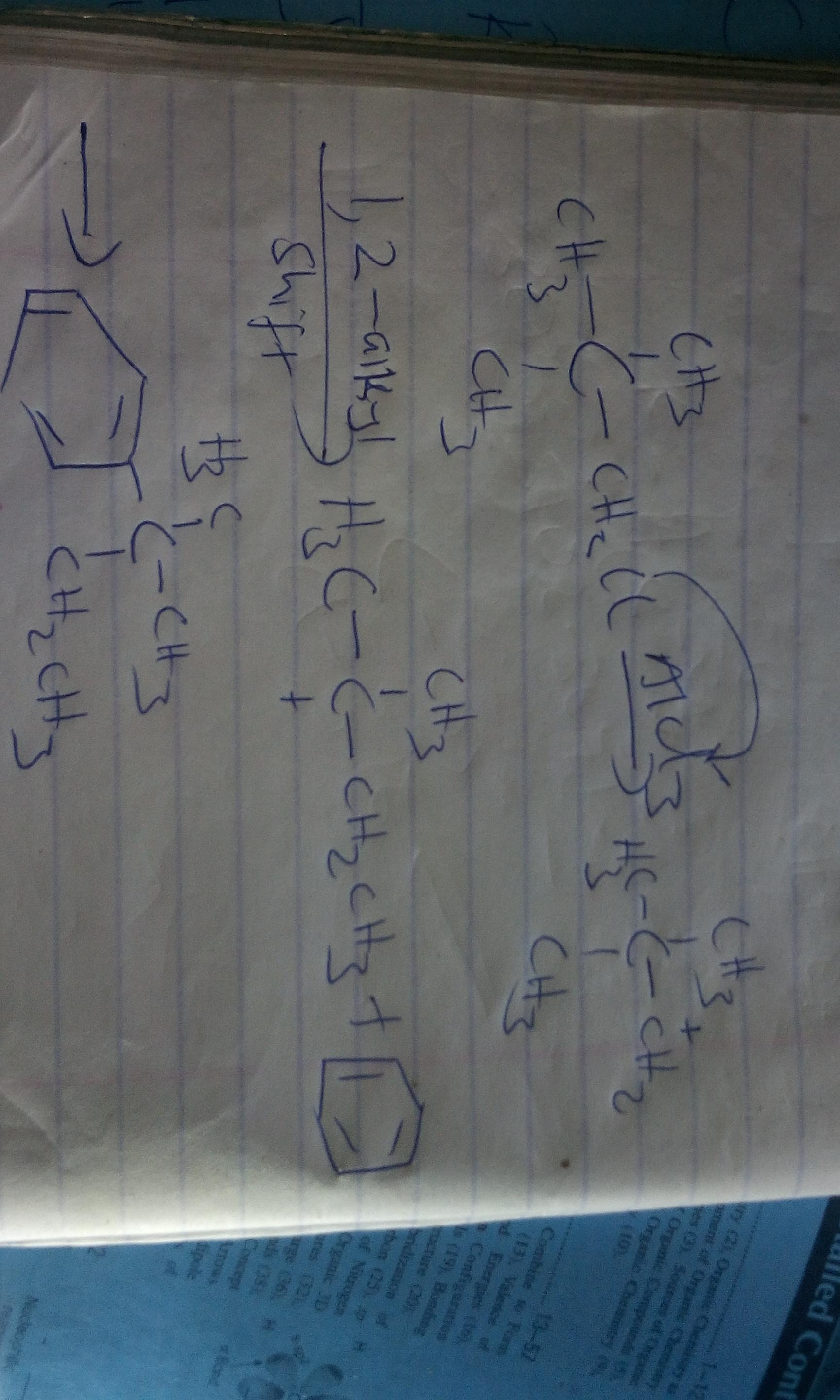
The reaction of benzene with (CH3)3CCH2Cl in the presence of anhydrous aluminum chloride produces principally which of these?
Sedaia [141]

Answer:

See explanation and image attached

Explanation:

When the carbocation is formed by the action of AlCl3 on the (CH3)3CCH2Cl, a primary carbocation is formed. The formation of the carbonation is followed by a 1,2-alkyl shift to give a tertiary carbocation which subsequently adds to the benzene ring as shown in the image attached to this answer.

6 0
2 years ago
Other questions:
  • What is the mass in grams of 6.022×10²³ atoms of mass 16.00 amu?
    10·1 answer
  • Silver (ag) has a molar mass of 107.8682 g, nitrogen has a molar mass of 14.0067 g, and oxygen has a molar mass of 15.9994 g. wh
    13·2 answers
  • Suppose that 2.5 mmol n2 (g) occupies 42 cm3 at 300 k and expands isothermally to 600 cm3. calculate δgm in kj/mol for the proc
    14·1 answer
  • Two liquids are known to be miscible. They are placed in a beaker and shaken. Which of the following describes what will happen?
    5·2 answers
  • Why is liquid mercury a good electrical conductor in terms of atomic structure?
    8·2 answers
  • Which of the following reactions will not occur as written? Which of the following reactions will not occur as written? Sn (s) +
    8·2 answers
  • The delocalized π system in benzene is formed by a cyclic overlap of 6 ________ orbitals.
    8·1 answer
  • Vinegar is a solution of acetic acid (the solute) in water (the solvent) with a solution density of 1010 g/L. If vinegar is 0.80
    7·1 answer
  • Some versions of the periodic table show hydrogen at the top of Group 1A(1) and at the top of Group 7A(17). What properties of h
    10·1 answer
  • When the following equation is balanced, the coefficients are __________. Al(NO3)3 + Na2S → Al2S3 + Na(NO3)
    11·1 answer
Add answer
Login
Not registered? Fast signup
Signup
Login Signup
Ask question!