answer.
Ask question
Login Signup
Ask question
All categories
  • English
  • Mathematics
  • Social Studies
  • Business
  • History
  • Health
  • Geography
  • Biology
  • Physics
  • Chemistry
  • Computers and Technology
  • Arts
  • World Languages
  • Spanish
  • French
  • German
  • Advanced Placement (AP)
  • SAT
  • Medicine
  • Law
  • Engineering
REY [17]
2 years ago
3

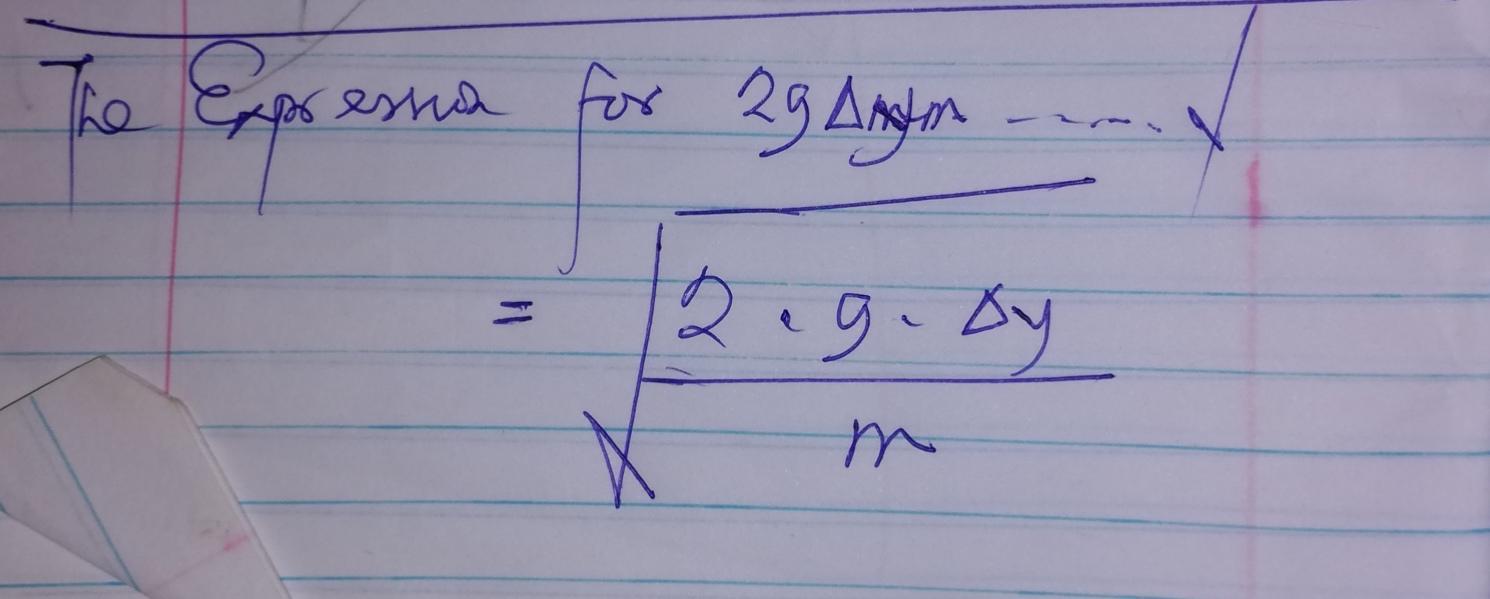
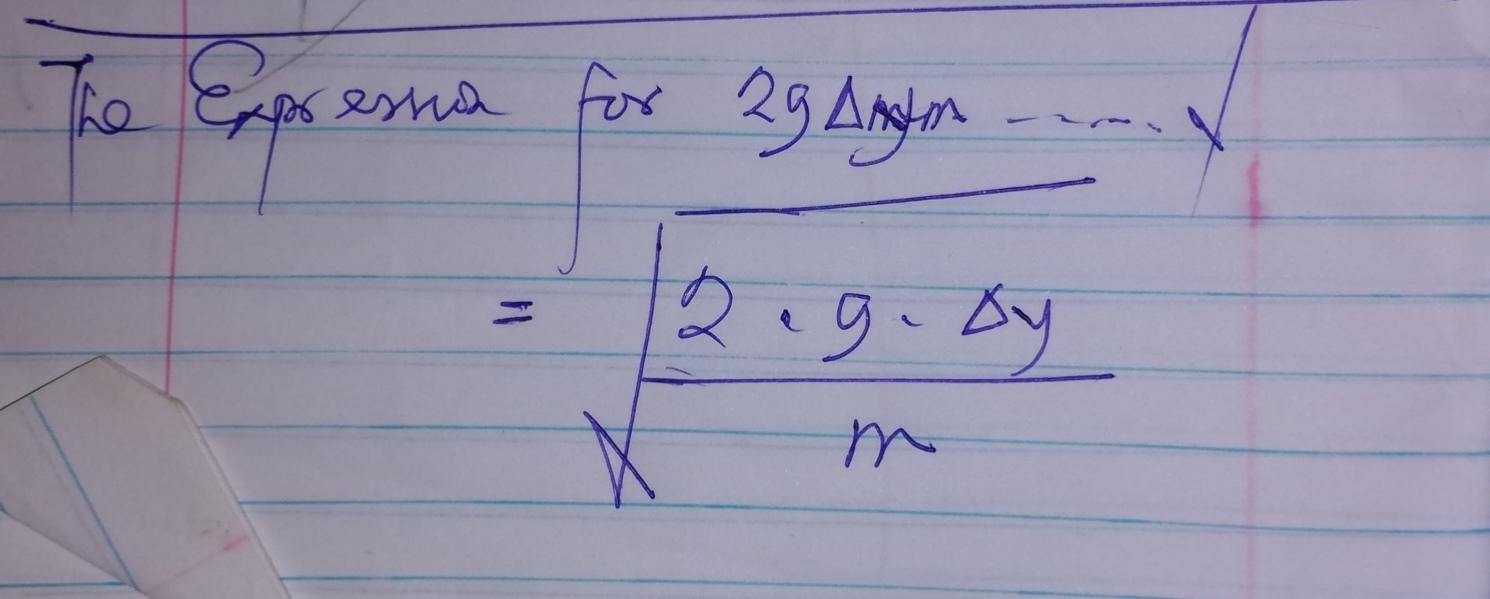
Enter the expression 2gΔym−−−−√, where Δ is the uppercase Greek letter Delta. Note: the term Δy represents a single variable, no

t two separate variables multiplied together.

Chemistry
1 answer:
Hatshy [7]2 years ago
5 0

Answer:

Square root { 2g * Delta-y * /m}

Explanation:

it is as shown in the attached file.

You might be interested in
Q 11.20: What is the product of the reaction between t-BuCl and MeOH? A : t-BuOH B : MeOCl C : t-BuOMe D : (CH3)2CCH2
Sholpan [36]

Answer:

C : t-BuOMe

Explanation:

The tert -butanol is a tertiary alcohol and when chloride ion attacks the carbocation, it forms t-BuCl.

The reaction of tert-butyl chloride or t-BuCl ((CH3)3C−Cl) with methanol and MeOH (CH3−OH) gives the product tert-Butyl methyl ether or t-BuOMe (CH3)3C−OCH3:

                   (CH3)3C−Cl + CH3−OH => (CH3)3C−OCH3 + HCl

Hence, the correct asnwer is C : t-BuOMe

5 0
2 years ago
A 50.0 mL sample of 0.600 M calcium hydroxide is mixed with 50.0 mL sample of 0.600 M hydrobromic acid in a Styrofoam cup. The t
TEA [102]

Explanation:

The reaction equation will be as follows.

     Ca(OH)_{2}(aq) + 2HBr(aq) \rightarrow CaBr_{2}(aq) + 2H_{2}O(l)

So, according to this equation, 1 mole Ca(OH)_{2} = 2 mol HBr = 1 mol CaBr_{2}

Therefore, calculate the number of moles of calcium hydroxide as follows.

     No. of moles of Ca(OH)_{2} = V \times Molarity

                                    = 50 \times 0.6

                                    = 30 mmol

Similarly, calculate the number of moles of HBr as follows.

        No. of moles of HBr = M \times V

                                          = 50 \times 0.6

                                          = 30 mmol

This means that the limiting reactant is HBr.

So, no. of moles of CaBr_{2} = 30 \times \frac{1}{2}

                                                     = 15 mmol

Hence, calculate the amount of heat released as follows.

                Heat released in the reaction(q) = m \times s \times \Delta T

as,    m = mass of solution

and,             Density = \frac{mass}{volume}

or,                  mass = Density × Volume

                               = 1.08 g/ml \times (50 + 50) ml

                               = 108 g

where,    s = specific heat of solution = 4.18 j/g.k

and,        change in temperature \Delta T = (26 - 23)^{o}C

                                                                 = 3
^{o}C

Hence, the heat released will be as follows.

                   q = m \times s \times \Delta T

                        q = 108 \times 4.18 \times 3^{o}C

                           = 1354.32 joule

or,                        = 1.354 kJ       (as 1 kJ = 1000 J)    

Also,          \Delta H_{rxn} = \frac{-q}{n}

                              = \frac{-1.354}{15 \times 10^{-3}}

                              = -90.267 kJ/mol

Thus, we can conclude that the enthalpy change for the given reaction is -90.267 kJ/mol.
6 0
2 years ago
The enthalpy of formation of water is –285.8 kJ/mol. What can be inferred from this statement?
LiRa [457]
A negative formation enthalpy means that the reaction is exothermic, or that heat is released during the process.
(C,)
4 0
2 years ago
Read 2 more answers
The volume of a gas is 7.15 l measured at 1.00 atm. what is the pressure of the gas in mmhg if the volume is changed to 9.25 l?
IRINA_888 [86]
1 atm=7.15/9.25
Volume increase comes from reduced pressure
3 0
2 years ago
Which of the following statements concerning hydrocarbons is/are correct?
Alona [7]

Answer:

1.  Saturated hydrocarbons may be cyclic or acyclic molecules.

2.  An unsaturated hydrocarbon molecule contains at least one double bond.

Explanation:

Hello,

In this case, hydrocarbons are defined as the simplest organic compounds containing both carbon and hydrogen only, for that reason we can immediately discard the third statement as ethylenediamine is classified as an amine (organic chain containing NH groups).

Next, as saturated hydrocarbons only show single carbon-to-carbon bonds and carbon-to-hydrogen bonds, they may be cyclic (ring-like-shaped) or acyclic (not forming rings), so first statement is true

Finally, since we can find saturated hydrocarbons which have single carbon-to-carbon and carbon-to-hydrogen bonds only and unsaturated hydrocarbons which could have double or triple bonds between carbons and carbon-to-hydrogen bonds, the presence of at least one double bond makes the hydrocarbon unsaturated.

Therefore, first and second statements are correct.

Best regards.

6 0
2 years ago
Other questions:
  • The transition metal with the smallest atomic mass
    9·1 answer
  • As Jesse's hybrid accelerates to pass a car on the highway, he notices that his gas mileage drops from 40 miles per gallon to 15
    15·2 answers
  • A 30.0 g sample of a metal was heated in a hot water bath to 80°c. it was then quickly transferred to a coffee-cup calorimeter.
    15·2 answers
  • Driving cars lowers the pH of the oceans by _______.
    5·2 answers
  • Which of the following statements concerning the attraction of ions to polar molecules is/are CORRECT? 1. The force of attractio
    14·1 answer
  • An increase in the ratio of insulin to glucagon will increase the activity of which of the following enzymes (+ indicates activi
    8·1 answer
  • An unknown element X has the following isotopes: ⁵²X (89.00% abundant), ⁴⁹X (8.00% abundant), ⁵⁰X (3.00% abundant). What is the
    13·1 answer
  • A piece of silver releases 202.8 J of heat while cooling 65.0 °C. What is the mass of the sample? Silver has a specific heat of
    10·1 answer
  • Addition of an excess of lead (II) nitrate to a 50.0mL solution of magnesium chloride caused a formation of 7.35g of lead (II) c
    10·1 answer
  • Evaluate the following conversion. Will the answer be correct? Explain. If incorrect, how could you adjust one of the factors to
    13·1 answer
Add answer
Login
Not registered? Fast signup
Signup
Login Signup
Ask question!