answer.
Ask question
Login Signup
Ask question
All categories
  • English
  • Mathematics
  • Social Studies
  • Business
  • History
  • Health
  • Geography
  • Biology
  • Physics
  • Chemistry
  • Computers and Technology
  • Arts
  • World Languages
  • Spanish
  • French
  • German
  • Advanced Placement (AP)
  • SAT
  • Medicine
  • Law
  • Engineering
vichka [17]
2 years ago
15

After fracture, the total length was 47.42 mm and the diameter was 18.35 mm. Plot the engineering stress strain curve and calcul

ate (a) the 0.2% offset yield strength; (b) the tensile strength; (c) the modulus of elasticity, using a linear fit to the appropriate data; (d) the % elongation; (e) the % reduction in area;

Physics
1 answer:
Fittoniya [83]2 years ago
6 0

Answer:

Part a: <em>The value of yield strength at 0.2% offset is obtained from the engineering stress-strain curve which is given as 274 MPa.</em>

Part b: <em>The value of tensile strength  is obtained from the engineering stress-strain curve which is given as 417 MPa</em>

Part c: <em>The value of Young's modulus at given point is 172 GPa.</em>

Part d: <em>The percentage elongation is 18.55%.</em>

Part e: The percentage reduction in area is 15.81%

Explanation:

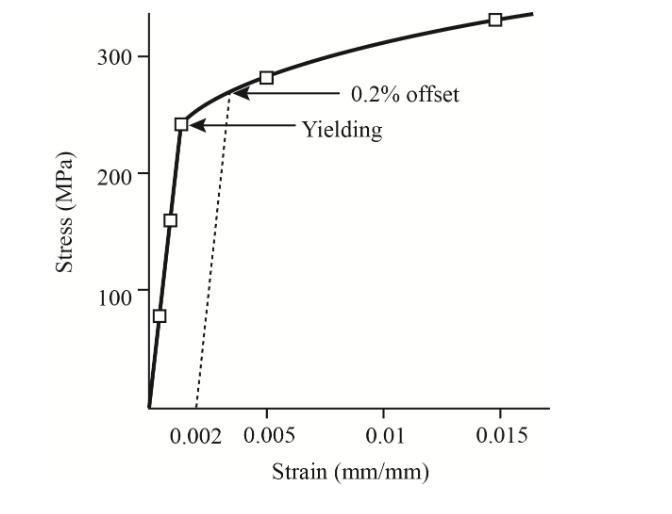
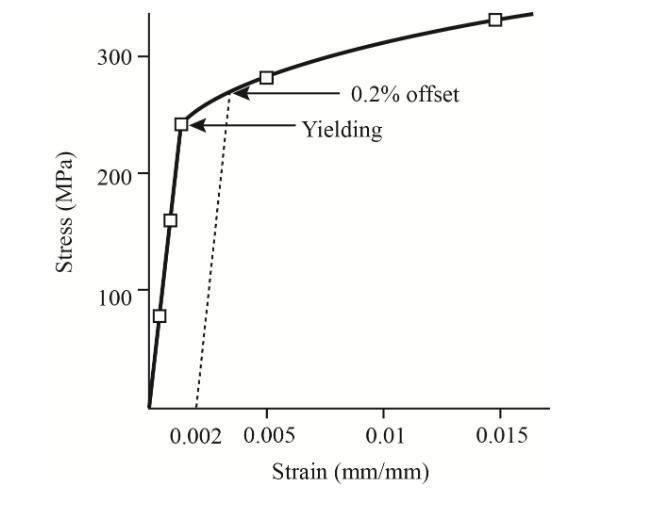
From the complete question the data is provided for various Loads in ductile testing machine for a sample of d0=20 mm and l0=40mm. The plot is drawn between stress and strain whose values are calculated using following formulae. The corresponding values are attached with the solution.

The engineering-stress is given as

\sigma=\frac{F}{A}\\\sigma=\frac{F}{\pi \frac{d_0^2}{4}}\\\sigma=\frac{F}{\pi \frac{(20 \times 10^-3)^2}{4}}\\\sigma=\frac{F}{3.14 \times 10^{-4}}    

Here F are different values of the load

Now Strain is given as

\epsilon=\frac{l-l_0}{l_0}\\\epsilon=\frac{\Delta l}{40}\\

So the curve is plotted and is attached.

<h2>Part a</h2>

<em>The value of yield strength at 0.2% offset is obtained from the engineering stress-strain curve which is given as 274 MPa.</em>

<h2>Part b</h2>

<em>The value of tensile strength  is obtained from the engineering stress-strain curve which is given as 417 MPa</em>

<h2>Part c</h2>

Young's Modulus is given as

E=\frac{\sigma}{\epsilon}\\E=\frac{238 /times 10^6}{0.00138}\\E=172,000 MPa\\E=172 GPa

<em>The value of Young's modulus at given point is 172 GPa.</em>

<h2>Part d</h2>

The percentage elongation is given as

Elongation=\frac{l_f-l_0}{l_0} \times 100\\Elongation=\frac{47.42-40}{40}\times 100\\Elongation=18.55 \%\\

So the percentage elongation is 18.55%

<h2>Part e</h2>

The reduction in area is given as

Reduction=\frac{A_0-A_n}{A_0} \times 100\\Reduction=\frac{\pi \frac{d_0^2}{4}-\pi \frac{d_n^2}{4}}{\pi \frac{d_0^2}{4}}\times 100\\Reduction=\frac{{d_0^2}-{d_n^2}}{{d_0^2}} \times 100\\Reduction=\frac{{20^2}-{18.35^2}}{{20^2}} \times 100\\Reduction=15.81\%

So the reduction in area is 15.81%

You might be interested in
There are two different size spherical paintballs and the smaller one has a diameter of 5 cm and the larger one is 9 cm in diame
slavikrds [6]

Answer:

145.8 cm³ of paint

Explanation:

d₁ = Smaller diameter paintball = 5 cm

d₂ = Larger diameter paintball = 9 cm

V₂ = Volume of larger diameter paintball

Volume of smaller diameter paintball

V_1=\frac{4}{3}\pi r_1^3\\\Rightarrow V_1=\frac{4}{3}\pi \left(\frac{d_1}{2}\right)^3\\\Rightarrow V_1=\frac{4}{24}\pi d_1^3

Similarly

V_2=\frac{4}{24}\pi d_2^3

Dividing the above two equations, we get

\frac{V_1}{V_2}=\frac{d_1^3}{d_2^3}\\\Rightarrow V_2=\frac{V_1}{\frac{d_1^3}{d_2^3}}\\\Rightarrow V_2=\frac{28}{\frac{125}{729}}\\\Rightarrow V_2=163.296\ cm^3

∴ The larger one hold 163.296 cm³ of paint

5 0
2 years ago
A 1.0 kg object moving at 4.5 m/s has a wavelength of:
Lisa [10]
By wave particle  duality.

Wavelength , λ = h / mv

where h = Planck's constant = 6.63 * 10⁻³⁴ Js,  m = mass in kg,  v = velocity in m/s.
m = 1kg,  v = 4.5 m/s

λ = h / mv

λ = (6.63 * 10⁻³⁴) /(1*4.5)

λ ≈  1.473 * 10⁻³⁴  m

Option D.
7 0
2 years ago
Joe learned that decaying plants produce an acidic environment. Joe wants to know if pill bugs prefer acidic environments instea
Anna11 [10]
Yessgshhshe the answer
6 0
2 years ago
Read 2 more answers
Two objects, X and Y, move toward one another and eventually collide. Object X has a mass of 2M and is moving at a speed of 2v0
Sergeu [11.5K]

Answer:

c. The force exerted by X on Y is F to the right, and the force exerted by Yon X is F to the left.

Explanation:

If we take both objects as one single system, during the collision, assuming no external forces acting, the only forces present are the one that object X exerts on object Y, and the force that object Y does on object X.

These two forces, according to Newton's 3rd Law, form an action-reaction pair, and consequently, are equal in magnitude, acting in opposite directions.

As the object X is moving to the right, the force that produces, (F), is in the same direction (on Y), while for object Y, moving to the left, the force that produces (F also in magnitude) is in the same direction (on X), so the right answer is c.

The effect of the forces is different, due to masses are different, according Newton's 2nd Law.

6 0
2 years ago
Consider an object with s=12cm that produces an image with s′=15cm. Note that whenever you are working with a physical object, t
Leni [432]

A. 6.67 cm

The focal length of the lens can be found by using the lens equation:

\frac{1}{f}=\frac{1}{s}+\frac{1}{s'}

where we have

f = focal length

s = 12 cm is the distance of the object from the lens

s' = 15 cm is the distance of the image from the lens

Solving the equation for f, we find

\frac{1}{f}=\frac{1}{12 cm}+\frac{1}{15 cm}=0.15 cm^{-1}\\f=\frac{1}{0.15 cm^{-1}}=6.67 cm

B. Converging

According to sign convention for lenses, we have:

- Converging (convex) lenses have focal length with positive sign

- Diverging (concave) lenses have focal length with negative sign

In this case, the focal length of the lens is positive, so the lens is a converging lens.

C. -1.25

The magnification of the lens is given by

M=-\frac{s'}{s}

where

s' = 15 cm is the distance of the image from the lens

s = 12 cm is the distance of the object from the lens

Substituting into the equation, we find

M=-\frac{15 cm}{12 cm}=-1.25

D. Real and inverted

The magnification equation can be also rewritten as

M=\frac{y'}{y}

where

y' is the size of the image

y is the size of the object

Re-arranging it, we have

y'=My

Since in this case M is negative, it means that y' has opposite sign compared to y: this means that the image is inverted.

Also, the sign of s' tells us if the image is real of virtual. In fact:

- s' is positive: image is real

- s' is negative: image is virtual

In this case, s' is positive, so the image is real.

E. Virtual

In this case, the magnification is 5/9, so we have

M=\frac{5}{9}=-\frac{s'}{s}

which can be rewritten as

s'=-M s = -\frac{5}{9}s

which means that s' has opposite sign than s: therefore, the image is virtual.

F. 12.0 cm

From the magnification equation, we can write

s'=-Ms

and then we can substitute it into the lens equation:

\frac{1}{f}=\frac{1}{s}+\frac{1}{s'}\\\frac{1}{f}=\frac{1}{s}+\frac{1}{-Ms}

and we can solve for s:

\frac{1}{f}=\frac{M-1}{Ms}\\f=\frac{Ms}{M-1}\\s=\frac{f(M-1)}{M}=\frac{(-15 cm)(\frac{5}{9}-1}{\frac{5}{9}}=12.0 cm

G. -6.67 cm

Now the image distance can be directly found by using again the magnification equation:

s'=-Ms=-\frac{5}{9}(12.0 cm)=-6.67 cm

And the sign of s' (negative) also tells us that the image is virtual.

H. -24.0 cm

In this case, the image is twice as tall as the object, so the magnification is

M = 2

and the distance of the image from the lens is

s' = -24 cm

The problem is asking us for the image distance: however, this is already given by the problem,

s' = -24 cm

so, this is the answer. And the fact that its sign is negative tells us that the image is virtual.
3 0
2 years ago
Other questions:
  • Assuming the same current is running through two separate coils, why is it easier to thrust a magnet into a wire coil with one l
    6·2 answers
  • A hiker walks 200m west and then walks 100m north. What is the magnitude and direction of her resulting displacement?
    7·2 answers
  • Find the moments Mx and My and the center of mass of the system, assuming that the particles have equal mass m.
    7·1 answer
  • What is the acceleration of a ball rolling down a ramp that starts from rest and travels 0.9 m in 3 s?
    15·1 answer
  • A rock, which weighs 1400 n in air, has an apparent weight of 900 n when submerged in fresh water (998 kg/m3). the volume of the
    14·1 answer
  • Two infinite parallel surfaces carry uniform charge densities of 0.20 nC/m2 and -0.60 nC/m2. What is the magnitude of the electr
    6·1 answer
  • As the driver steps on the gas pedal, a car of mass 1 140 kg accelerates from rest. During the first few seconds of motion, the
    14·1 answer
  • Calculate the orbital period of a dwarf planet found to have a semimajor axis of a = 4.0x 10^12 meters in seconds and years.
    6·1 answer
  • Evaluate the final kinetic energy of the supply spacecraft for the actual tractor beam force, F(x)=αx3+βF(x)=αx3+β.
    12·1 answer
  • On James’s MP3 player, he has 12 sad songs and 40 upbeat songs that he wants to put into playlists. He wants to have the same nu
    7·2 answers
Add answer
Login
Not registered? Fast signup
Signup
Login Signup
Ask question!
