answer.
Ask question
Login Signup
Ask question
All categories
  • English
  • Mathematics
  • Social Studies
  • Business
  • History
  • Health
  • Geography
  • Biology
  • Physics
  • Chemistry
  • Computers and Technology
  • Arts
  • World Languages
  • Spanish
  • French
  • German
  • Advanced Placement (AP)
  • SAT
  • Medicine
  • Law
  • Engineering
makvit [3.9K]
2 years ago
12

The ""size"" of an atom is sometimes defined by the radius of a sphere that contains 90% of the charge density of the electrons.

Calculate the ""size"" of the hydrogen atom in its ground state according to this definition. (see below for useful integral; you do not need to fully solve for a numerical answer –you may leave in polynomial form. A guess and check approach will get you pretty close if you want to see the numerical answer.)

Chemistry
1 answer:
vfiekz [6]2 years ago
8 0

Answer:

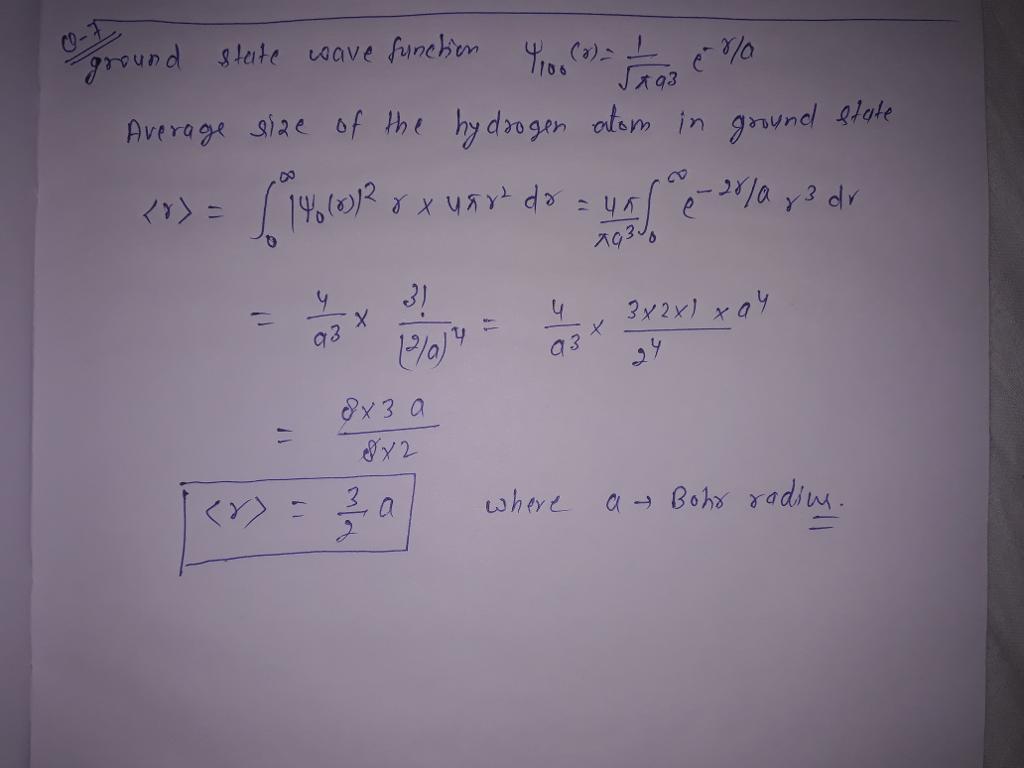
3/2a

Explanation:

The complete step by step answer is found in the attachment

You might be interested in
A sample of an ideal gas occupies 2.78 x 10^3 mL at 25°C and 760 mm Hg.
iris [78.8K]

Answer: It will occupy 4.45\times 10^3ml at the same temperature and 475 mm Hg.

Explanation:

Boyle's Law: This law states that pressure is inversely proportional to the volume of the gas at constant temperature and number of moles.

P\propto \frac{1}{V}     (At constant temperature and number of moles)

P_1V_1=P_2V_2    (At constant temperature and number of moles)

where,

P_1 = initial pressure of gas = 760 mm Hg

P_2 = final pressure of gas = 475 mm Hg

V_1 = initial volume of gas = 2.78\times 10^3ml

V_2  = final volume of gas = ?

Putting in the values:

760mm Hg\times 2.78\times 10^3ml=475 mm Hg\times V_2

V_2=4.45\times 10^3ml

Thus it will occupy 4.45\times 10^3ml at the same temperature and 475 mm Hg

5 0
2 years ago
Read 2 more answers
ethylene glycol used in automobile antifreeze and in the production of polyester. The name glycol stems from the sweet taste of
Luden [163]

<u>Answer:</u> The empirical and molecular formula for the given organic compound is CH_3O and C_4H_{12}O_4

<u>Explanation:</u>

The chemical equation for the combustion of hydrocarbon having carbon, hydrogen and oxygen follows:

C_xH_yO_z+O_2\rightarrow CO_2+H_2O

where, 'x', 'y' and 'z' are the subscripts of Carbon, hydrogen and oxygen respectively.

We are given:

Mass of CO_2=9.06g

Mass of H_2O=5.58g

We know that:

Molar mass of carbon dioxide = 44 g/mol

Molar mass of water = 18 g/mol

  • <u>For calculating the mass of carbon:</u>

In 44g of carbon dioxide, 12 g of carbon is contained.

So, in 9.06 g of carbon dioxide, \frac{12}{44}\times 9.06=2.47g of carbon will be contained.

  • <u>For calculating the mass of hydrogen:</u>

In 18g of water, 2 g of hydrogen is contained.

So, in 5.58 g of water, \frac{2}{18}\times 5.58=0.62g of hydrogen will be contained.

  • Mass of oxygen in the compound = (6.38) - (2.47 + 0.62) = 3.29 g

To formulate the empirical formula, we need to follow some steps:

  • <u>Step 1:</u> Converting the given masses into moles.

Moles of Carbon =\frac{\text{Given mass of Carbon}}{\text{Molar mass of Carbon}}=\frac{2.47g}{12g/mole}=0.206moles

Moles of Hydrogen = \frac{\text{Given mass of Hydrogen}}{\text{Molar mass of Hydrogen}}=\frac{0.62g}{1g/mole}=0.62moles

Moles of Oxygen = \frac{\text{Given mass of oxygen}}{\text{Molar mass of oxygen}}=\frac{3.29g}{16g/mole}=0.206moles

  • <u>Step 2:</u> Calculating the mole ratio of the given elements.

For the mole ratio, we divide each value of the moles by the smallest number of moles calculated which is 0.206 moles.

For Carbon = \frac{0.206}{0.206}=1

For Hydrogen  = \frac{0.62}{0.206}=3

For Oxygen  = \frac{0.206}{0.206}=1

  • <u>Step 3:</u> Taking the mole ratio as their subscripts.

The ratio of C : H : O = 1 : 3 : 1

Hence, the empirical formula for the given compound is C_1H_{3}O_1=CH_3O

For determining the molecular formula, we need to determine the valency which is multiplied by each element to get the molecular formula.

The equation used to calculate the valency is:

n=\frac{\text{molecular mass}}{\text{empirical mass}}

We are given:

Mass of molecular formula = 124 amu = 124 g/mol

Mass of empirical formula = 31 g/mol

Putting values in above equation, we get:

n=\frac{124g/mol}{31g/mol}=4

Multiplying this valency by the subscript of every element of empirical formula, we get:

C_{(1\times 4)}H_{(3\times 4)}O_{(1\times 4)}=C_4H_{12}O_4

Thus, the empirical and molecular formula for the given organic compound is CH_3O and C_4H_{12}O_4

3 0
2 years ago
A vessel contains Ar(g) at a high pressure. Which of the following statements best helps to explain why the measured pressure is
Luda [366]

Answer:

4. The combined volume of the Ar atoms is too large to be negligible compared with the total volume of the container.

Explanation:

Deviations from ideality are due to intermolecular forces and to the nonzero volume of the molecules themselves. At infinite volume, the volume of the molecules themselves is negligible compared with the infinite volume the gas occupies.

However, the volume occupied by the gas molecules must be taken into account. Each <u>molecule does occupy a finite, although small, intrinsic volume.</u>

The non-zero volume of the molecules implies that instead of moving in a given volume V they are limited to doing so in a smaller volume. Thus, the molecules will be closer to each other and repulsive forces will dominate, resulting in greater pressure than the one calculated with the ideal gas law, that means, without considering the volume occupied by the molecules.

5 0
2 years ago
In redox half-reactions, a more positive standard reduction potential means I. the oxidized form has a higher affinity for elect
qwelly [4]

Answer:

The 1st and 4th options are correct

I.the oxidized form has a higher affinity for electrons

IV. the greater the tendency for the oxidized form to accept electrons

Explanation:

Half reaction can be described as the oxidation or reduction reaction in a redox reaction.it is In the redox rection there is a change in the oxidation states of Chemical species involved. the oxidized form in the redox has a higher affinity for electrons and the greater the tendency for the oxidized form to accept electrons.

Standard reduction potential which is also referred to as standard cell potential can be described as the potential difference that exist between cathode and anode of the cell. In the standard reduction potential most times the species will be reduced which is usually analysed in a reduction half reaction.

(Standard Hydrogen Electrode) is utilized when determining the Standard reduction or potentials of a chemical specie. this is because of Hydrogen having zero reduction and oxidation potentials, as a result of this a measured potential of any species is compared with that of Hydrogen, the difference helps to know the potential reduction of that particular specie.

4 0
2 years ago
Which of the following gives the molarity of a 17.0% by mass solution of sodium acetate, CH 3COONa (molar mass = 82.0 g/mol) in
weeeeeb [17]

Answer:

The molarity of this solution is 2.26 M (option D)

Explanation:

Step 1: Data given

Mass % = 17%

Molar mass of CH3COONa = 82.0 g/mol

Density of the solution = 1.09 g/mL

Step 2:

Assume the mass of the solution is 1.00 gram

⇒ 17.0 % CH3COONa = 0.17 grams

⇒ 83.0 % H2O = 0.83 grams

Step 3:

Density = 1.09 g/mL

Volume of the solution = total mass / density of solution

Volume of solution : 1.00 grams / 1.09 g/mL

Volume of the solution = 0.917 mL = 0.000917 L

Step 4: Calculate  number of moles of CH3COONa

Number of moles = Mass / molar mass

Number of moles CH3COONa = 0.170 grams / 82.0 g/mol

Number of moles = CH3COONa = 0.00207 moles

Step 5: Calculate molarity

Molarity = moles / volume

Molarity solution =   0.00207 / 0.000917 L

Molarity solution =  2.26 mol/L = 2.26 M

The molarity of this solution is 2.26 M (option D)

6 0
2 years ago
Other questions:
  • X-ray photons with a wavelength of 0.135 nm . express the energy numerically in kilojoules per mole.
    7·2 answers
  • A heat energy of 645 J is applied to a sample of glass with a mass of 28.4 g. Its temperature increases from –11.6 ∞C to 15.5 ∞C
    11·1 answer
  • In the compound k[co(c2o4)2(h2o)2] (where c2o42– = oxalate) the oxidation number and coordination number of cobalt are, respecti
    8·2 answers
  • The density of concentrated ammonia, which is 28.0% w/w nh3, is 0.899 g/ml. what volume of this reagent should be diluted to 1.0
    7·1 answer
  • A 37.2-g sample of lead (Pb) pellets at 20°C is mixed with a 62.7-g sample of lead pellets at the same temperature. What are th
    10·1 answer
  • Question14 of 20If 5.15 g FeCl3 is dissolved in enough water to make exactly 150.0 mL of solution, what is the molar concentrati
    10·1 answer
  • A sample of the compound MSO4 weighing 0.1131 g reacts with BaCl2 and yields 0.2193 g BaSO4. What is the elemental mass of M and
    5·1 answer
  • The bond enthalpy of the C―N bond in the amide group of proteins can be treated as an average of C―N (276 kJ/mol) and C═N (615 k
    14·1 answer
  • A sample of a solid labeled as NaCl may be impure. a student analyzes the sample and determines that it contains 75 percent chlo
    6·1 answer
  • It is 762 miles from here to Chicago. An obese physics teacher jogs at a rate of 5.0 miles every 20.0 minutes. How long would it
    10·1 answer
Add answer
Login
Not registered? Fast signup
Signup
Login Signup
Ask question!