answer.
Ask question
Login Signup
Ask question
All categories
  • English
  • Mathematics
  • Social Studies
  • Business
  • History
  • Health
  • Geography
  • Biology
  • Physics
  • Chemistry
  • Computers and Technology
  • Arts
  • World Languages
  • Spanish
  • French
  • German
  • Advanced Placement (AP)
  • SAT
  • Medicine
  • Law
  • Engineering
tatiyna
2 years ago
3

The effectiveness of nitrogen fertilizers depends on both their ability to deliver nitrogen to plants and the amount of nitrogen

they can deliver. Four common nitrogen-containing fertilizers are ammonia, ammonium nitrate, ammonium sulfate, and urea [(NH2) 2CO)]. Rank these fertilizers in terms of the mass percentage nitrogen they contain.

Chemistry
1 answer:
vladimir2022 [97]2 years ago
6 0

Answer: ammonia>urea>ammonium sulphate>ammonium nitrate

Explanation:

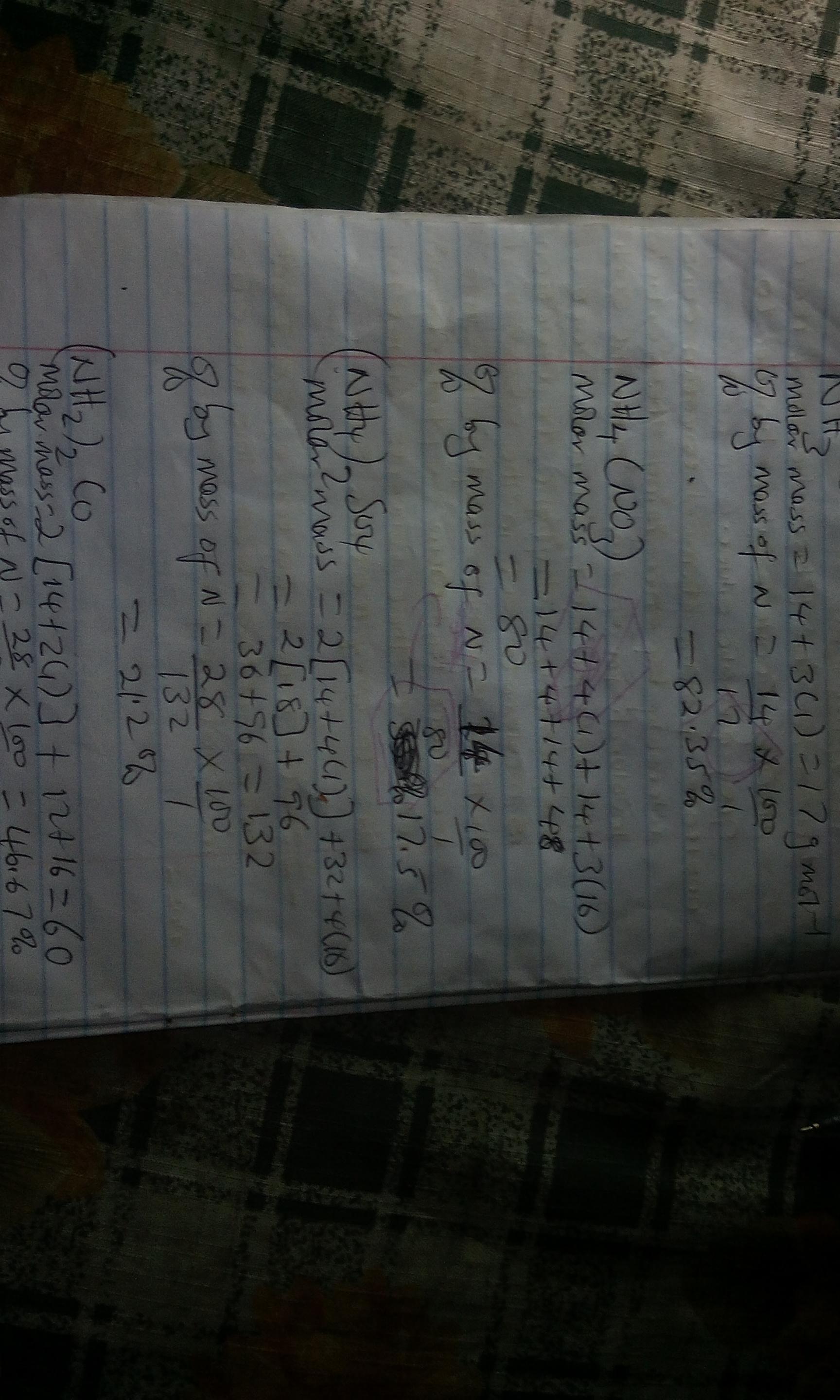
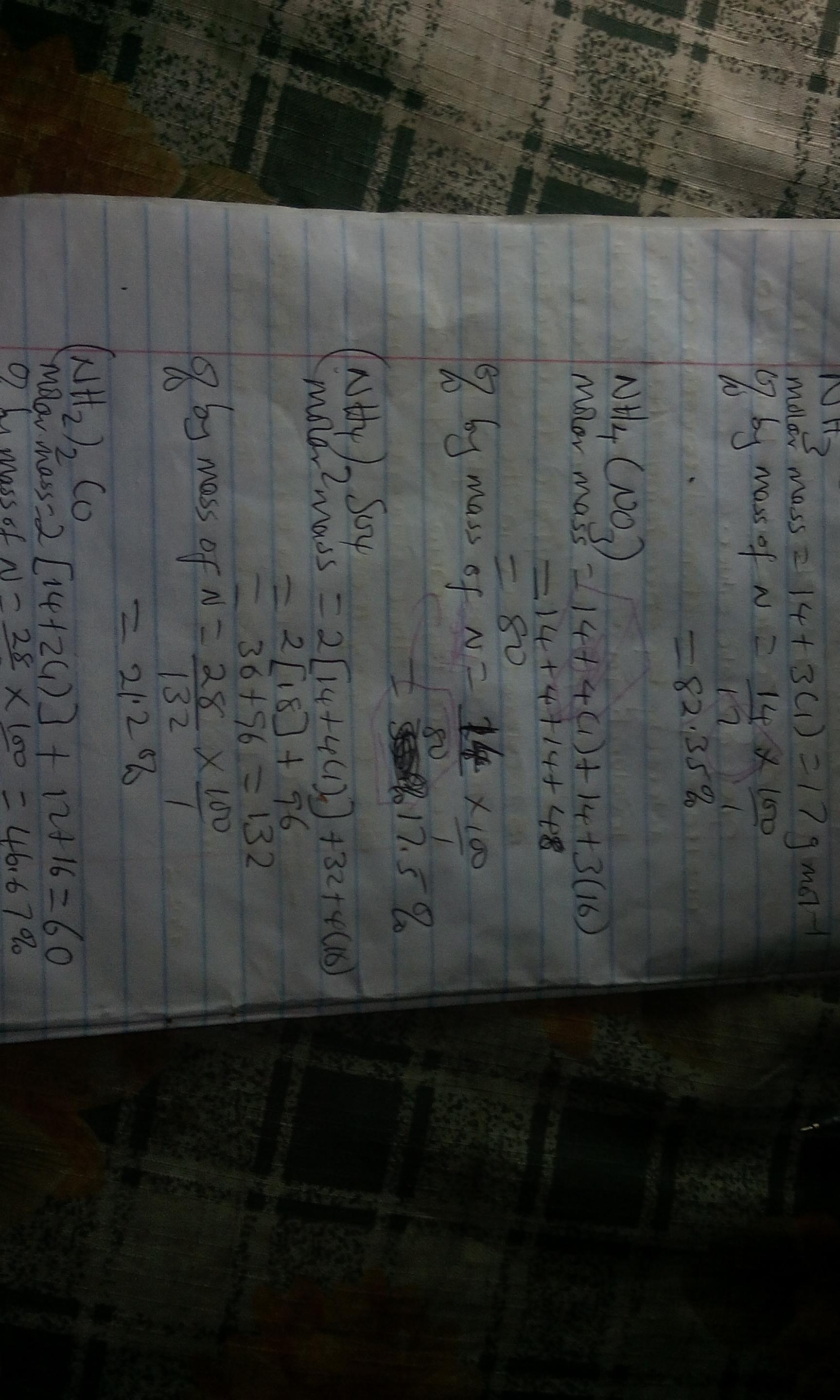
The calculation of percentage by mass of each of the nitrogenous fertilizers mentioned is shown in the image attached. Ammonia has the greatest percentage by mass of nitrogen and is the best nitrogenous fertilizer among others mentioned in the question.

You might be interested in
Suggest why sodium and hydrogen ions do not diffuse at the same rate
Troyanec [42]

Answer:

sodium has got ionic bonds that are weak

compared to hydrogen covalent bonds that are strong

8 0
2 years ago
Question14 of 20If 5.15 g FeCl3 is dissolved in enough water to make exactly 150.0 mL of solution, what is the molar concentrati
Serhud [2]

Answer: 0.635 M

Explanation:

Molarity : It is defined as the number of moles of solute present per liter of the solution.

Formula used :

Molarity=\frac{n\times 1000}{V_s}

where,

n= Moles=\frac{\text{Given mass}}{\text{Molar mass}}=\frac{5.15g}{162.4g/mol}=0.0317moles  

V_s = volume of solution  = 150 ml

Molarity=\frac{0.0317\times 1000}{150ml}=0.2114M

FeCl_3\rightarrow Fe^{3+}+3Cl^-

as 1 mole of FeCl_3 gives 3 moles of Cl^- ions

Thus molarity of Cl^- = 3\times 0.2114=0.635M

Molarity of Cl^- = 0.635 M

8 0
2 years ago
The activation energy for the reaction no2(g)+co(g)⟶no(g)+co2(g) is ea = 75 kj/mol and the change in enthalpy for the reaction i
Nonamiya [84]
Answer: 350 kj/mol


Explanation:

As shown below this expression gives the activation energy of the reverse reaction:

EA reverse reaction = EA forward reaction + | enthalpy change |

1) The activation energy, EA is the difference between the potential energies of the reactants and the transition state:

EA = energy of the transition state - energy of the reactants.

2) The activation energy of the forward reaction given is:

EA = energy of the transition state - energy of  [ NO2(g) + CO(g) ] = 75 kj/mol

3) The negative enthalpy change - 275 kj / mol for the forward reaction means that the products are below in the potential energy diagram, and that the potential energy of the products, [NO(g) + CO2(g) ] is equal to 75 kj / mol - 275 kj / mol = - 200 kj/mol

4) For the reverse reaction the reactants are [NO(g) + CO2(g)], and the transition state is the same than that for the forward reaction.

5) The difference of energy between the transition state and the potential energy of [NO(g) + CO2(g) ] will be the absolute value of the change of enthalpy plus the activation energy for the forward reaction:

EA reverse reaction = EA forward reaction + | enthalpy change |

EA reverse reaction = 75 kj / mol + |-275 kj/mol | = 75 kj/mol + 275 kj/mol = 350 kj/mol.

And that is the answer, 350 kj/mol

3 0
2 years ago
A cell consists of a gold wire and a saturated calomel electrode (S.C.E.) in a 0.150 M AuNO 3 solution at 25 °C. The gold wire i
almond37 [142]

The half reaction that occurs at the Au electrode is  1.64

<u>Explanation:</u>

Half cell reaction at 'Au' electrode

We have the equation,

Au + (aq) + e-  ---> Au(s)

Given the concenration of AuNO3=0.150 M

[Au +] =0.150 m

From the equation,

Au + (aq) + e-  ---> Au(s)

Standard electric potential= Eo= 1.69 volt

Solving the problem using the Nerst equation

E cell= E0 cell - 2.303 RT/ nF  log Qc

Where,

T = 298 K

n= no of electron lost or gained

F= faraday's constant= 965000/mole

R= universal constant= 8.314 J/ K/ Mole

Substitue the values we get

E cell = 1.69 volt - 0.05 g/n log (1/0.150M)

E cell = 1.69 volt - 0.05 g/1  0.824

E cell= 1.64

The half reaction that occurs at the Au electrode is  1.64

<u />

6 0
2 years ago
A 2 mole sample of F2(g) reacts with excess NaOH(aq) according to the equation above. If the reaction is repeated with excess Na
77julia77 [94]

Answer:

The amount of NaF produced is doubled.

(d) is correct option.

Explanation:

Given that,

A 2 mole sample of F₂ reacts with excess NaOH according to the equation.

The balance equation is

2F_{2}+2NaOH\Rightarrow 2NaF +H_{2}O+OF_{2}

If the reaction is repeated with excess NaOH but with 1 mole of F₂

The balance equation is

F_{2}+2NaOH\Rightarrow 2NaF +2OH

Hence, The amount of NaF produced is doubled.

(d) is correct option.

6 0
2 years ago
Other questions:
  • At 73.0 ∘c , what is the maximum value of the reaction quotient, q, needed to produce a non-negative e value for the reaction so
    11·1 answer
  • At what temperature is the following reaction feasible: HCl(g) + NH3(g) -&gt; NH4Cl(s)?
    11·2 answers
  • Suppose you did not have any indicator available, how else would you be able to identify the end point of the titration?
    13·1 answer
  • While hiking in the woods, you see a brown, rotting apple lying on the ground. What changes is the physical properties of the ap
    14·1 answer
  • Classify each property as associated with a liquid that has strong or weak intermolecular forces Drag the appropriate items to t
    9·1 answer
  • he solutions in the arms of a U-tube are separated at the bottom of the tube by a selectively permeable membrane. The membrane i
    10·1 answer
  • Calculate the pOH of a solution that contains 3.9 x 10⁻⁵ M H3O+ at 25°C.
    9·1 answer
  • Completa la siguiente tabla, que indica las temperaturas registradas en un día para algunas ciudades del mundo.
    6·1 answer
  • Catherine has some seawater. She wants to separate pure water from the seawater.
    8·2 answers
  • When sand is coated with a layer of trimethylhydroxysilane, (CH3)3SiOH, it repels water and can no longer get wet. Hydrophobic s
    10·1 answer
Add answer
Login
Not registered? Fast signup
Signup
Login Signup
Ask question!