answer.
Ask question
Login Signup
Ask question
All categories
  • English
  • Mathematics
  • Social Studies
  • Business
  • History
  • Health
  • Geography
  • Biology
  • Physics
  • Chemistry
  • Computers and Technology
  • Arts
  • World Languages
  • Spanish
  • French
  • German
  • Advanced Placement (AP)
  • SAT
  • Medicine
  • Law
  • Engineering
Ann [662]
2 years ago
6

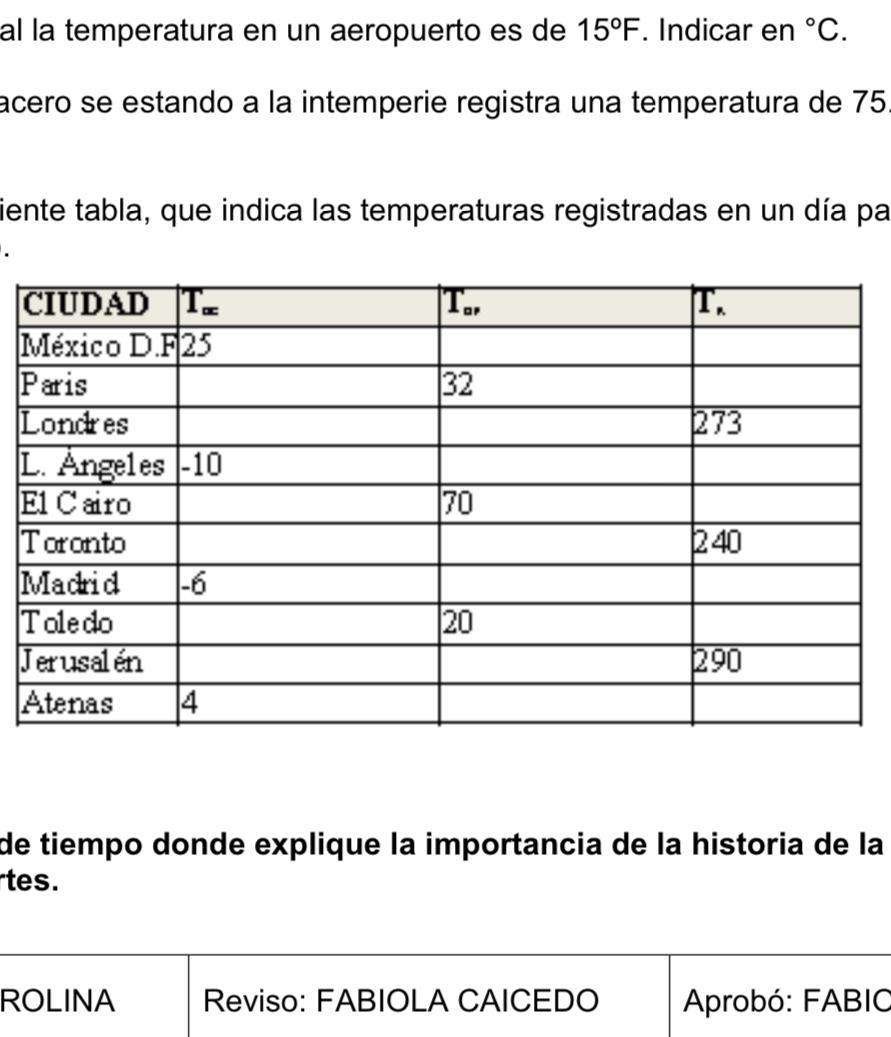
Completa la siguiente tabla, que indica las temperaturas registradas en un día para algunas ciudades del mundo.

Chemistry
1 answer:
Solnce55 [7]2 years ago
7 0

Answer:

50Explanation:

You might be interested in
Why is radioactive dating important when approximating the age of earth?
Furkat [3]

Answer:

So, we rely on radiometric dating to calculate their ages. Radiometric dating, or radioactive dating as it is sometimes called, is a method used to date rocks and other objects based on the known decay rate of radioactive isotopes.

Explanation:

radiometric dating is a very accurate way to date the Earth.We know it is accurate because radiometric dating is based on the radioactive decay of unstable isotopes. When an unstable Uranium (U) isotope decays, it turns into an isotope of the element Lead (Pb).

6 0
2 years ago
Read 2 more answers
What name is used to describe the H-N-H group?
mamaluj [8]

Answer:

an amine group

Explanation:

Hope that helped :)

5 0
2 years ago
The reading on a speedometer represents the average velocity of the car. True False
Sedbober [7]
Answer: False. Hope this helps!!
7 0
2 years ago
Calculate the mass in grams of each of the following amounts: 1.002 mol of chromium 4.08 x 10⁻⁸ mol of neon
Pepsi [2]

Answer:

Mass_{chromium}=52.1\ g

Mass_{neon}=8.23\times 10^{-7}\ g

Explanation:

<u>Calculation of the mass of chromium as:- </u>

Moles = 1.002 moles

Molar mass of chromium = 51.9961 g/mol

The formula for the calculation of moles is shown below:

moles = \frac{Mass\ taken}{Molar\ mass}

Thus,

1.002\ mol= \frac{Mass}{51.9961\ g/mol}

Mass_{chromium}=1.002\times 51.9961\ g = 52.1\ g

<u>Calculation of the mass of neon as:- </u>

Moles = 4.08\times 10^{-8} moles

Molar mass of neon = 20.1797 g/mol

Thus,

1.002\ mol= \frac{Mass}{20.1797\ g/mol}

Mass_{neon}=4.08\times 10^{-8}\times 20.1797\ g = 8.23\times 10^{-7}\ g

6 0
2 years ago
A graduated cylinder is filled to 10.0 mL with water and a piece of granite is placed in the cylinder displacing the level to 23
Rus_ich [418]

Answer:

13.7 cubic centimeters

Explanation:

23.7-10=13.7mL

8 0
2 years ago
Other questions:
  • Here is a sketch of a 2px orbital: This sketch is about 800pm wide. The coordinate ( x , y , and z ) axes are also shown. You ca
    15·1 answer
  • A student titrates 10.00 milliliters of hydrochloric acid of unknown molarity with 1.000 m naoh. it takes 21.17 milliliters of b
    11·1 answer
  • How many molecules of ascorbic acid (vitamin c, c6h8o6) are in a 500 mg tablet?
    14·2 answers
  • What is the stoichiometric ratio between BaCl2 and NaCl
    11·1 answer
  • A 1.00 l solution contains 3.50×10⁻⁴ m cu(no3)2 and 1.75×10⁻³ m ethylenediamine (en). the kf for cu(en)22+ is 1.00×10²⁰. what is
    6·1 answer
  • What is the molarity and molality of a solution that is 10.00 % by mass potassium hydrogen carbonate (KHCO3, 100.11 g/mol) and h
    15·1 answer
  • How did surgeon Joseph Lister kill the bacteria in urine specimens he had been studying?
    12·1 answer
  • Write chemical equations and corresponding equilibrium expressions for each of the two ionization steps of carbonic acid. Part A
    11·1 answer
  • Nitrogen dioxide gas is dark brown in color and remains in equilibrium with dinitrogen tetroxide gas, which is colorless.
    11·1 answer
  • Will is learning about a new kind of plastic used to make models. He learns that infrared light is absorbed by the plastic, X-ra
    7·2 answers
Add answer
Login
Not registered? Fast signup
Signup
Login Signup
Ask question!