answer.
Ask question
Login Signup
Ask question
All categories
  • English
  • Mathematics
  • Social Studies
  • Business
  • History
  • Health
  • Geography
  • Biology
  • Physics
  • Chemistry
  • Computers and Technology
  • Arts
  • World Languages
  • Spanish
  • French
  • German
  • Advanced Placement (AP)
  • SAT
  • Medicine
  • Law
  • Engineering
notsponge [240]
2 years ago
4

: A gas contained in a piston–cylinder assembly undergoes two processes, A and B, between the same end states, 1 and 2, where p1

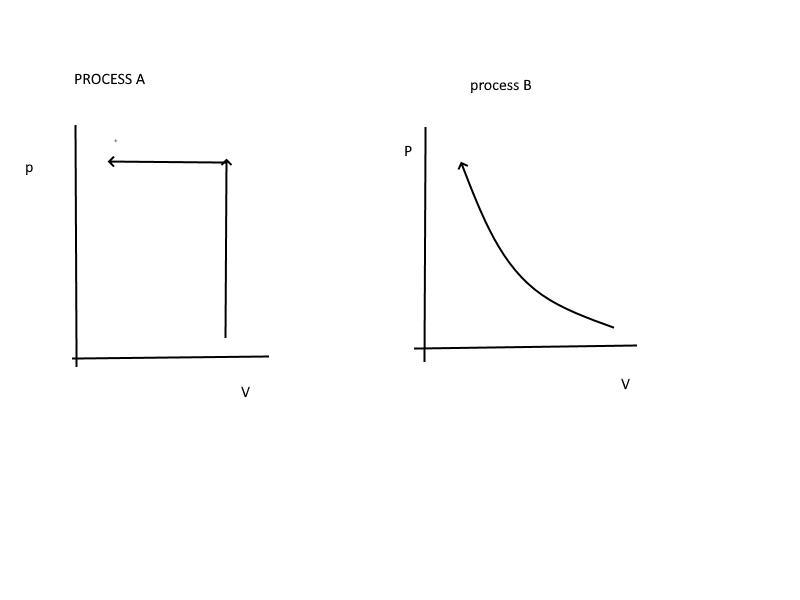
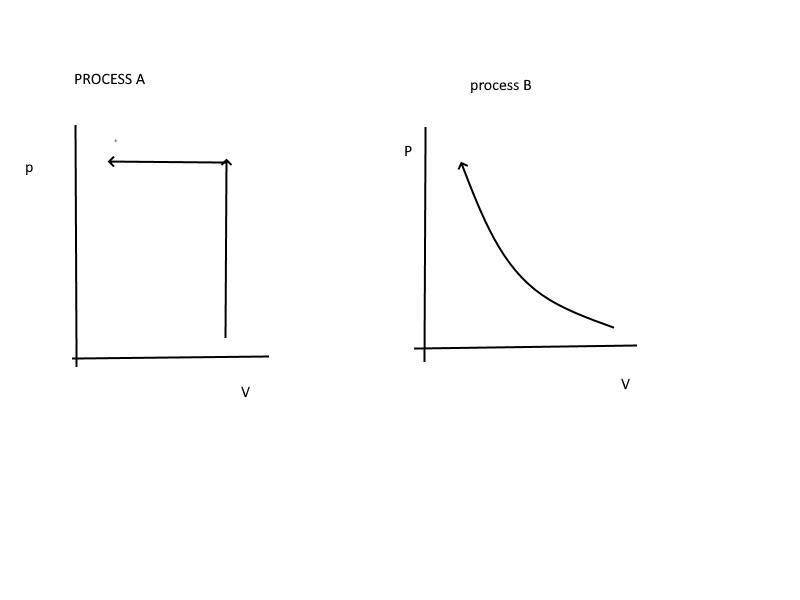
=1bar, V1 = 1m3 , U1 =400kJ and p2 = 10 bar, V2 = 0.1 m3 , U2 = 450 kJ: Process A: Constant-volume process from state 1 to a pressure of 10 bar, followed by a constantpressure process to state 2. Process B: Process from 1 to 2 during which the pressure-volume relation is pV = constant. Kinetic and potential effects can be ignored. For each of the processes A and B, (a) sketch the process on p–V coordinates, (b) evaluate the work, in kJ, and (c) evaluate the heat transfer, in kJ.

Physics
1 answer:
bogdanovich [222]2 years ago
8 0

Answer:

b) W = 9.09 10² kJ ,  W = -2.3 nRT

c)  Q_total = -409 kJ ,   Q = 232 kJ

Explanation:

a) we have an outline of the two processes in the attached

Process A

        Isocoric - Isobaric

B process

        Isothermal

b) This is a thermodynamic process where we can find work with the expression

         W = ∫P dV

A Process  

In the constant volume part ΔV = 0, so the work is zero

            W₁ = 0

In the constant pressure part

        W = P DV

Let's reduce the pressure to SI units

       P = 10 Bar (1.01 105 Pa / 1 Bar) = 10.1 10⁵ Pa

        W₂ = 10.1 10⁵ (1 -0.1)

        W₂ = 9.09 10⁵ J= 9.09 10² kJ

The total work is

      W = W₁ + W₂

      W = 9.09 10² kJ

B process

       PV = d

Where d is a constant, we assume an ideal gas

          PV = nRT

        W = nRT ∫ dV / V

        W = nRT ln V₂ / V₁

        W = nrT ln 0.1 / 1

        W = -2.3 nRT

c) Let's use the first law of thermodynamics

         DU = Q-W

Process A


The first part of the process is at constant volume, so the work is zero

        ΔU₁ = Q₁

        Q₁ = 450 -400

        Q₁ = 50 kJ

The second part

        ΔU₂ = Q₂ + W₂

        Q₂ = ΔU₂ - W₂

        Q₂ = 450 - 909

         Q₂ = -459 kJ

The total heat in the process is

        Q_total = Q₁ + Q₂

         Q_total = 50 - 459

         Q_total = -409 kJ

The negative sign indicates that this heat is released

B process

       ΔU = Q + W

       Q = ΔU - W

       Q = (450-400) - (-2.3 d)

        Q = 50 + 2.3 d

let's use the initial values ​​to calculate the constant

        P V = d

         1.01 10⁵ 1 = d

        Q = 50 + 2.3 1.01 105

         Q = 2.3 10⁵ J

         Q = 2.323 10² kJ
You might be interested in
A container of nitrogen (an ideal diatomic gas, molecular weight=28) is at a pressure of 2 atm and has a mass density of 1.6 gra
Nikolay [14]

Answer:

Explanation:What is the root-mean-square velocity (vrms) of the center of mass of one of the molecules?

3 0
2 years ago
A solution is oversaturated with solute. Which could be done to decrease the oversaturation?
salantis [7]
Ans: Dilute the solution

Explanation:
To decrease the over-saturation, dilute the solution. Dilution<span> is the process of decreasing the solute's concentration in the </span>solution. It is<span> usually done by mixing with more solvent. In other words, to </span>dilute<span> a </span>solution<span> means to add more solvent without the addition of more solute.</span>
3 0
2 years ago
Read 2 more answers
A farmer wants to determine which of two brands of cow feed is best for the cows on a farm. Before using one of the feeds on all
Effectus [21]

Answer:

the answer is A

Explanation:

6 0
2 years ago
Read 2 more answers
4. Dr. Copus is in charge of the cognition department at the University of Wisconsin-Madison. A new drug named Mem-Reen has beco
MrMuchimi

Answer:

See the answer below

Explanation:

<u>Independent variable</u>: Type of drug (Mem-Reen or placebo)

<u>Dependent variable</u>: memories

<u>Experimental group</u>: The group that was given Mem-Reen

<u>Control group</u>: The group that was given placebo

<u>Constants</u>: Food, hours of sleep, memory test procedures.

The independent variable is an input variable that produces effects on the dependent variable. As the variable is changed, it produces different effects on the dependent variable.

The dependent variable is the actual variable that is measured during an experiment. It is the main purpose of setting-up of an experiment.

The experimental group is also referred to as the treatment group while the control group is the group that does not receive treatment at all or they receive fake treatment/placebo.

Constants are unchanging variables included in experiments. They remain unchanged both in the treatment and the control group, otherwise, the outcome of the experiment will be unreliable.

5 0
2 years ago
A team of astronauts is on a mission to land on and explore a large asteroid. In addition to collecting samples and performing e
Blizzard [7]
<h2>Answer: 117.626m/s</h2>

Explanation:

The escape velocity V_{esc} is given by the following equation:

V_{esc}=\sqrt{\frac{2GM}{R}}   (1)

Where:

G is the Gravitational Constant and its value is 6.674(10)^{-11}\frac{m^{3}}{kgs^{2}}

M  is the mass of the asteroid

R  is the radius of the asteroid

On the other hand, we know the density of the asteroid is \rho=3.84(10)^{8}g/m^{3} and its volume is V=2.17(10)^{12}m^{3}.

The density of a body is given by:

\rho=\frac{M}{V}  (2)

Finding M:

M=\rhoV=(3.84(10)^{8} g/m^{3})(2.17(10)^{12}m^{3})  (3)

M=8.33(10)^{20}g=8.33(10)^{17}kg  (4)  This is the mass of the spherical asteroid

In addition, we know the volume of a sphere is given by the following formula:

V=\frac{4}{3}\piR^{3}   (5)

Finding R:

R=\sqrt[3]{\frac{3V}{4\pi}}   (6)

R=\sqrt[3]{\frac{3(2.17(10)^{12}m^{3})}{4\pi}}   (7)

R=8031.38m   (8)  This is the radius of the asteroid

Now we have all the necessary elements to calculate the escape velocity from (1):

V_{esc}=\sqrt{\frac{2(6.674(10)^{-11}\frac{m^{3}}{kgs^{2}})(8.33(10)^{17}kg)}{8031.38m}}   (9)

Finally:

V_{esc}=117.626m/s This is the minimum initial speed the rocks need to be thrown in order for them never return back to the asteroid.

6 0
2 years ago
Other questions:
  • While looking at bromine (Br) on the periodic table, a student needs to find another element with very similar chemical properti
    13·2 answers
  • Charge is distributed uniformly on the surface of a large flat plate. the electric field 2 cm from the plate is 30 n/c. the elec
    9·1 answer
  • Which of the following is probably not a reason why society might initially reject a new scientific theory
    14·1 answer
  • What meal can you get from standing on a hot sidewalk riddle answer?
    9·1 answer
  • (1 point) Suppose a spring with spring constant 7 N/m is horizontal and has one end attached to a wall and the other end attache
    10·1 answer
  • When a car drives along a "washboard" road, the regular bumps cause the wheels to oscillate on the springs. (What actually oscil
    10·1 answer
  • You are using a lightweight rope to pull a sled along level ground. The sled weighs 485 N, the coefficient of kinetic friction b
    11·1 answer
  • A lab technician uses laser light with a wavelength of 670 nm to test a diffraction grating. When the grating is 40.0 cm from th
    11·1 answer
  • A pillow is thrown downward with an initial speed of 6 m/s.
    7·1 answer
  • Two astronauts, A and B, both with mass of 60Kg, are moving along a straight line in the same direction in a weightless spaceshi
    11·1 answer
Add answer
Login
Not registered? Fast signup
Signup
Login Signup
Ask question!