answer.
Ask question
Login Signup
Ask question
All categories
  • English
  • Mathematics
  • Social Studies
  • Business
  • History
  • Health
  • Geography
  • Biology
  • Physics
  • Chemistry
  • Computers and Technology
  • Arts
  • World Languages
  • Spanish
  • French
  • German
  • Advanced Placement (AP)
  • SAT
  • Medicine
  • Law
  • Engineering
son4ous [18]
2 years ago
13

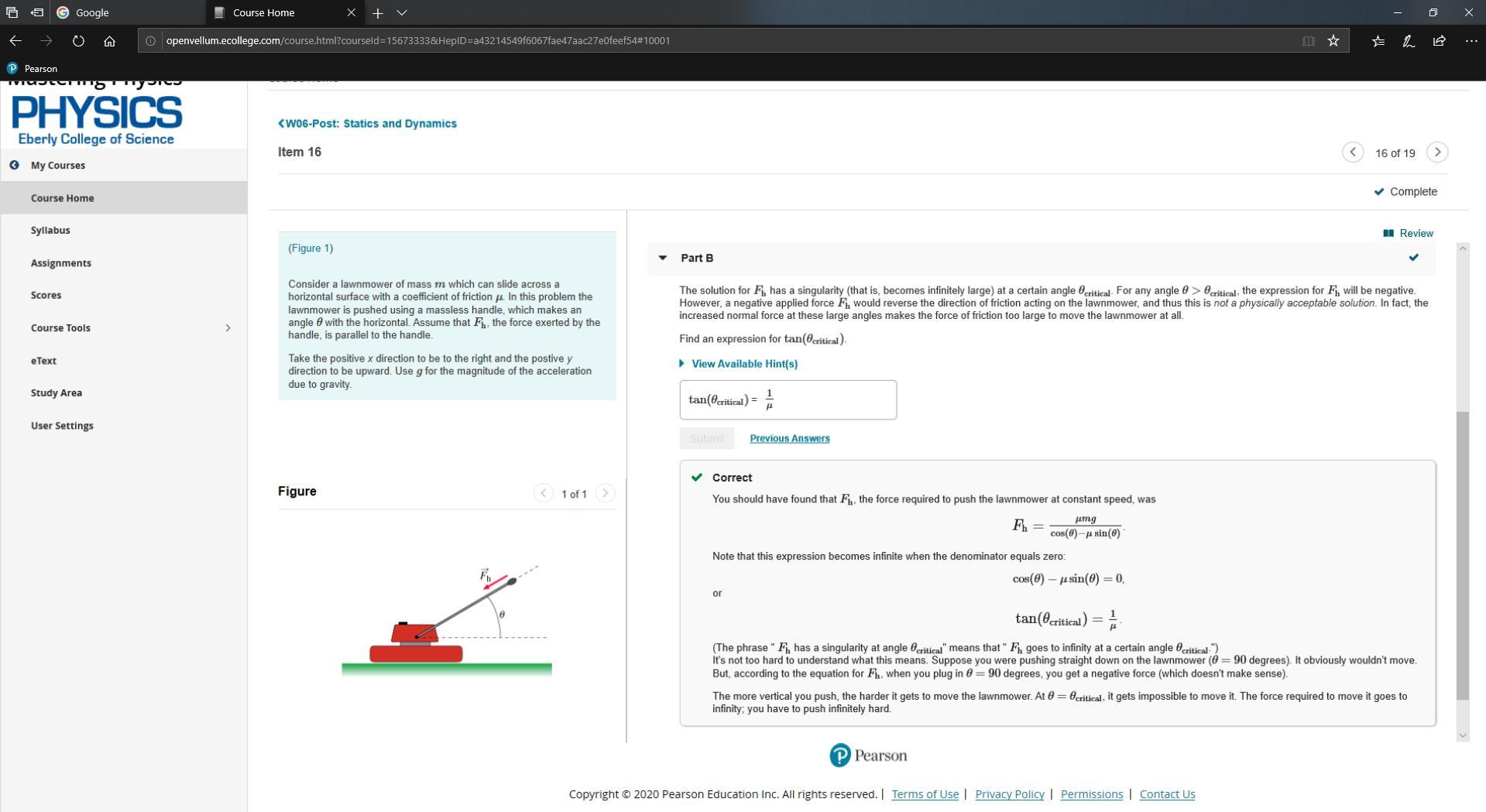
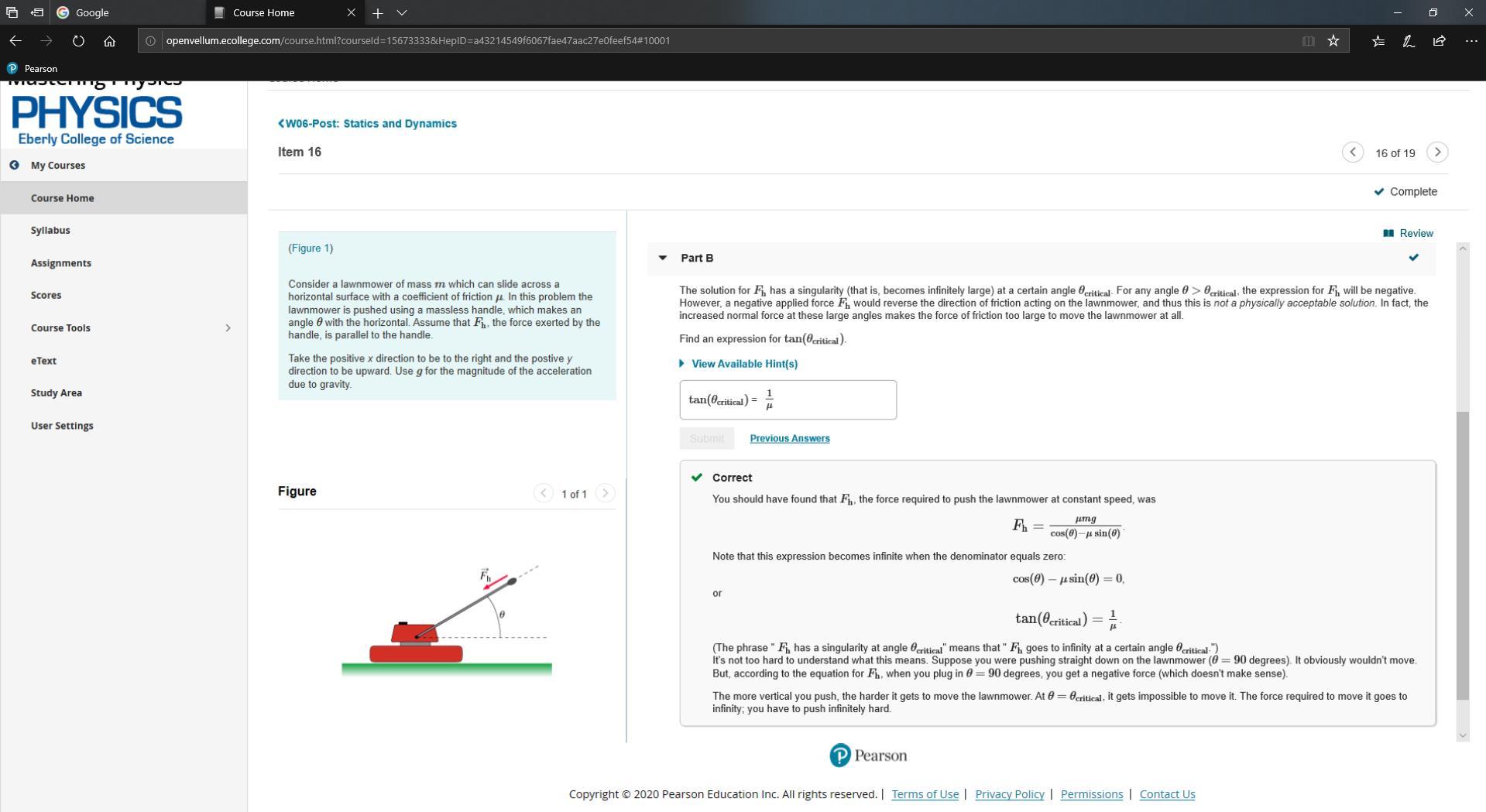
Consider a lawnmower of mass m which can slide across a horizontal surface with a coefficient of friction μ. In this problem the

lawnmower is pushed using a massless handle, which makes an angle θ with the horizontal. Assume that Fh, the force exerted by the handle, is parallel to the handle.
Find the magnitude, Fh, of the force required to slide the lawnmower over the ground at constant speed by pushing the handle.

The solution for Fh has a singularity (that is, becomes infinitely large) at a certain angle θcritical. For any angle θ>θcritical, the expression for Fh will be negative. However, a negative applied force Fh would reverse the direction of friction acting on the lawnmower, and thus this is not a physically acceptable solution. In fact, the increased normal force at these large angles makes the force of friction too large to move the lawnmower at all.

Find an expression for tan(θcritical).

Physics
1 answer:
Free_Kalibri [48]2 years ago
8 0

ou should have found that  

F

h

FhF_h

, the force required to push the lawnmower at constant speed, was

F

h

=

μmg

cos(θ)−μsin(θ)

Fh=μmgcos⁡(θ)−μsin⁡(θ)

.

Note that this expression becomes infinite when the denominator equals zero:

cos(θ)−μsin(θ)=0

cos⁡(θ)−μsin⁡(θ)=0

,

or  

tan(

θ

critical

)=

1

μ

tan⁡(θcritical)=1μ

.

(The phrase "  

F

h

FhF_h

has a singularity at angle  

θ

critical

θcriticaltheta_critical

" means that "  

F

h

FhF_h

goes to infinity at a certain angle  

θ

critical

θcriticaltheta_critical

.")

It's not too hard to understand what this means. Suppose you were pushing straight down on the lawnmower (

θ=90

θ=90

degrees). It obviously wouldn't move. But, according to the equation for  

F

h

FhF_h

, when you plug in  

θ=90

θ=90

degrees, you get a negative force (which doesn't make sense).

The more vertical you push, the harder it gets to move the lawnmower. At  

θ=

θ

critical

θ=θcritical

, it gets impossible to move it. The force required to move it goes to infinity; you have to push infinitely hard.

Provide Feedback

Next  

Correct. Followup.  

You should have found that , the force required to push the lawnmower at constant speed, was

.

Note that this expression becomes infinite when the denominator equals zero:

,

or  

.

(The phrase " has a singularity at angle " means that " goes to infinity at a certain angle .")

It's not too hard to understand what this means. Suppose you were pushing straight down on the lawnmower ( degrees). It obviously wouldn't move. But, according to the equation for , when you plug in degrees, you get a negative force (which doesn't make sense).

The more vertical you push, the harder it gets to move the lawnmower. At , it gets impossible to move it. The force required to move it goes to infinity; you have to push infinitely hard.

End of followup.
You might be interested in
Steam at 0.6 MPa, 200 oC, enters an insulated nozzle with a velocity of 50 m/s. It leaves at a pressure of 0.15 MPa and a veloci
Rudiy27

Answer:

x2 = 0.99

Explanation:

from superheated water table

at pressure p1 = 0.6MPa and temperature 200 degree celcius

h1 = 2850.6 kJ/kg

From energy equation we have following relation

\dot m( h1+\frac{v1^2}{2}+ gz1 )+ Q = \dot m( h2+\frac{v2^2}{2}+ gz1) + W

\dot m( h1+\frac{v1^2}{2}) = \dot m( h2+\frac{v2^2}{2})

h1+\frac{v1^2}{2} = h2+\frac{v2^2}{2}

2850.6 + [\frac{50^2}{2} * \frac{1 kJ/kg}{1000 m^2/S^2}] = h2 +[ \frac{600^2}{2} * \frac{1 kJ/kg}{1000 m^2/S^2}]

h2 = 2671.85 kJ/kg

from superheated water table

at pressure p2 = 0.15MPa

specific enthalpy of fluid hf = 467.13 kJ/kg

enthalpy change hfg = 2226.0 kJ/kg

specific enthalpy of the saturated gas hg = 2693.1 kJ/kg

as it can be seen from above value hf>h2>hg, so phase 2 is two phase region. so we have

quality of steam x2

h2 = hf + x2(hfg)

2671.85 = 467.13 +x2*2226.0

x2 = 0.99

6 0
2 years ago
What is an example of convection currents? a. marshmallows toasting over a campfire b. a pot being heated by an electric burner,
SCORPION-xisa [38]

Answer:

B

Explanation:

because, convection is the transfer of heat between fluid substances/materials

7 0
2 years ago
Read 2 more answers
A What CE describes the way energy is stored in a sandwich​
SVETLANKA909090 [29]
What is Potential Energy? You probably already know that without eating, your body becomes weak from lack of energy. Take a few bites of a turkey sandwich, and moments later, you feel much better. That's because food molecules contain potential energy, or stored energy, that can do work in the future. Hope it helps
8 0
2 years ago
You jump off a platform 134 m above the Neuse River. After you have free-fallen for the first 40 m, the bungee cord attached to
omeli [17]

Answer:

The acceleration at lowest point is 19.62 m/s^2

Explanation:

Conservation of energy is an concept in which it is stated that the energy of an isolated object remains the same. Energy changes from one form to another.

Lets Assume

Constant of string is K

By using the conservation of energy we will have the following equation

1/2 x 80^2 x K = m x 9.81 x 120

3200 K =  1177.2 m

K = 1177.2 m / 3200

K = 0.368 m

At the lowest point we will have

a = ( K x X - m x g ) / m

a = ( 0.368 m x 80 - m x 9.81 ) / m

a = 19.62 m / s^2

So, the acceleration at lowest point is 19.62 m/s^2

7 0
2 years ago
Read 2 more answers
A horizontal rectangular surface has dimensions 2.80 cm by 3.20 cm and is in a uniform magnetic field that is directed at an ang
koban [17]

Answer:

magnitude of the magnetic field 0.692 T

Explanation:

given data

rectangular dimensions = 2.80 cm by 3.20 cm

angle of 30.0°

produce a flux Ф = 3.10 × 10^{-4}  Wb

solution

we take here rectangular side a and b as a = 2.80 cm and b = 3.20 cm

and here angle between magnitude field and area will be ∅ = 90 - 30

∅ = 60°

and flux  is express as

flux Ф = \int \vec{B}.d\vec{A}   .................1

and Ф = BA cos∅    ............2

so B = \frac{\phi }{Acos\theta }    

and we know

A = ab

so

B = \frac{\phi }{abcos\theta }    ..............3

put here value

B =  \frac{3.10\times 10^{-4} }{2.80 \times 10^{-2}\times 3.20 \times 10^{-2}\times cos60}  

solve we get

B = 0.692 T

8 0
2 years ago
Other questions:
  • The temperature, T, of a gas is jointly proportional to the pressure P of the gas and the volume V occupied by the gas. Use C as
    12·1 answer
  • A spaceship is travelling at 20,000.0 m/s. After 5.0 seconds, the rocket thrusters are turned on. At the 55.0 second mark, the s
    9·1 answer
  • The first and second coils have the same length, and the third and fourth coils have the same length. They differ only in the cr
    8·1 answer
  • You are conducting an experiment inside a train car that may move along level rail tracks. A load is hung from the ceiling on a
    5·1 answer
  • (1 point) Which of the following statements are true?A.The equation Ax=b is referred to as a vector equation.B.If the augmented
    10·1 answer
  • A foam ball of mass 0.150 g carries a charge of -2.00 nC. The ball is placed inside a uniform electric field, and is suspended a
    5·1 answer
  • A vessel, divided into two parts by a partition, contains 4 mol of nitrogen gas at 75°C and 30 bar on one side and 2.5 mol of ar
    8·1 answer
  • (4%) Problem 10: The standard frequency of the musical pitch called "middle C" is 261.6 Hz. show answer No Attempt How fast, in
    6·1 answer
  • A 2.0 m × 4.0 m flat carpet acquires a uniformly distributed charge of −10 μC after you and your friends walk across it several
    15·1 answer
  • If the ac peak voltage across a 100-ohm resistor is 120 V, then the average power dissipated by the resistor is ________
    12·1 answer
Add answer
Login
Not registered? Fast signup
Signup
Login Signup
Ask question!