answer.
Ask question
Login Signup
Ask question
All categories
  • English
  • Mathematics
  • Social Studies
  • Business
  • History
  • Health
  • Geography
  • Biology
  • Physics
  • Chemistry
  • Computers and Technology
  • Arts
  • World Languages
  • Spanish
  • French
  • German
  • Advanced Placement (AP)
  • SAT
  • Medicine
  • Law
  • Engineering
Naya [18.7K]
2 years ago
15

Use a sheet of paper to answer the following question. Take a picture of your answers and attach to this assignment. Predict the

product formed in the nucleophilic aromatic substitution reaction between 1-chloro-2,4-dinitrobenzene and sodium methoxide (NaOCH3). Draw the mechanism of the reaction in (a), showing why the product you have selected is formed.

Chemistry
2 answers:
romanna [79]2 years ago
5 0

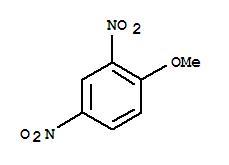
Answer:1-methoxy-2,4-dinitrobenzene

Explanation:

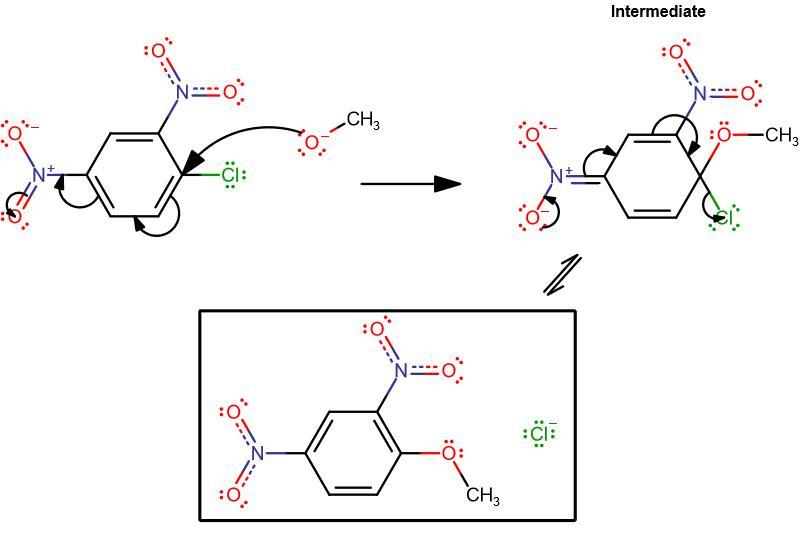
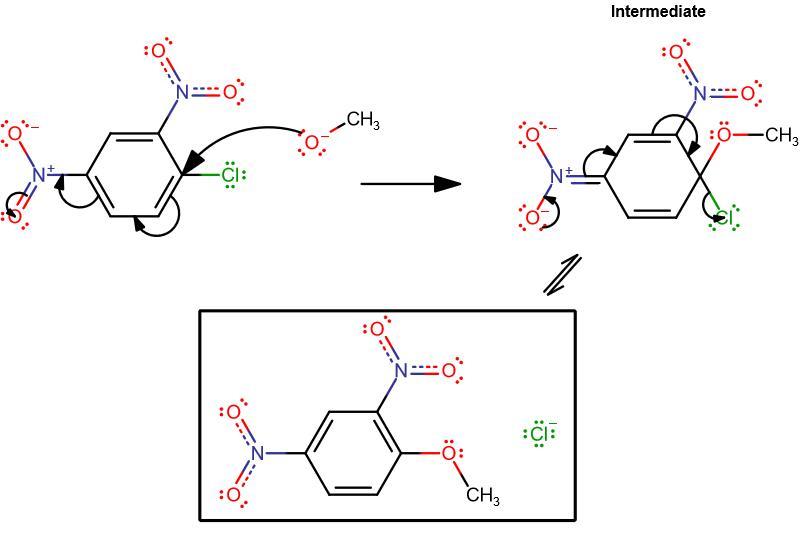
The nitro groups are strongly electron withdrawing and promote nucleophilic substitution reactions where one of the original substituents is removed and replaced by a strong nucleophile such as the methoxy group. The mechanism of the reaction is attached below. The electron withdrawing nitrogroup assists the formation of the intermediate in the reaction as shown.

Alja [10]2 years ago
4 0

Answer: 1-Methoxy-2,4-dinitrobenzene is formed which is solublw in the solution of hot methanol giving it almost a 95% transperency.

Explanation:

Its not SN1 or SN2 infact it is "Nucleophilic aromatic substitution and a SNAr reaction"

At first initial step is the attach of the nucleophile (CH₃O⁻) as the methanol and Sodium Ethoxide are in equiliberium with each other where the Pi bonds are broken and then where the chlorine is attached and then this pi bond is travels to the Electron withdrawing group that is ortho or para to the leaving group and the double bond forms between the carbon and the Electron withdrawing group. The last step follows the elimination of chlorine and the methoxide group cannot bond with electron withdrawing group as they both negative in charge.

You might be interested in
According to the bohr model of the atom, the single electron in what motion of a hydrogen atom circles the nucleus
Lady bird [3.3K]
It would be elliptical according to him.....
4 0
2 years ago
An ice cube measuring 5.80 cm by 5.80 cm by 5.80 cm has a density of 0.917 g/mL What is the mass?
OLga [1]

Answer: 178.9 g

Explanation:

Density = \frac{mass}{volume in mL}

find volume of the cube: (5.80 cm) (5.80 cm) (5.80cm) = 195.112 cm³

1.0 cm³ = 1.0 mL

so 195.112 cm³ = 195.112 mL

plug value into density equation:

0.917 g/mL = (mass) / (195.112 mL)

and solve for mass!

3 0
2 years ago
Given equilibrium partial pressures of PNO2= 0.247 atm, PNO = 0.0022atm, and PO2 = 0.0011 atm calculate the equilibrium constant
maxonik [38]
Answer 1:
Equilibrium constant (K) mathematically expressed as the ratio of the concentration of products to concentration of reactant. In case of gaseous system, partial pressure is used, instead to concentration.

In present case, following reaction is involved:

                        2NO2    ↔      2NO + O2

Here, K = \frac{[PNO]^2[O2]}{[PNO2]^2}

Given: At equilibrium, <span>PNO2= 0.247 atm, PNO = 0.0022atm, and PO2 = 0.0011 atm
</span>
Hence,  K = \frac{[0.0022]^2[0.0011]}{[0.247]^2}
                 = 8.727 X 10^-8

Thus, equilibrium constant of reaction = 8.727 X 10^-8
.......................................................................................................................

Answer 2:
Given: <span>PNO2= 0.192 atm, PNO = 0.021 atm, and PO2 = 0.037 atm.

Therefore, Reaction quotient = </span>\frac{[PNO]^2[O2]}{[PNO2]^2}
                                              = \frac{[0.021]^2[0.037]}{[0.192]^2}
                                              = 4.426 X 10^-4.

Here, Reaction quotient > Equilibrium constant.

Hence, <span>the reaction need to go to reverse direction to reattain equilibrium </span>
5 0
2 years ago
Read 2 more answers
4. A nuclear engineer is designing a nuclear reactor for a new power plant. The reactor core will have an operating temperature
Readme [11.4K]
Sodium Chloride because its still a liquid at the 773 temperature mark<span />
8 0
2 years ago
How many sigma and pi bonds in propionic bond
Ierofanga [76]
Propanoic acid formula is ch ch 2 so it has 8 bonds
7 0
2 years ago
Other questions:
  • Make a quantitative and qualitative statement about the following:. water, carbon, iron, hydrogen gas, sucrose, table salt, merc
    7·2 answers
  • 1a) 2 properties that glass and plastic always share
    10·1 answer
  • given that the molar mass of Na2SO4 × nH2O is 322.1 g/mol calculate the number of moles of water in this hydrate
    11·1 answer
  • Enter the ions formed when (NH4)2S dissolves in water.
    13·2 answers
  • suppose that during the icy hot lab that 65 kj of energy were transferred to 450 g of water at 20 C. What would have been the fi
    12·1 answer
  • Determine the percent composition by mass of a 100g salt solution which contains 20g salt
    13·2 answers
  • 2) Of the following, which has the shortest de Broglie wavelength? A) an airplane moving at a velocity of 300 mph B) a helium nu
    12·1 answer
  • Calculate the mass in grams of each sample.
    15·1 answer
  • Which statement best describes the relationship between the frequency and energy of light?
    13·2 answers
  • A sample of hydrate sodium carbonate has a mass of 71.5 g. after heating, the anhydrous sodium carbonate has a mass of 26.5 gram
    11·1 answer
Add answer
Login
Not registered? Fast signup
Signup
Login Signup
Ask question!