answer.
Ask question
Login Signup
Ask question
All categories
  • English
  • Mathematics
  • Social Studies
  • Business
  • History
  • Health
  • Geography
  • Biology
  • Physics
  • Chemistry
  • Computers and Technology
  • Arts
  • World Languages
  • Spanish
  • French
  • German
  • Advanced Placement (AP)
  • SAT
  • Medicine
  • Law
  • Engineering
goldfiish [28.3K]
2 years ago
3

A cylinder contains 0.250mol of carbon dioxide (CO2) gas at a temperature of 27.0∘C. The cylinder is provided with a frictionles

s piston, which maintains a constant pressure of 1.00atm on the gas. The gas is heated until its temperature increases to 127.0∘C. Assume that the CO2 may be treated as an ideal gas. Part A How much work is done by the gas in this process? Part B On what is this work done?Part C What is the change in internal energy of the gas?Part D How much heat was supplied to the gas? Part E How much work would have been done if the pressure had been 0.50atm?

Physics
1 answer:
Harlamova29_29 [7]2 years ago
8 0

Answer:

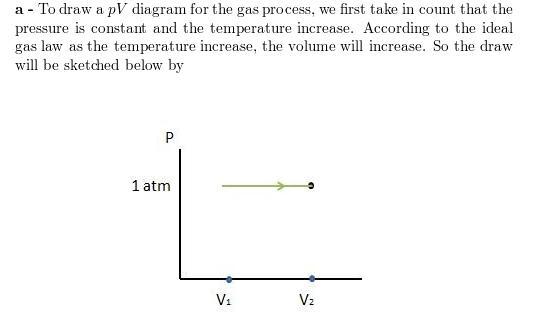
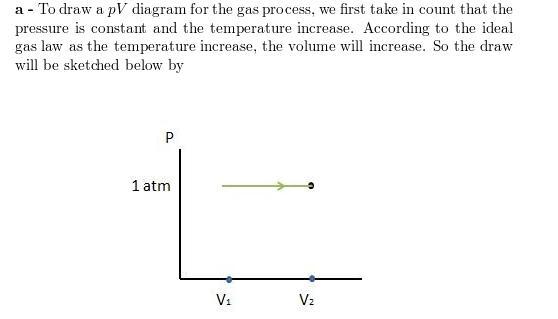
a) see the attached graph

b) 208 J

c) the gas applies a work on the piston.  

d) 712 J

e) 920 J

f) 208 J

Explanation:

<u>Given  </u>

We are given a cylinder contains CO2 gas with a number of moles n = 0.250 mol at an initial temperature T_1 = 27 C° which in Kelvins equals 300 K when the pressure is constant and equals p = 1 atm.Then the gas heated up to temperature T_2 = 127C° which in Kelvins equals 400 K.  

a) see the attached graph

b) The pressure is constant so the work done at a constant pressure is  

W = pΔV                                                       (1)

We are not given ΔV ! So from ideal gas law

pV = nRT

As the volume V change, the temperature T will change and the ideal gas law for this change will be  

pΔV=nRΔT

 ΔV=nR/p( T_2- T_1)

Now we can sub in equation (1) by the value of dV and calculate the work done W where  

W = pΔV  

   =  p*nR/p( T_2- T_1)

  = 208 J

c ) The work in part (b) is positive which leads us to conclude that the gas applies a work on the piston.  

d - The temperature change from 300 K to 400 K and as we know, the internal energy depends on the temperature T. So the change in internal energy ΔU would express by  

ΔU=nCvΔT

ΔU=nCv(T_2- T_1)

Where Cv is the molar heat specific capacity at constant volume and for CO2, Cv = 28.46 J/mol K

Now we can sub by the values of Cv , T_2 T_1and n to calculate ΔU  

ΔU=nCv(T_2- T_1)

    =712 J

e ) The heat Q that must be supplied to the gas to increase its internal energy and the work done is given by the first law of thermodynamics where  

Q = ΔU + W

Now sub by the value of ΔU that we calculated in part (d) and the work done that we calculated in part (b) to find the added heat Q  

Q = ΔU + W

   = 920 J

f) In part (b) we calculated the work done for p = 1 atm which is constant during the process and from the equation W = nR(T_2- T_1) we will conclude that the work does not depend on the pressure in this case, therefore, the work done will not change as the pressure change and it will be the same  

W= 208 J

You can repeat the steps in part (b) to confirm the result.  
You might be interested in
The brain receives messages in signals called nerve impulses. Which part of the ear first generates these nerve impulses?
liberstina [14]

That's the job of the tiny "hair cells", located in the <em>inner ear.</em>

If you're a sound wave, this is how you reach the hair cells:

-- go into the big funnel of skin on the outside of the head, that thing we call the "ear"

-- go about an inch or two, down through a skinny dark tunnel inside the skull

-- at the end of the tunnel, hit a dead end, made of a wall of thin skin like a drum, called the "ear drum";  sound waves hit the ear drum and make it vibrate

-- on the other side of the ear drum, inside, is the chamber called the "middle ear".  In there are the three smallest bones in the body; the ear drum touches the first one and makes it vibrate; the first one touches the second one and makes it vibrate; the second one touches the third one and makes it vibrate;  then the third one touches another dead end made of thin skin.

-- the region on the other side of this wall of thin skin is the "inner ear";  it's a long skinny chamber, called the "cochlea",  wound up in a spiral and filled with liquid; the walls of the cochlea are lined with millions of tiny hairs, sticking out into the liquid; the vibrations make waves in the liquid, and the waves make the tiny hairs wave back and forth; each tiny hair is the end of a nerve that goes into the brain; when that hair wiggles, it sends a nerve "message" into the brain.  

-- there are two complete copies of this whole structure ... one on each side of your head.

6 0
2 years ago
Read 2 more answers
An antibaryon composed of two antiup quarks
Sveta_85 [38]

Answer:

(2) −1 e

Explanation:

A quark is the lightest elementary particles which form hadron such as proton and neutron. A quark has fractional charge.

Up, charm and top quarks have +\frac{2}{3} e charge where as down, strange and bottom quarks have -\frac{1}{3}e charge.

The antiparticle of up quark is antiup quark and has charge -\frac{2}{3}e charge.

The antiparticle of down quark is antidown quark and has charge +\frac{1}{3}e charge.

An antibaryon is composed of two anti-up quark and one anti-down quark.

Net charge of the anti-baryon is:

2\times (-\frac{2}{3} e)+1\times (+\frac{1}{3})e=-1e

Thus, antibaryon has -1e charge.

5 0
2 years ago
Cylinder A is moving downward with a velocity of 3 m/s when the brake is suddenly applied to the drum. Knowing that the cylinder
Xelga [282]

Answer:

Incomplete question

Check attachment for the given diagram

Explanation:

Given that,

Initial Velocity of drum

u=3m/s

Distance travelled before coming to rest is 6m

Since it comes to rest, then, the final velocity is 0m/s

v=3m/s

Using equation of motion to calculate the linear acceleration or tangential acceleration

v²=u²+2as

0²=3²+2×a×6

0=9+12a

12a=-9

Then, a=-9/12

a=-0.75m/s²

The negative sign shows that the cylinder is decelerating.

Then, a=0.75m/s²

So, using the relationship between linear acceleration and angular acceleration.

a=αr

Where

a is linear acceleration

α is angular acceleration

And r is radius

α=a/r

From the diagram r=250mm=0.25m

Then,

α=0.75/0.25

α =3rad/sec²

The angular acceleration is =3rad/s²

b. Time take to come to rest

Using equation of motion

v=u+at

0=3-0.75t

0.75t=3

Then, t=3/0.75

t=4 secs

The time take to come to rest is 4s

7 0
2 years ago
Paul and Ivan are riding a tandem bike together. They’re moving at a speed of 5 meters/second. Paul and Ivan each have a mass of
Sonbull [250]
The formula is Ke = 1/2 m v^2
The two of them together have a Ke of mv^2. So you either increase m or v. That's what makes the problem difficult. He can do D or B. We have to choose.

A is no solution. The Ke goes down because Paul loses Ivan's mass.
C is out of the question 3 meters/sec is a big reduction from 5 m/s. So now what do we do about B and D?

The question is what does the third person add. The tandoms I've peddled only allow for 1 or 2 people to add to the motion. So the third person only adds mass. He does not have a v that he is contributing to. To say that he is going 5m/s is true, but he's not contributing anything to that motion.

I pick B, but it is one of those questions that the correctness of it is in the head of the proposer. Be prepared to get it wrong. Argue the point politely if you agree with me, but back off as soon as you have presented your case.

B <<<<====== answer. 
5 0
2 years ago
Read 2 more answers
How is a seismograph similar to an X-ray?
aleksklad [387]

Answer: Seismograph is an instrument that is used to measure the vibration of the earthquake. It is based on seismic waves. X ray is an electromagnetic energy wave that is used for CAT ( computerized axial tomography) scan.

Hence, both seismic wave and X ray are energy waves.

The velocity of seismic waves is different in different media. Similarly, X ray loses its amplitude depending upon the dense layer of the tissue.

5 0
2 years ago
Other questions:
  • A 0.70-m radius cylindrical region contains a uniform electric field that is parallel to the axis and is increasing at the rate
    11·2 answers
  • A small object slides along the frictionless loop-the-loop with a diameter of 3 m. what minimum speed must it have at the top of
    11·1 answer
  • A 3.00-kg model airplane has velocity components of 5.00 m/s due east and 8.00 m/s due north. What is the plane’s kinetic energy
    15·2 answers
  • A 4.00 kg rock is rolling 10.0 m/s find its kinetic energy
    14·1 answer
  • What is the threshold frequency for sodium metal if a photon with frequency 6.66 × 10¹⁴ s−1 ejects a photon with 7.74 × 10⁻²⁰ J
    9·1 answer
  • An oxygen atom at a particular site within a DNA molecule can be made to execute simple harmonic motion when illuminated by infr
    5·1 answer
  • You must determine the length of a long, thin wire that is suspended from the ceiling in the atrium of a tall building. A 2.00-c
    6·1 answer
  • Did the kinetic frictional coefficient (for the wood/aluminum and felt/aluminum cases) vary with area of contact
    8·1 answer
  • hows a map of Olivia's trip to a coffee shop. She gets on her bike at Loomis and then rides south 0.9mi to Broadway. She turns e
    10·1 answer
  • Which illustration represents the arrangement of particles in a gas?
    6·1 answer
Add answer
Login
Not registered? Fast signup
Signup
Login Signup
Ask question!