answer.
Ask question
Login Signup
Ask question
All categories
  • English
  • Mathematics
  • Social Studies
  • Business
  • History
  • Health
  • Geography
  • Biology
  • Physics
  • Chemistry
  • Computers and Technology
  • Arts
  • World Languages
  • Spanish
  • French
  • German
  • Advanced Placement (AP)
  • SAT
  • Medicine
  • Law
  • Engineering
zmey [24]
2 years ago
12

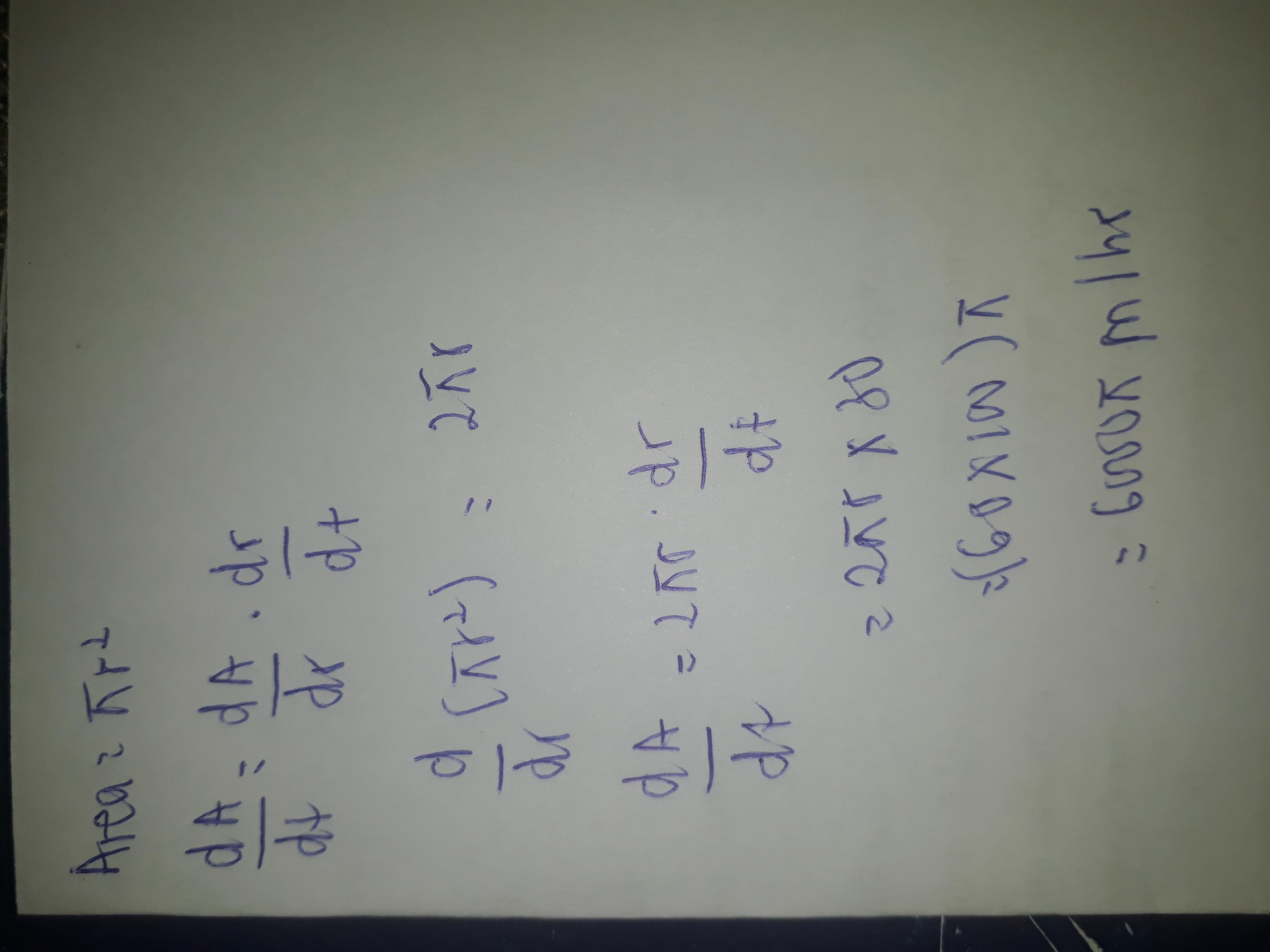
An offshore rig begins to spill oil in a circular patch centered on the rig. If the radius ofthe oil spill increases at a rate o

f 30 m/hr, how fast is the area of the oil spill increasing when the radiusis 100 meters

Physics
2 answers:
Tresset [83]2 years ago
7 0

Answer:

Explanation:

The area of a circle is given b

A=πr²

Then,

dA/dr= 2πr

Also give that,

dr/dt=30m/hr, r=100m

We want to find dA/dt

dA/dt=dA/dr×dr/dt

dA/dt= 2πr × 30

dA/dt= 2 ×π ×100×30

dA/dt=18849.56m²/s.

The rate of the area is 18849.56m²/s

Brut [27]2 years ago
3 0

Explanation:

Below is an attachment containing the solution.

You might be interested in
Stu wanted to calculate the resistance of a light bulb connected to a 4.0-V battery, with a resulting current of 0.5 A. He used
Margarita [4]

Answer:

The answer is not correct.

Explanation:

Stu's answer is not correct, the equation to use is known as the law of ohm. In which the voltage is defined as the product of the current by the resistance, then we will see this equation.

V = I*R\\where:\\I = current [amp]\\R = resistance [ohm]\\V = voltage [volts]\\

In order to find resistance, this term is found multiplying the current on the right side of the equation, therefore the current will be divided on the left side of the equation.

R=\frac{V}{I} \\replacing:\\R=\frac{4}{0.5} \\R=8[ohms]

That is the reason that the result found by Stu is not correct.

6 0
2 years ago
Read 2 more answers
an iron rod of length 100m at 10 degree Celsius is used to measure a distance of 2km on a day when the temperature is 40 degree
german

Answer:

0.68 m

Explanation:

α = dL / L1*(dT)

dL = L1(dT) * α

Initial length, L1 = 100

Chang in Length =dL

α linear expansivity ; dL = change in length ; dT = change in temperature ; L1 = initial length

α of iron rod = 1.13 * 10^-5 k

dL = 100(40 - 10) * 1.13 * 10^-5

dL = 100(30) * 1.13 * 10^-5

dL = 3000 * 1.13 * 10^-5

dL = 3390 * 10^-5

dL = 0.0339 m

Error :

Distance measured = 2km = (2 * 1000) = 2000m

[Distance measured / (initial length + change in length)] × change in length

Error = (2000 / (100 + 0.0339)) * 0.0339

Error = (2000 / 100.0339) * 0.0339

Error = 19.993222 * 0.0339

Error = 0.6777702

Error = 0.68 m

4 0
2 years ago
Which of the following statements are true about an object in two-dimensional projectile motion with no air resistance? (There c
ki77a [65]

Answer:

The correct answers are

The following statements are true about an object in two-dimensional projectile motion with no air resistance

D) The speed of the object is zero at its highest point.

E) The horizontal acceleration is always zero and the vertical acceleration is always a non-zero constant downward

Explanation:

A) The speed of the object is constant but its velocity is not constant.

False the vertical velocity increases on descent

B) The acceleration of the object is constant but its object is + g when the object is rising and -g when it is falling.

False, the acceleration is -g when the object is rising

C) The acceleration of the object is zero at its highest point.

False, the acceleration is constant in magnitude throughout the motion

D) The speed of the object is zero at its highest point.

True, the direction of motion changes at the highest point from hence the body comes to rest and the speed is zero

E) The horizontal acceleration is always zero and the vertical acceleration is always a non-zero constant downward

True, the horizontal acceleration has associated force during motion but the vertical acceleration is due to gravity which is constant downwards

6 0
2 years ago
The famous cliff divers of Acapulco leap from a perch 35 m above the ocean. How fast are they moving when they reach the surface
Rus_ich [418]

1) 26.2 m/s

The mechanical energy of the divers at any point of their vertical motion is sum of the kinetic energy and the gravitational potential energy:

E=K+U = \frac{1}{2}mv^2 + mgh

where

m is the mass of the diver

v is the speed

g = 9.8 m/s^2 is the acceleration due to gravity

h is the height above the water

When the diver is on the cliff, v = 0 (he is at rest), so K=0 and the initial mechanical energy is just potential energy:

E_i = mgh

where h=35 m is the height of the cliff.

When the diver hits the water above, h = 0, so U=0 and the final mechanical energy is just kinetic energy:

E_f = \frac{1}{2}mv^2

since the total mechanical energy is conserved, we have

E_i = E_f\\mgh = \frac{1}{2}mv^2

And solving the equation for v, we find the speed when they reach the surface of the water:

v=\sqrt{2gh}=\sqrt{2(9.8 m/s^2)(35 m)}=26.2 m/s

2) It is converted into thermal energy of the water

When the diver enters the water, he suddenly feels another force acting against the motion of the diver: the resistance of the water. The resistance of the water acts upward, slowing down the diver until he stops.

In this process, the speed of the diver (v) decreases, and therefore the kinetic energy of the diver decreases as well, until it becomes zero.

However, this does not mean that the conservation of energy has been violated. In fact, the kinetic energy of the diver has been converted into thermal energy of the molecules of water surrounding the diver.
8 0
2 years ago
Nicki rides her bike at a constant speed for 6 km. That part of her ride takes her 1 h. She then rides her bike at a constant sp
Savatey [412]

km x h = km/h

First trial: 6 x 1 = 6km/h

Second trial: 9 x 2 = 18km/h

6 + 18 = <u>24km/h</u> (Total)

Or

6 + 9 = 15 km

2 + 1 = 3h

15 + 3 = 18

15 x 2 = 30

3 x 2 = 6

30 - 6 = <u>24km/h</u>

8 0
2 years ago
Other questions:
  • The eiffel tower has a mass of 7.3 million kilograms and a height of 324 meters. its base is square with a side length of 125 me
    7·1 answer
  • Keisha looks out the window from a tall building at her friend Monique standing on the ground, 8.3 m away from the side of the b
    10·1 answer
  •  A bartender slides a beer mug at 1.50 m/s toward a customer at the end of a frictionless bar that is 1.20 m tall. The customer
    7·1 answer
  • Which of the following statements are true of an object in orbit around Earth? (Select all that apply.) The gravity force on the
    8·1 answer
  • You are a member of an alpine rescue team and must get a box of supplies, with mass 2.20 kg , up an incline of constant slope an
    12·1 answer
  • After a 60-kg person steps from a boat onto the shore, the boat moves away with a speed of 0.60 m/s with respect to the shore. I
    13·1 answer
  • Combine Newton's 2nd law and Hooke's law for a spring to find the acceleration of the block a(t) as a function of time. Express
    15·1 answer
  • A non-uniform rod 60cm long and weighs 32N is balanced at the 45cm mark. A load of 2N is hung on the zinc rod at the 25cm mark.
    11·1 answer
  • Scientists studying an anomalous magnetic field find that it is inducing a circular electric field in a plane perpendicular to t
    10·1 answer
  • 8. An unpowered flywheel is slowed by a constant frictional torque. At time t = 0 it has an angular velocity of 200 rad/s. Ten s
    7·1 answer
Add answer
Login
Not registered? Fast signup
Signup
Login Signup
Ask question!
