answer.
Ask question
Login Signup
Ask question
All categories
  • English
  • Mathematics
  • Social Studies
  • Business
  • History
  • Health
  • Geography
  • Biology
  • Physics
  • Chemistry
  • Computers and Technology
  • Arts
  • World Languages
  • Spanish
  • French
  • German
  • Advanced Placement (AP)
  • SAT
  • Medicine
  • Law
  • Engineering
OlgaM077 [116]
2 years ago
4

Liquid methanol is fed to a space heater at a rate of 12.0 L/h and burned with excess air. The product gas is analyzed and the f

ollowing dry-basis mole percentages are determined: CH3OH = 0.45%, CO2 = 9.03%, and CO = 1.81%. (a) After drawing and labeling a flowchart, verify that the system has zero degrees of freedom. (b) Calculate the fractional conversion of methanol, the percentage excess air fed, and the mole fraction of water in the product gas. (c) Suppose the combustion products are released directly into a room. What potential problems do you see and what remedies can you suggest?

Chemistry
1 answer:
Sergeu [11.5K]2 years ago
8 0

Answer:

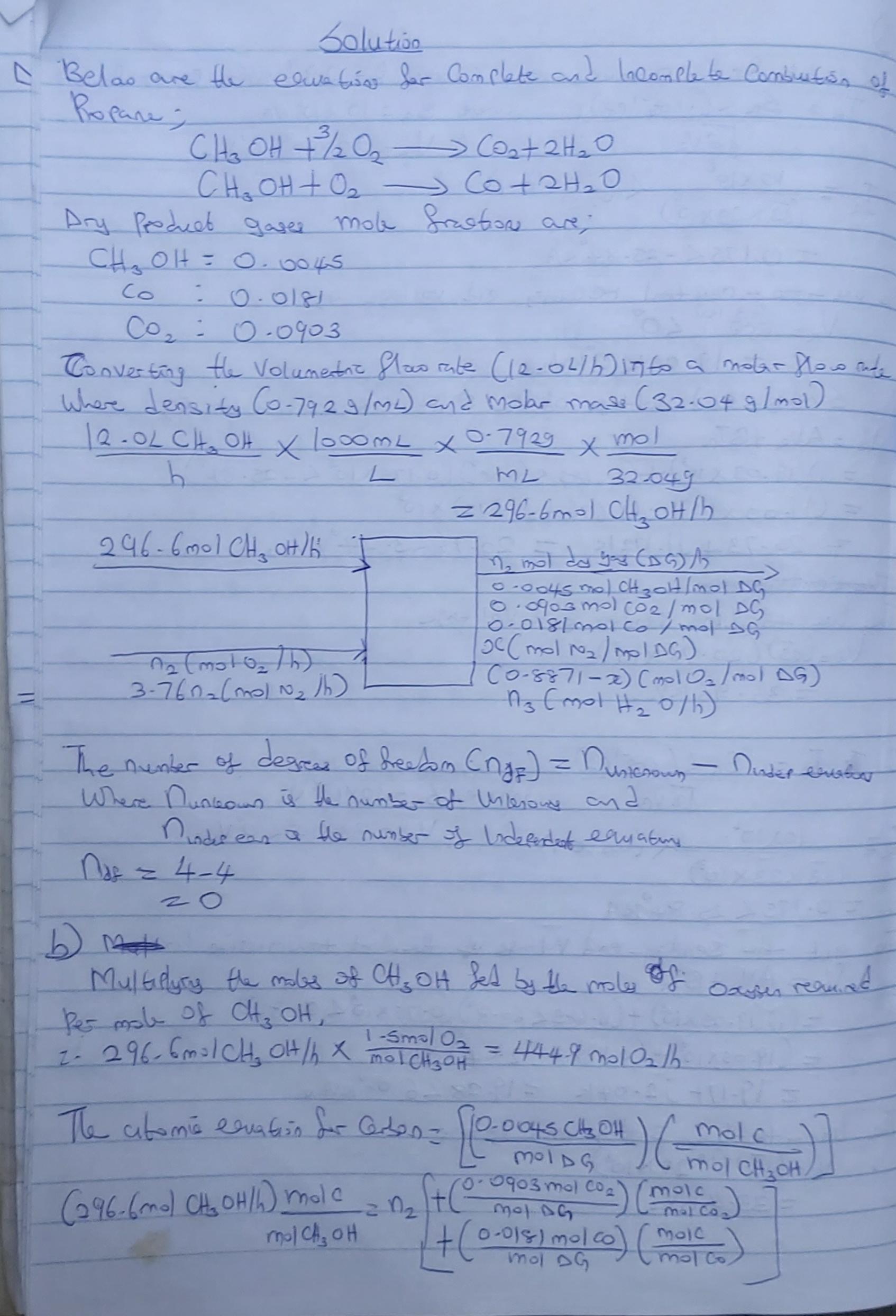
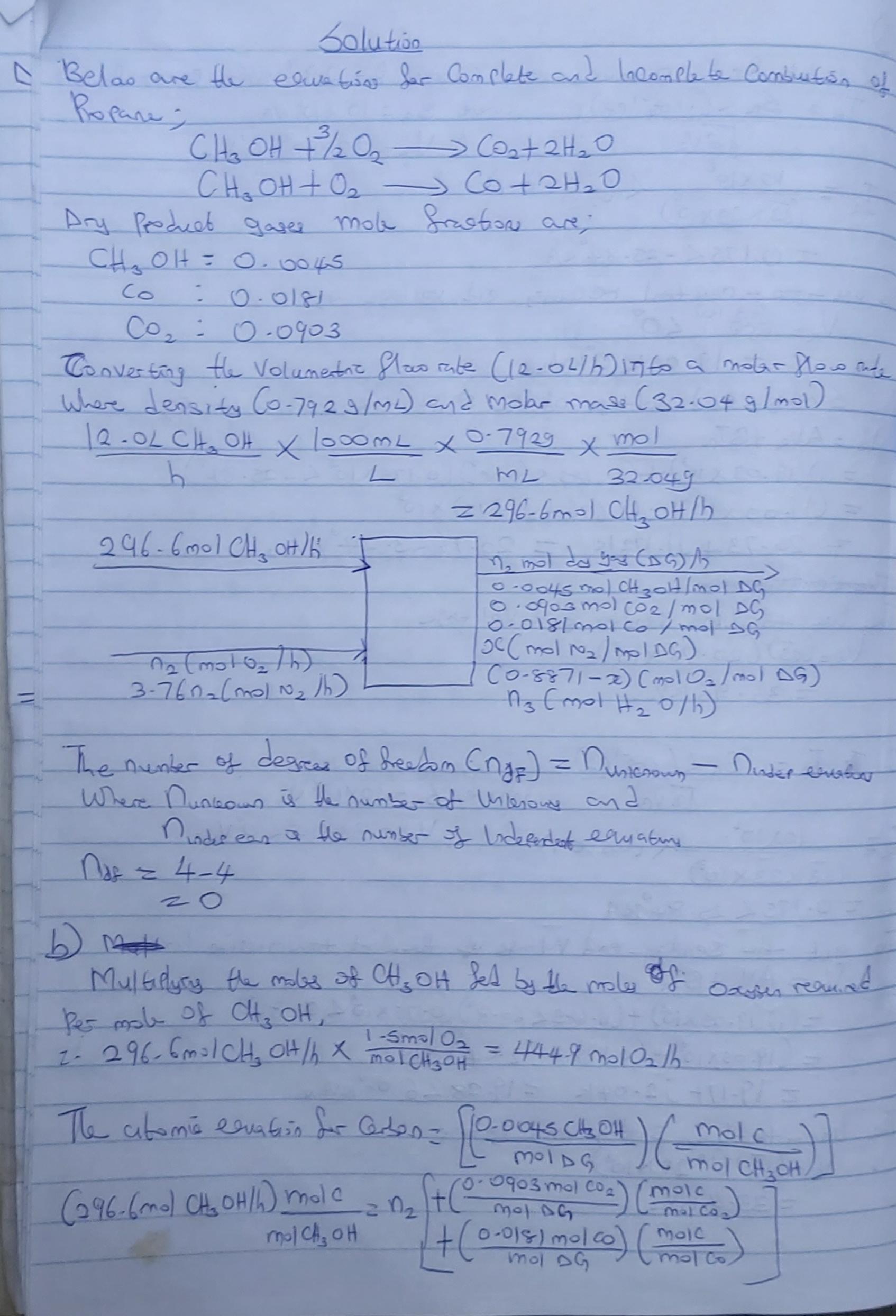
(a) The bellow flow chart shows that the system has 0° of freedom.

(b) i - Fractional conversion of menthol: 0.960 mol CH₃OH reacted/mol fed

    ii - The percentage excess air fed: 28.5%

   iii - molecular fraction of water in the product gas: 0.178 mol H₂O/mol

(c)  <u>Potential Problems: Remedies</u>

    Conflagration: The gas should be vented outside to prevent fire outbreak.

    Toxicity: Put a CO detection alarm in the room.

Explanation:

See picture for the flow chat and calculation of other answers.

You might be interested in
How many moles of ions are in 1.45 mol of K2SO4 ?
leonid [27]

Answer:

Explanation:

First we look generally at what makes K2SO4.

In one mole of K2SO4, there are 2 moles of the potassium ion (K+) and 1 mole of sulfate ion (SO4 2-).

Knowing that; in 1.75 moles of K2SO4, there must be 2 x 1.75moles of potassium ion (K+) and 1 x 1.75moles of Sulfate ion (SO4 2-)

This gives us 3.5moles of K+ and 1.75moles of SO4 2-

3 0
2 years ago
An ideal gas contained in a piston which is compressed. The gas is insulated so that no heat flows into or out of it. 1) What ha
Goryan [66]

Answer:Temperature increases

Explanation: As the gas in the container is an ideal gas so it should follow the ideal gas equation, the equation of state.

We know ideal gas equation to be PV=nRT where

   P=pressure

   V=Volume

   T=Temperature

   R=Real gas constant

   n=Number of moles

since the gas is insulated such that no heat goes into or out of the system .

When we compress the ideal gas using a piston, Thermodynamically it means that work is done on the system by the surroundings.

Now as the ideal gas is been compressed so the volume of the gas would decrease and slowly a time will reach when no more gas can be compressed that is there cannot be any further decrease in volume of the gas.

From the equation PV=nRT

Once there is no further compression is possible hence volume becomes constant so pressure of the ideal gas becomes directly proportional to the temperature as n and R are constants. Also as the pressure and volume are inversely related so an decrease in volume would lead to an increase in pressure.

As the ideal  gas is compressed so the pressure of the gas would increase since the gas molecules have smaller volume available after compression hence the gas molecules would quite frequently have collisions with other gas molecules or piston and this collision would lead to increase in speed of the gas molecules and  so the pressure would increase .

The increase in pressure would lead to an increase in temperature as show by the above ideal gas equation because the pressure and temperature are directly related.

So here we can say that work done on the system by surroundings leads to increase in temperature of the system.

5 0
2 years ago
Germanium is a group 4A semiconductor. The addition of a dopant atom (group 3A element) that has fewer valence electrons than th
klasskru [66]

Answer:

Doping with galium or indium will yield a p-type semiconductor while doping with arsenic, antimony or phosphorus will yield an n-type semiconductor.

Explanation:

Doping refers to improving the conductivity of a semiconductor by addition of impurities. A trivalent impurity leads to p-type semiconductor while a pentavalent impurity leads to an n-type semiconductor.

7 0
2 years ago
Gasoline has a density of 0.749 g/mL. There are 454 grams in a pound and 3.7854 litres in a gallon. How many pounds does 19.2 ga
alexgriva [62]

Answer:

119.9 pound

Explanation:

Given data:

Density of gasoline = 0.749 g/mL

Volume of gasoline = 19.2 gal (19.2× 37854 =72679.9 mL)

Mass = ?

Solution:

Density:

Density is equal to the mass of substance divided by its volume.

Units:

SI unit of density is Kg/m3.

Other units are given below,

g/cm3, g/mL , kg/L

Formula:

D=m/v

D= density

m=mass

V=volume

Now we will put the values in formula:

d = m/v

0.749 g/mL = m/ 72679.9 mL

m = 54437.25 g

gram to gallon:

54437.25/ 454

m = 119.9 pound

7 0
2 years ago
65g of nitric acid are produced in a reaction. 2.5g of platinum are added to the reaction vessel at the start of the reaction to
AysviL [449]

Answer:

2.5 g of platinum

Explanation:

Recall that a catalyst is a specie added to a reaction system to increase the rate of reaction. A catalyst does not participate in the chemical reaction hence it remains unchanged at the end of the chemical reaction. A catalyst merely provides an alternative reaction pathway by lowering the activation energy of the reaction system. Hence a catalysed reaction usually proceeds faster with less energy requirement than the uncatalysed reaction.

Since the catalyst does not participate in the reactions and remains unchanged at the end of the reaction, the mass of platinum will remain the same (2.5g). The mass can only change if a specie participates in the chemical reaction. Hence the answer.

6 0
2 years ago
Other questions:
  • if 5 moles of P4 reacted with 22 moles Cl2 according to the above reaction, determine:How many moles PCl3 are produced
    14·1 answer
  • Concentration of 10.00 mL of HBr if it takes 5 mL of a 0.253 M LiOH solution to<br> neutralize it?
    6·1 answer
  • A flask contains 0.230 mol of liquid bromine, br2. determine the number of bromine molecules present in the flask.
    11·2 answers
  • If 3.45 grams of Mg are burned how many grams of MgO are produced
    15·2 answers
  • Methylamine (ch3nh2) is a weakly basic compound. calculate the kb for methylamine if a 0.253 m solution is 4.07% ionized.
    8·1 answer
  • When trying to identify an unknown element a scientist determine other elements the unknown element reacts with chemicals watch
    6·1 answer
  • Classify each property as associated with a liquid that has strong or weak intermolecular forces Drag the appropriate items to t
    9·1 answer
  • What will occur if solution A containing 400 mosmol/L nonpenetrating solute is separated by a biological membrane from solution
    14·1 answer
  • A 0.050 M solution of AlCl3 had an observed osmotic pressure of 3.85 atm at 20 ∘C . Calculate the van't Hoff factor i for AlCl3.
    10·1 answer
  • After a reaction, a new compound contains 0.73 g Mg and 0.28 g N. What is the empirical formula of this compound?
    12·1 answer
Add answer
Login
Not registered? Fast signup
Signup
Login Signup
Ask question!