answer.
Ask question
Login Signup
Ask question
All categories
  • English
  • Mathematics
  • Social Studies
  • Business
  • History
  • Health
  • Geography
  • Biology
  • Physics
  • Chemistry
  • Computers and Technology
  • Arts
  • World Languages
  • Spanish
  • French
  • German
  • Advanced Placement (AP)
  • SAT
  • Medicine
  • Law
  • Engineering
ivolga24 [154]
2 years ago
4

1 m3 of saturated liquid water at 200°C is expanded isothermally in a closed system until its quality is 80 percent. Determine t

he total work produced by this expansion, in kJ.

Physics
1 answer:
shutvik [7]2 years ago
8 0

Answer:

w = 134121.2 [kJ]

Explanation:

This is a classic problem of thermodynamics, with the initial saturation conditions we can find the initial enthalpy.

We have to remember that working in a closed system that expands is equal to:

W = P * DV

where:

P = pressure of the system [Pa]

DV = volume differential (Final - initial)[m^3]

W = work done by the volume change [J]

And the enthalpy in each state is given by the following expression.

H = U + P*V

Where:

H = enthalpy [J]

U = internal energy [J]

P = pressure [Pa]

V = volume [m^3]

The work performed per unit of mass is equal to:

w = m*(h2 - h1)

Where:

m = mass of the system [kg}

h2 = enthalpy at pooint with 80% of quality [kJ]

h1 = enthalpy at saturated liquid water [kJ]

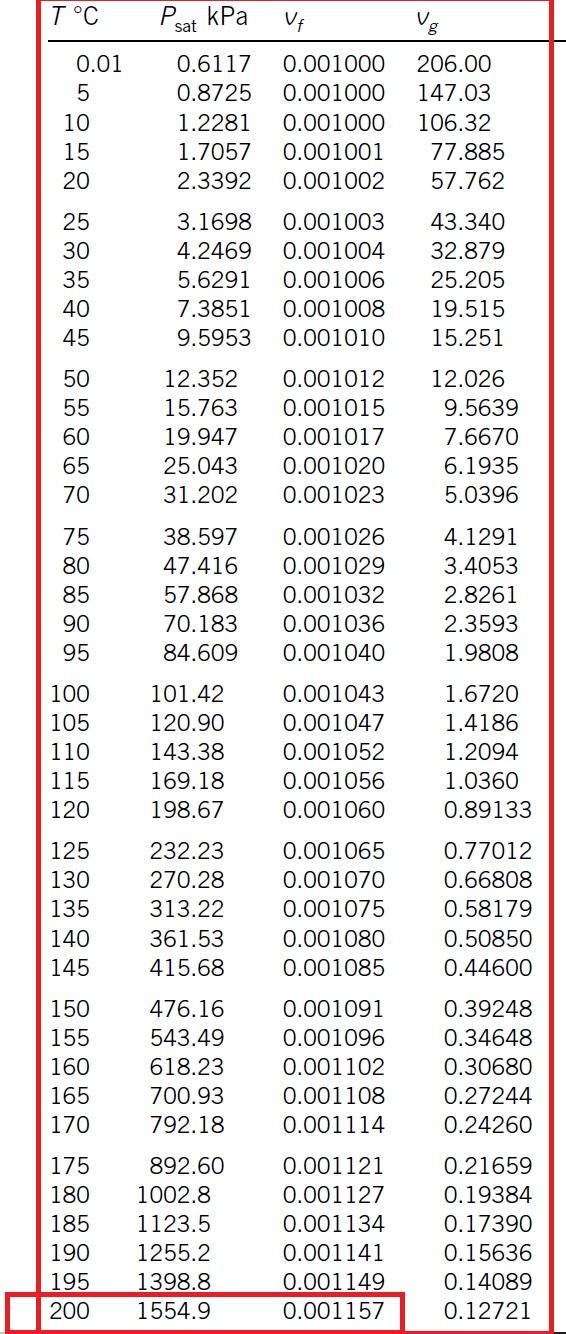
The mass can be solved using the initial data of water saturation.

In the attached image we can see how was selected the specific volume for the saturated liquid water.

v_{specf}=0.01157[m^3/kg]

m=\frac{V}{v_{specf}}\\ m=\frac{1}{0.01157}\\ m=86.43[kg]

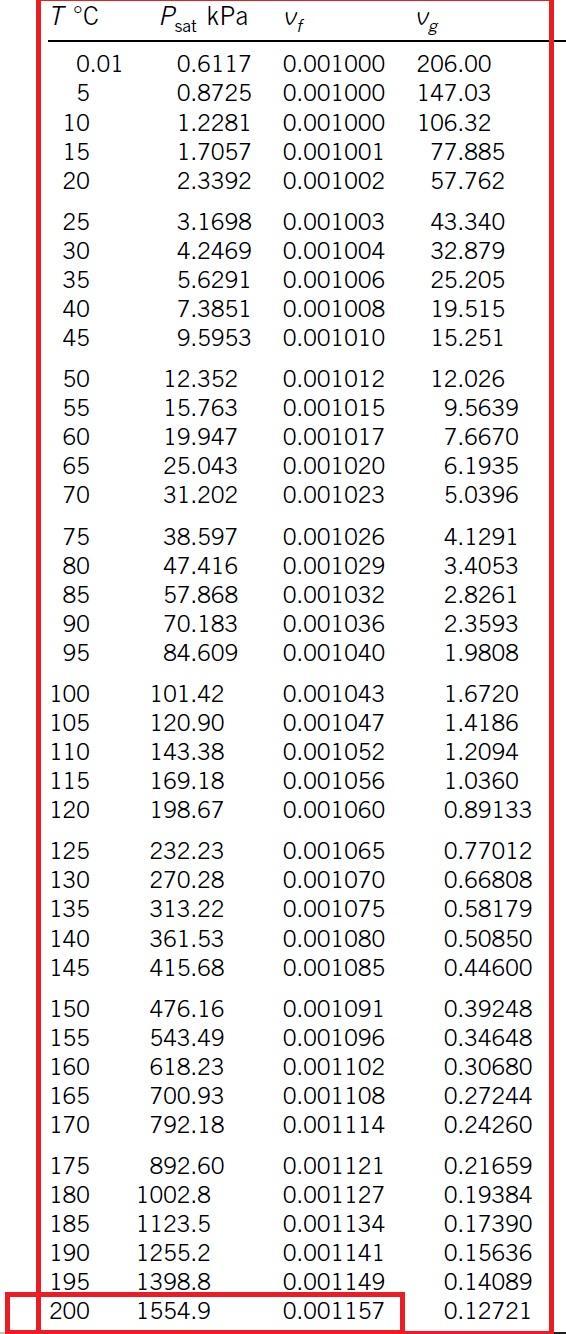
And the enthalpy at the initial saturation point can be found using the tables, (see the second attached image).

h1 = 852.26[kJ/kg]

And now using the definition for the quality of a pure substance in the saturation condition we can find the enthalpy at the second point.

h2 = hf + x*(hg - hf)

where:

hf = enthalpy at saturated liquid [kJ/kg]

hg = enthalpy at saturated gas [kJ/kg]

x = quality

h2 = enthalpy at the second point [kJ/kg]

using the tables we can find the values for hf and hg

hg = 2792 [kJ/kg]

hf = 852.26 [kJ/kg]

h2 = 852.26 + 0.8*(2792 - 852.26)

h2 = 2404.05[kJ/kg]

Now replacing in the equation we have:

w = 86.43 * (2404.05 - 852.26)

w = 134121.2 [kJ]
You might be interested in
3. A large crane lifts a 25,000 kg mass in the air. The amount of work that must be done by the
andreev551 [17]

\mathfrak{\huge{\orange{\underline{\underline{AnSwEr:-}}}}}

Actually Welcome to the concept of Efficiency.

Here we can see that, the Input work is given as 2.2 x 10^7 J and the efficiency is given as 22%

The efficiency is => 22% => 22/100.

so we get as,

E = W(output) /W(input)

hence, W(output) = E x W(input)

so we get as,

W(output) = (22/100) x 2.2 x 10^7

=> W(output) = 0.22 x 2.2 x 10^7 => 0.484 x 10^7

hence, W(output) = 4.84 x 10^6 J

The useful work done on the mass is 4.84 x 10^6 J

5 0
2 years ago
Two 8.0 Ω lightbulbs are connected in a 12 V series circuit. What is the power of both glowing bulbs?
V125BC [204]

Answer:

18 W

Explanation:

Applying,

P = V²/R.................. Equation 1

Where P = Power of both glowing bulbs, V = Voltage, R = Combined Resistance of both bulbs

Since: It is a series circuit,

Then,

R = R1+R2............. Equation 2

Where R1= Resistance of the first bulb, R2 = Resistance of the second bulb

Given: R1 = R2 = 8 Ω

Substitute into equation 1

R = 8+8

R = 16 Ω

Also Given: V = 12 V

Substitute into equation 1

P = 12²/8

P = 144/8

P = 18 W

7 0
2 years ago
A child is running his 46.1 g toy car down a ramp. The ramp is 1.73 m long and forms a 40.5° angle with the flat ground. How lon
frosja888 [35]

Answer:

t=0.704s

Explanation:

A child is running his 46.1 g toy car down a ramp. The ramp is 1.73 m long and forms a 40.5° angle with the flat ground. How long will it take the car to reach the bottom of the ramp if there is no friction?

from newton equation of motion , we look for the y component of the speed and look for the x component of the speed. we can then find the resultant of the speed

V^{2} =u^{2} +2as

Vy^2=0+2*9.8*1.73sin40.5

Vy^2=22.021

Vy=4.69m/s

Vx^2=u^2+2*9.81*cos40.5

Vy^2=25.81

Vy=5.08m/s

V=(Vy^2+Vx^2)^0.5

V=47.71^0.5

V=6.9m/s

from newtons equation of motion we know that force applied is directly proportional to the rate of change in momentum on a body.

f=force applied

v=velocity final

u=initial velocity

m=mass of the toy, 0.046

f=ma

f=m(v-u)/t

v=u+at

6.9=0+9.8t

t=6.9/9.81

t=0.704s

4 0
2 years ago
3. What conclusion can you make about the electric field strength between two parallel plates? Explain your answer referencing P
KIM [24]

Answer:

From the relation above we can conclude that the  as the distance between the two plate increases the electric field strength decreases

Explanation:

I cannot  find any attached photo, but we can proceed anyways theoretically.

The electric field strength (E) at any point in an electric field is the force experienced by a unit positive charge (Q) at that point

i.e

E=\frac{F}{Q}

But the force F

F= \frac{kQ1Q2}{r^2}

But the electric field intensity due to a point charge Q at a distance r meters away is given by

E= \frac{\frac{kQ1Q2}{r^2}}{Q} \\\\\E= \frac{Q1}{4\pi er^2 }

<em>From the relation above we can conclude that the  as the distance between the two plate increases the electric field strength decreases</em>

6 0
2 years ago
To make the jump, Neo and Morpheus have pushed against their respective launch points with their legs applying a _____ to the la
ra1l [238]
Force, newtons 3rd law of motion stated for every action there is an equal and opposite reaction
7 0
2 years ago
Other questions:
  • The temperature, T, of a gas is jointly proportional to the pressure P of the gas and the volume V occupied by the gas. Use C as
    12·1 answer
  • In the Daytona 500 auto race, a Ford Thunderbird and a Mercedes Benz are moving side by side down a straightaway at 71.0 m/s. Th
    12·1 answer
  • Two red blood cells each have a mass of 9.05×10⁻¹⁴ kg and carry a negative charge spread uniformly over their surfaces. The repu
    9·1 answer
  • For which of the following problems would a scientist most likely use carbon-14?
    7·1 answer
  • In Hooke's law, Fspring=kΔx , what does the Fspring stand for?
    8·2 answers
  • A gas laser has a cavity length of 1/3 m and a single oscillation frequency of 9.0 x 10¹⁴ Hz. What is the cavity mode number?
    13·1 answer
  • You live on a planet far from ours. "Based on extensive communication with a physicist on earth", you have determined that all l
    6·1 answer
  • A steel cylinder at sea level contains air at a high pressure. Attached to the tank are two gauges, one that reads absolute pres
    11·2 answers
  • A solid cube of edge length r, a solid sphere of radius r, and a solid hemisphere of radius r, all made of the same material, ar
    9·1 answer
  • Two very small +3.00-μC charges are at the ends of a meter stick. Find the electric potential (relative to infinity) at the cent
    6·1 answer
Add answer
Login
Not registered? Fast signup
Signup
Login Signup
Ask question!