answer.
Ask question
Login Signup
Ask question
All categories
  • English
  • Mathematics
  • Social Studies
  • Business
  • History
  • Health
  • Geography
  • Biology
  • Physics
  • Chemistry
  • Computers and Technology
  • Arts
  • World Languages
  • Spanish
  • French
  • German
  • Advanced Placement (AP)
  • SAT
  • Medicine
  • Law
  • Engineering
KIM [24]
2 years ago
4

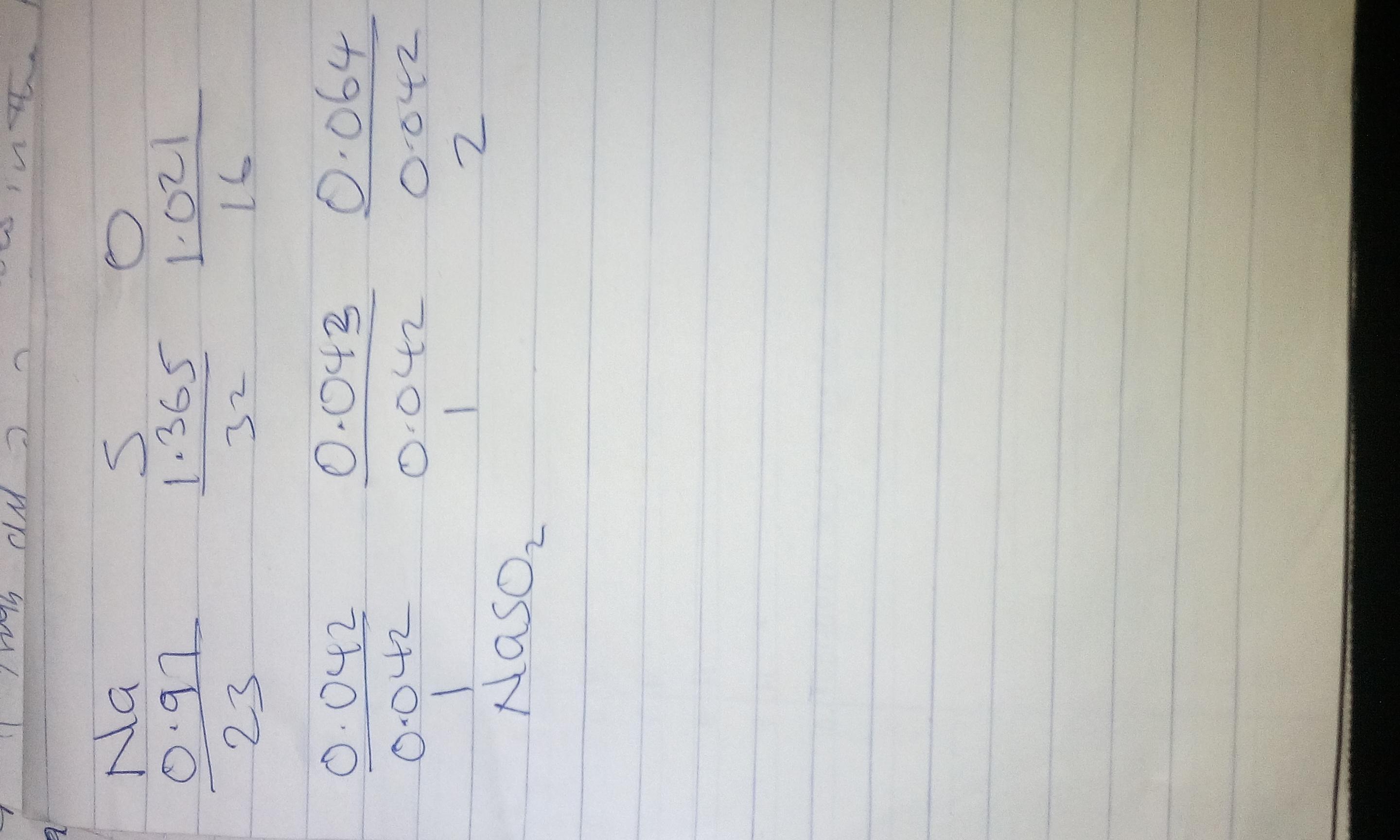
The active ingredient in photographic fixer solution contains sodium, sulfur, and oxygen. Analysis of a sample shows that the sa

mple contains 0.97 g of Na, 1.365 g of S, and 1.021 g of O. What is the empirical formula of the substance

Chemistry
1 answer:
svetlana [45]2 years ago
4 0

Answer:

NaSO2

Explanation:

The empirical formula is the simplest formula of a compound that shows the ratio of atoms of each element present in a compound. We obtain this empirical formula from the information given by dividing the relative atomic mass of each element by the given mass of each atom. Then we use the lowest ratio to divide through and record whole numbers. Hence the answer.

You might be interested in
Calculate the mass in grams of each of the following amounts: 1.002 mol of chromium 4.08 x 10⁻⁸ mol of neon
Pepsi [2]

Answer:

Mass_{chromium}=52.1\ g

Mass_{neon}=8.23\times 10^{-7}\ g

Explanation:

<u>Calculation of the mass of chromium as:- </u>

Moles = 1.002 moles

Molar mass of chromium = 51.9961 g/mol

The formula for the calculation of moles is shown below:

moles = \frac{Mass\ taken}{Molar\ mass}

Thus,

1.002\ mol= \frac{Mass}{51.9961\ g/mol}

Mass_{chromium}=1.002\times 51.9961\ g = 52.1\ g

<u>Calculation of the mass of neon as:- </u>

Moles = 4.08\times 10^{-8} moles

Molar mass of neon = 20.1797 g/mol

Thus,

1.002\ mol= \frac{Mass}{20.1797\ g/mol}

Mass_{neon}=4.08\times 10^{-8}\times 20.1797\ g = 8.23\times 10^{-7}\ g

6 0
2 years ago
Elements that do not have full outer electron shells will donate, share, or take electrons from other atoms. Choose the items th
Tamiku [17]

it´s actually Lithium and fluorine / Magnesium and Chlorine / Beryllium and Nitrogen

8 0
2 years ago
Which of the compounds above are strong enough acids to react almost completely with a hydroxide ion (pka of h2o = 15.74) or wit
luda_lava [24]

The compounds can react with OH⁻ and HCO₃⁻ only C₅H₆N pyridinium

<h3><em>Further explanation </em></h3>

In an acid-base reaction, it can be determined whether or not a reaction occurs by knowing the value of pKa or Ka from acid and conjugate acid (acid from the reaction)

Acids and bases according to Bronsted-Lowry

Acid = donor (donor) proton (H + ion)

Base = proton (receiver) acceptor (H + ion)

If the acid gives (H +), then the remaining acid is a conjugate base because it accepts protons. Conversely, if a base receives (H +), then the base formed can release protons and is called the conjugate acid from the original base.

From this, it can be seen whether the acid in the product can give its proton to a base (or acid which has a lower Ka value) so that the reaction can go to the right to produce the product.

The step that needs to be done is to know the pKa value of the two acids (one on the left side and one on the right side of the arrow), then just determine the value of the equilibrium constant

Can be formulated:

K acid-base reaction = Ka acid on the left : K acid on the right.

or:

pK = acid pKa on the left - pKa acid on the right

K = equilibrium constant for acid-base reactions

pK = -log K;

K~=~10^{-pK}

K value> 1 indicates the reaction can take place, or the position of equilibrium to the right.

There is some data that we need to complete from the problem above, which is the pKa value of some compounds that will react, namely:

pyridinium pKa = 5.25

acetone pKa = 19.3

butan-2-one pKa = 19

Let's look at the K value of each possible reaction:

pka H₂O = 15.74, pka of H₂CO₃ = 6.37)

  • 1. C₅H₆N pyridinium

* with OH⁻

C₅H₆N + OH- ---> C₅H₅N- + H₂O

pK = pKa pyridinium - pKa H₂O

pK = 5.25 - 15.74

pK = -10.49

K~=~10^{4.9}

K values> 1 indicate the reaction can take place

* with HCO3⁻

C₅H₆N + HCO₃⁻-- ---> C₅H₅N⁻ + H₂CO₃

pK = 5.25 - 6.37

pK = -1.12

K`=~10^{1.12]

Reaction can take place

  • 2. Acetone C₃H₆O

* with OH-

C₃H₆O + OH⁻ ---> C₃H₅O- + H₂O

pK = 19.3 - 15.74

pK = 3.56

K~=~10^{ -3.56}

Reaction does not happen

* with HCO₃-

C₃H₆O + HCO₃⁻ ----> C₃H₅O⁻ + H₂CO₃

pK = 19.3 - 6.37

pK = 12.93

K`=~10 ^{-12.93}

Reaction does not happen

  • 3. butan-2-one C₄H₇O

* with OH-

C₄H₇O + OH- ---> C₄H₆O- + H₂O

pK = 19 - 15.74

pK = 3.26

K~=~10^{-3.26}

Reaction does not happen

* with HCO₃⁻

C₄H₇O + HCO₃⁻ ---> C₄H₆O⁻ + H₂CO₃

pK = 19 - 6.37

pK = 12.63

K~=~ 10^{-12.63}

Reaction does not happen

So that can react with OH⁻ and HCO₃⁻ only C₅H₆N pyridinium

<h3><em>Learn more </em></h3>

the lowest ph

brainly.com/question/9875355

the concentrations at equilibrium.

brainly.com/question/8918040

the ph of a solution

brainly.com/question/9560687

Keywords : acid base reaction, the equilibrium constant
5 0
2 years ago
Read 2 more answers
Which of the following contains maximum number of atoms? a) 2.0g hydrogen b) 2.0g oxygen c) 2.0g nitrogen d) 2.0g methane
Fynjy0 [20]
A) 2.0g hydrogen is your answer
7 0
2 years ago
Describe the many different forms of energy involved with stretching and releasing a rubber band. What other processes are simil
Nadya [2.5K]

Answer:

Conversion of kinetic energy to potential energy (chemo mechanical energy)

In the state of rest, the rubber is a tangled mass of long chained cross-linked polymer that due to their disorderliness are in a state of increased entropy. By pulling on the polymer, the applied kinetic energy stretches the polymer into straight chains, giving them order and reducing their entropy. The stretched rubber then has energy stored in the form of chemo mechanical energy which is a form of potential energy

Conversion of the stored potential energy in the stretched to kinetic energy

By remaining in a stretched condition, the rubber is in a state of high potential energy, when the force holding the rubber in place is removed, due to the laws of thermodynamics, the polymers in the rubber curls back to their state of "random" tangled mass releasing the stored potential energy in the process and doing work such as moving items placed in the rubber's path of motion such as an object that has weight, w then takes up the kinetic energy 1/2×m×v² which can can result in the flight of the object.

Explanation:

5 0
2 years ago
Read 2 more answers
Other questions:
  • Looking at the same nonmetal group on the periodic table, how does the reactivity of an element in period 2 compare to the react
    12·2 answers
  • An ideal gas contained in a piston which is compressed. The gas is insulated so that no heat flows into or out of it. 1) What ha
    7·1 answer
  • A class is given a demonstration of solution chemistry and solubility equilibria.Passage: A 6.57-g sample of NiSO4•6H2O (molar m
    10·1 answer
  • Atorvastatin is sold under the trade name Lipitor and is used for lowering cholesterol. Annual global sales of this compound exc
    6·1 answer
  • For the reaction: MgF2(s) ⇌ Mg2+(aq) + 2F- (aq), Ksp= 6.4 × 10⁻⁹, the addition of 0.10 M NaF to the solution cause what effect o
    15·1 answer
  • What we call "tin cans" are really iron cans coated with a thin layer of tin. The anode is a bar of tin and the cathode is the i
    13·1 answer
  • A solution is made by dissolving 58.125 g of sample of an unknown, nonelectrolyte compound in water. The mass of the solution is
    12·1 answer
  • A mixture of gases containing 0.20 mol of SO2 and 0.20 mol of O2 in a 4.0 L flask reacts to form SO3. If the temperature is 25ºC
    11·1 answer
  • The decantate from Question 1 that possibly contains K, Zn, or Cr, is neutralized with acetic acid and divided into the appropri
    9·1 answer
  • Draw the Lewis structures for CH3OH, CH2O and HCOOH. Indicate the hybrid orbital used in the sigma bonds for each of the carbon
    7·1 answer
Add answer
Login
Not registered? Fast signup
Signup
Login Signup
Ask question!