answer.
Ask question
Login Signup
Ask question
All categories
  • English
  • Mathematics
  • Social Studies
  • Business
  • History
  • Health
  • Geography
  • Biology
  • Physics
  • Chemistry
  • Computers and Technology
  • Arts
  • World Languages
  • Spanish
  • French
  • German
  • Advanced Placement (AP)
  • SAT
  • Medicine
  • Law
  • Engineering
Korvikt [17]
2 years ago
11

Which of the following 100.0-g samples contains the greatest number of atoms?a.Magnesiumb.Zincc.Silverd.Calciume.All samples con

tain the same number of atom

Chemistry
2 answers:
KATRIN_1 [288]2 years ago
3 0

Answer: The correct answer is (a)Magnesium

Explanation:

Step 1:

Calculate the number of moles of each of the samples mentioned.

a)Magnesium

n=mass/atomic mass

n=100.0/24.305

n=4.11 moles

b)Zinc

n=100.0/65.38

n=1.53 moles

c)Silver

n=100.0/107.87

n=0.93 moles

d)Calcium

n=100/40.078

n= 2.30 moles

Step 2

Find the number of atoms by multiplying no. of moles with avogadro's number

a)Magnesium

no. of atoms=4.11 * 6.022*10^23

= 2.45*10^24 atoms

b)Zinc

no. of atoms=1.53 * 6.022*10^23

= 9.21*10^23 atoms

c)Silver

no. of atoms=0.93 * 6.022*10^23

=5.60*10^23 atoms

d)Calcium

no. of atoms=2.30 * 6.022*10^23

=1.39*10^24 atoms

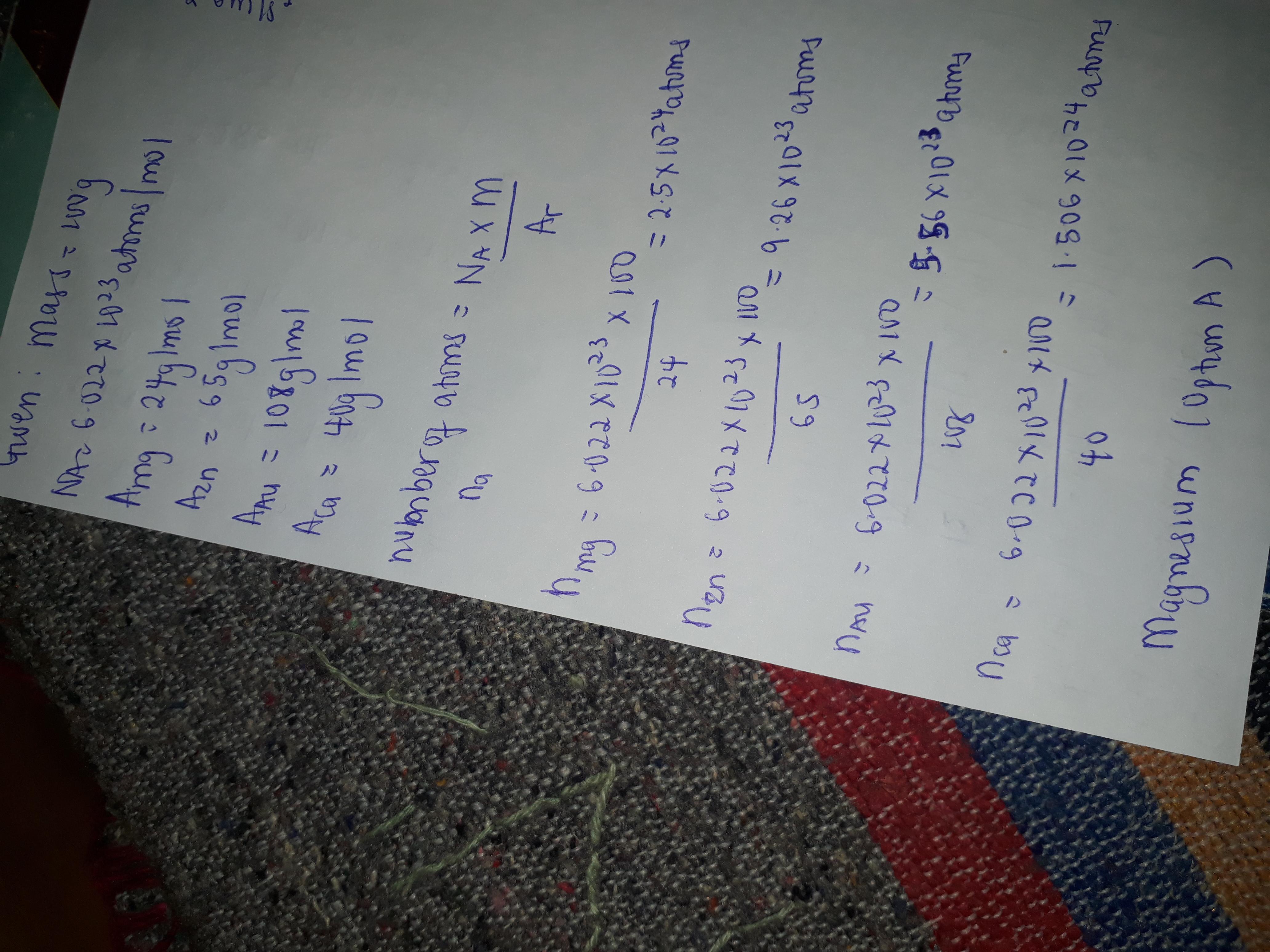
As pet the above calculations, sample of Magnesium contains the highest number of atoms

andreev551 [17]2 years ago
3 0

Explanation:

Below is an attachment containing the solution.

You might be interested in
Analyze and solve this partially completed galvanic cell puzzle. There are 4 electrodes each identified by a letter of the alpha
klasskru [66]

Complete Question

The complete question is shown on the first uploaded image

Answer:

The correct option is  E_{cell}__{AC}} = 0.94

Explanation:

  From the question we are told that

          the cell voltage for AD is  E_{cell}__{AD}} = 1.56V

From the data give we can see that

               E_{cell}__{AD}} - E_{cell}__{BD}} = E_{cell}__{AB}}

i.e           1.56 - 1.53 = 0.03

   In the same way we can say that

              E_{cell}__{AD}}-E_{cell}__{CD}} = E_{cell}__{AC}}

=>        E_{cell}__{AC}}=1.56- 0.62

                       E_{cell}__{AC}} = 0.94


5 0
2 years ago
What is net ionic equation borax hydrolysis?
deff fn [24]
The net ionic equation of borax hydrolysis would be:

 <span>Na2B4O7 + 7H2O-----------------> 2 NaOH + 4 H3BO3
</span>
Wherein 2 moles of sodium hydroxide and 4 moles of boric acid are produced by the hydrolysis.
I hope my answer has come to your help. Thank you for posting your question here in Brainly. We hope to answer more of your questions and inquiries soon. Have a nice day ahead!
7 0
2 years ago
A sample of an ideal gas occupies 2.78 x 10^3 mL at 25°C and 760 mm Hg.
iris [78.8K]

Answer: It will occupy 4.45\times 10^3ml at the same temperature and 475 mm Hg.

Explanation:

Boyle's Law: This law states that pressure is inversely proportional to the volume of the gas at constant temperature and number of moles.

P\propto \frac{1}{V}     (At constant temperature and number of moles)

P_1V_1=P_2V_2    (At constant temperature and number of moles)

where,

P_1 = initial pressure of gas = 760 mm Hg

P_2 = final pressure of gas = 475 mm Hg

V_1 = initial volume of gas = 2.78\times 10^3ml

V_2  = final volume of gas = ?

Putting in the values:

760mm Hg\times 2.78\times 10^3ml=475 mm Hg\times V_2

V_2=4.45\times 10^3ml

Thus it will occupy 4.45\times 10^3ml at the same temperature and 475 mm Hg

5 0
2 years ago
Read 2 more answers
A 15.0-L rigid container was charged with 0.500 atm of kryp‑ ton gas and 1.50 atm of chlorine gas at 350.8C. The krypton and chl
Alecsey [184]

Answer: 32.94 g

Explanation: It's stoichiometry problem so balanced equation is required. The balanced equation is given below:

Kr+2Cl_2\rightarrow KrCl_4

From the balanced equation, krypton and chlorine react in 1:2 mol ratio. We will calculate the moles of each reactant gas using ideal gas law equation(PV = nRT) and then using mol ratio the limiting reactant is figured out that helps to calculate the amount of the product formed.

for Krypton, P = 0.500 atm and for chlorine, P = 1.50 atm

V = 15.0 L

T = 350.8 + 273 = 623.8 K

For krypton, n=\frac{0.500*15.0}{0.0821*623.8}

n = 0.146 moles

for chlorine, n=\frac{1.50*15.0}{0.0821*623.8}

n = 0.439

From the mole ratio, 1 mol of krypton reacts with 2 moles of chlorine. So 0.146 moles of krypton will react with 2 x 0.146 = 0.292 moles of chlorine.

Since 0.439 moles of chlorine are available, it is present in excess and hence the limiting reactant is krypton.

So, the amount of product formed is calculated from moles of krypton.

Molar mass of krypton tetrachloride is 225.61 gram per mol.

There is 1:1 mol ratio between krypton and krypton tetrachloride.

0.146molKr(\frac{1molKrCl_4}{molKr})(\frac{225.61gKrCl_4}{1molKrCl_4})

= 32.94 g of KrCl_4

So, 32.94 g of the product will form.

5 0
2 years ago
Write the electron configurations for the following ions:
Ket [755]

Answer:

Co²⁺ : 1s² 2s² 2p⁶ 3s² 3p⁶ 3d⁷

Sn²⁺ : 1s² 2s² 2p⁶ 3s² 3p⁶ 4s² 3d¹⁰ 4p⁶ 5s² 4d¹⁰

Zr⁴⁺ : 1s² 2s² 2p⁶ 3s² 3p⁶ 4s² 3d¹⁰ 4p⁶

Ag⁺ : 1s² 2s² 2p⁶ 3s² 3p⁶ 4s² 3d¹⁰ 4p⁶ 4d¹⁰

S²⁻ : 1s² 2s² 2p⁶ 3s² 3p⁶

Explanation:

Cobalt (Co): atomic number 27

<u>The electronic configuration of Co in ground state: </u>

1s² 2s² 2p⁶ 3s² 3p⁶ 4s² 3d⁷

<u>The electronic configuration of Co in +2 oxidation state (Co²⁺) :</u>

1s² 2s² 2p⁶ 3s² 3p⁶ 3d⁷

Tin (Sn): atomic number 50

<u>The electronic configuration of Sn in ground state: </u>

1s² 2s² 2p⁶ 3s² 3p⁶ 4s² 3d¹⁰ 4p⁶ 5s² 4d¹⁰ 5p²

<u>The electronic configuration of Sn in +2 oxidation state (Sn²⁺) </u>:

1s² 2s² 2p⁶ 3s² 3p⁶ 4s² 3d¹⁰ 4p⁶ 5s² 4d¹⁰

Zirconium (Zr): atomic number 40

<u>The electronic configuration of Zr in ground state:</u>

1s² 2s² 2p⁶ 3s² 3p⁶ 4s² 3d¹⁰ 4p⁶ 5s² 4d²

<u>The electronic configuration of Zr in +4 oxidation state (Zr⁴⁺) :</u>

1s² 2s² 2p⁶ 3s² 3p⁶ 4s² 3d¹⁰ 4p⁶

Silver (Ag): atomic number 47

<u>The electronic configuration of Ag in ground state:</u>

1s² 2s² 2p⁶ 3s² 3p⁶ 4s² 3d¹⁰ 4p⁶ 5s¹ 4d¹⁰

<u>The electronic configuration of Ag in +1 oxidation state (Ag⁺) :</u>

1s² 2s² 2p⁶ 3s² 3p⁶ 4s² 3d¹⁰ 4p⁶ 4d¹⁰

Sulphur (S): atomic number 16

<u>The electronic configuration of S in ground state:</u>

1s² 2s² 2p⁶ 3s² 3p⁴

<u>The electronic configuration of S in -2 oxidation state (S²⁻) :</u>

1s² 2s² 2p⁶ 3s² 3p⁶
8 0
2 years ago
Read 2 more answers
Other questions:
  • A chemist has dissolved a certain substance in water. The chemist knows that more of the substance could be dissolved into the w
    13·2 answers
  • How can you tell if a sample contains baking soda and cornstarch or baking powder?
    6·2 answers
  • What is the name of the compound CuCO³?
    15·2 answers
  • If 200.0 g of copper(II) sulfate react with an excess of zinc metal, what is the theoretical yield of copper? 1.253 g 50.72 g 79
    11·1 answer
  • How many moles of libr are contained in 347 g of water in a 0.175 m libr solution?
    7·1 answer
  • Current of 250. a flows for 24.0 hours at an anode where the reaction occurring is as follows: mn2+(aq) + 2h2o(l) → mno2(s) + 4h
    8·2 answers
  • A student wants to form 2‑hexanol using acidic hydration. He finds four alkenes in the inventory cabinet that could be possible
    12·1 answer
  • Every Methane molecule looks different. True or false?
    5·1 answer
  • Use the words protons neutrons and I suppose in the same sentence ​
    5·1 answer
  • How many moles are present in 2.126 g of H2O2 ?
    5·2 answers
Add answer
Login
Not registered? Fast signup
Signup
Login Signup
Ask question!