answer.
Ask question
Login Signup
Ask question
All categories
  • English
  • Mathematics
  • Social Studies
  • Business
  • History
  • Health
  • Geography
  • Biology
  • Physics
  • Chemistry
  • Computers and Technology
  • Arts
  • World Languages
  • Spanish
  • French
  • German
  • Advanced Placement (AP)
  • SAT
  • Medicine
  • Law
  • Engineering
Likurg_2 [28]
2 years ago
12

A 5-mm-thick stainless steel strip (k = 21 W/m·K, rho = 8000 kg/m3, and cp = 570 J/kg·K) is being heat treated as it moves throu

gh a furnace at a speed of 1 cm/s. The air temperature in the furnace is maintained at 840°C with a convection heat transfer coefficient of 80 W/m2·K. If the furnace length is 3 m and the stainless steel strip enters it at 20°C, determine the surface temperature gradient of the strip at mid-length of the furnace. (Round the final answer to the nearest whole number.)

Physics
2 answers:
schepotkina [342]2 years ago
6 0

Answer:

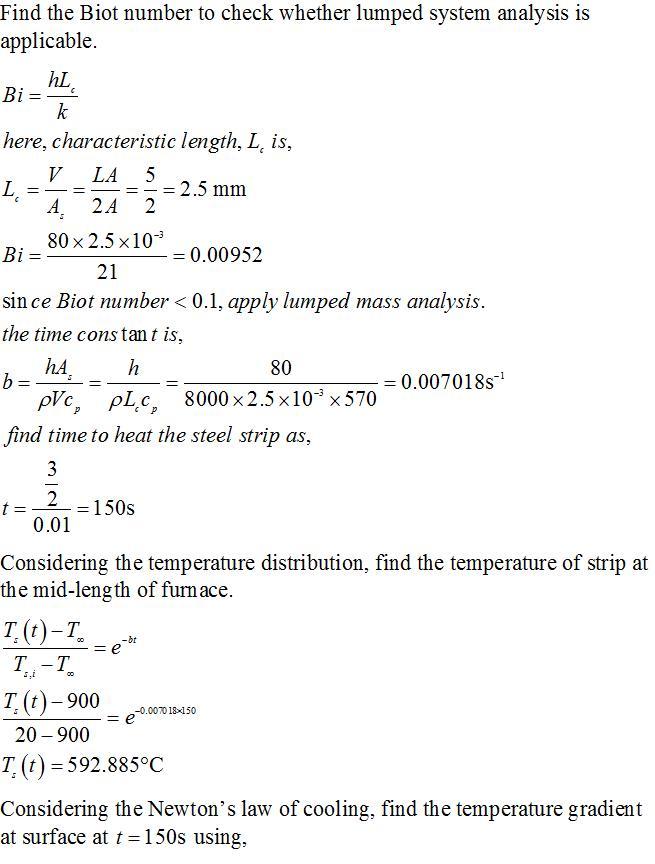
1170 Kelvin/meter

Explanation:

See attached pictures.

aivan3 [116]2 years ago
3 0

Answer:

The surface temperature gradient is given as 1170.137 K/m

Explanation:

In to obtain the surface temperature gradient we need to obtain the characteristics length and the formula for this is

                                 L_c = \frac{V}{A_s}

Where V is the volume of the ball and  A_s is the surface area of the particle

     Now let assume a one-dimensional heat transfer and that width of the strip is negligible

        Hence the surface area would be the two opposite surface of the strip which means that the volume is obtained by multiplying surface area and the thickness

          Mathematically

                    V = A *L

        and     A_s =2A

Substituting this into the formula above

             L_c = \frac{(A*L)}{(2A)}

                 =\frac{L}{2}  

Note that  L in this equation is the thickness of the plate and from the question it is equal to 5 mm

 So

               L_c = \frac{5}{2} = 2.5 \ mm

      In order to obtain the temperature of the gradient of the strip we need to obtain the temperature of the strip at mid-length of the furnace

  and the formula is

                  e^{-bt} = \frac{T(t)-T_\infty }{T_i-T_\infty}

Where T_\infty is the ambient temperature  = 900 °C

            T_i is the initial temperature  = 20 °C

            b is obtained with the formula

                             b =\frac{hA_s}{\rho C_p V}

           replacing  V with A_s * L_c  

                   b = \frac{hA_s}{\rho C_p L_c}

                    =\frac{h}{\rho C_p L_c}

 Where h is the heat transfer coefficient  \rho is the density , C_p is the specific heat at constant pressure  and L_c is the characteristics length

           Substituting

80 \ W/m^2\cdot K \ for \ h  \ 8000kg /m^3 \ for \ \rho , \ 570J/kg \ \cdot K \ for \ C_p \ and \\\\2.5mm \ for L_c

          b = \frac{80}{y(8000)* 570 * [2.5 \ mm}\frac{10^{-3 }m}{1mm} ]}

            =\frac{80} {8* 570* 2.5}

           = 0.007017 \ s^{-1}

       t is the of the stainless-steel  strip being heated and the formula is

                    t = \frac{(I_f/2)}{v}

       Where I_f is the length of the furnace , and v is the speed

       Substituting  3 m for  I_f  and 1 cm/s for v

                     t =\frac{(3/2)}{[1 cm/s \ * \frac{10^{-2}m}{1cm} ]}

                       = \frac{1.5}{10^{-2}}

                       = 150s

Substituting the obtained value into the formula for temperature of strip at mid-length of the furnace we have

                    e^{(-0.007017 s^{-2})(150s)} = \frac{T(t)- 900}{20 - 900}

                    T(t) = 900 + (20-900) (e^{(0.007017)(150)})

                           =592.839°C

     Now to obtain the surface temperature gradient of the strip at mid-length of the furnace we would apply this formula

                 h = \frac{-k[\frac{\delta T}{\delta y} ]_{y=0}}{T(t)-T_{\infty}}

=>        [\frac{\delta T}{\delta y} ]_{y=0}} =\frac{h}{k}  (T(t) - T_{\infty})

           Where h is the convection heat transfer coefficient

            Where [\frac{\delta T}{\delta y} ]_{y=0}} is the surface temperature gradient of the strip at mid-length of the furnace

      T(t) is the temperature of the strip at mid-length of the furnace , T_{\infty} the ambient temperature  and k is the thermal conductivity

      Substituting \ 80 \ W/m^2 \cdot K for h \ , \ 592.839 ^oC \ for \ T(t) \ , \ 900 ^o C\\for  \ T_{\infty }  \ and \ 21 W/m \ \cdot \ K \ for \ k

            So

                  [\frac{\delta T}{\delta y} ]_{y=0}} =-\frac{80}{21} (592.839 -900)

                              =1170.137 K/m


You might be interested in
Electric current in a solid metal conductor is caused by the movement of what ?
Vlad1618 [11]
Electric current in a solid metal conductor is caused by the movement of electric charge. An electric current is the flow of electric charge. An electron current, the flow of electrons, contributes to an electric current since the electron 'carries' negative electric charge. The flow of ions also contributes to an electric current in, for example, the electrolyte of an electrochemical cell. 
5 0
2 years ago
You throw a baseball straight up into the air with a speed of 24.5 m/s. How long does it take the baseball to reach its highest
galben [10]
Time=speed/acceleration
Gravitaional Acceleration=9.8 m/s^2
Speed=24.5 m/s
Time=24.5/9.8=2.5 s
3 0
2 years ago
Read 2 more answers
An object travels 50 m in 4 s. It had no initial velocity and experiences constant acceleration. What is the magnitude of the ac
Allisa [31]

Answer:

The formula to calculate velocity in this case:

v = v0 + at

=> a = (v - v0)/t

       = (50 - 0)/4

       = 50/4 = 12.5 (m/s2)

Hope this helps!

:)

3 0
2 years ago
An object that weighs 2.450 N is attached to an ideal massless spring and undergoes simple harmonic oscillations with a period o
Viktor [21]

Answer:

Spring constant, k = 24.1 N/m

Explanation:

Given that,

Weight of the object, W = 2.45 N

Time period of oscillation of simple harmonic motion, T = 0.64 s

To find,

Spring constant of the spring.

Solution,

In case of simple harmonic motion, the time period of oscillation is given by :

T=2\pi\sqrt{\dfrac{m}{k}}

m is the mass of object

m=\dfrac{W}{g}

m=\dfrac{2.45}{9.8}

m = 0.25 kg

k=\dfrac{4\pi^2m}{T^2}

k=\dfrac{4\pi^2\times 0.25}{(0.64)^2}

k = 24.09 N/m

or

k = 24.11 N/m

So, the spring constant of the spring is 24.1 N/m.

6 0
2 years ago
Summarize two of the most common arguments made by animal rights advocates to support the discontinuation of animals in research
Dvinal [7]
Animal rights<span> is the idea that some, or all, </span>non-human animals<span> are entitled to the possession of their own lives and that their most basic interests—such as the need to avoid </span>suffering—should be afforded the same consideration as similar interests of human beings. <span>They maintain that animals should no longer be viewed as property or used as food, clothing, research subjects, entertainment, or beasts of burden.</span>
3 0
2 years ago
Read 2 more answers
Other questions:
  • What upward gravitational force does a 5600kg elephant exert on the earth?
    12·2 answers
  • Which of the following would increase the strength of an electromagnet ?
    5·2 answers
  • Multiplying or dividing vectors by scalars results in a. vectors. b. scalars. c. vectors if multiplied or scalars if divided. d.
    14·2 answers
  • Which shows the correct magnification equation?
    5·2 answers
  • A box of mass 8 kg slides across a frictionless surface at an initial speed 1.5 m/s into a relaxed spring of spring constant 69
    12·1 answer
  • A point charge q1 = 4.50 nC is located on the x-axis at x = 1.95 m , and a second point charge q2 = -6.80 nC is on the y-axis at
    7·1 answer
  • A kickball is kicked straight up at a speed of 22.4m/s. how high does it go
    8·1 answer
  • Look at the two question marks between zinc (Zn) and arsenic (As). At the time, no elements were known
    9·1 answer
  • A hockey puck with a mass of 0.16 kg travels at a velocity of 40 m/s toward a goalkeeper. The goalkeeper has a mass of 120 kg an
    9·1 answer
  • Write the equivalent formulas for velocity, acceleration, and force using the relationships covered for UCM, Newton’s Laws, and
    12·1 answer
Add answer
Login
Not registered? Fast signup
Signup
Login Signup
Ask question!