answer.
Ask question
Login Signup
Ask question
All categories
  • English
  • Mathematics
  • Social Studies
  • Business
  • History
  • Health
  • Geography
  • Biology
  • Physics
  • Chemistry
  • Computers and Technology
  • Arts
  • World Languages
  • Spanish
  • French
  • German
  • Advanced Placement (AP)
  • SAT
  • Medicine
  • Law
  • Engineering
Pie
2 years ago
12

Sodium carbonate (Na2CO3) is used to neutralize the sulfuric acid spill. How many kilograms of sodium carbonate must be added to

neutralize 5.04×10³ kg of sulfuric acid solution?
Chemistry
1 answer:
valina [46]2 years ago
5 0

5.451 X 10³ kg of sodium carbonate must be added to neutralize 5.04×10³ kg of sulfuric acid solution.

<u>Explanation</u>:

  • Sodium carbonate is used to neutralized sulfuric acid, H₂SO₄. Sodium carbonate is the salt of a strong base (NaOH) and weak acid (H₂CO₃). The balanced chemical reaction for neutralization is as follows:

                        Na₂CO₃ + H₂SO₄ ----> Na₂SO₄ + H₂CO₃

  • From a balanced chemical equation, it is clear that one mole of Na₂CO₃ is required to neutralize one mole of  H₂SO₄.
  • Molar mass of Na₂CO₃= 106 g/mol = 0.106 kg/mol and                                Molar mass of H₂SO₄= 98 g/mol = 0.098 kg/mol.
  • To neutralize 0.098 kg of H₂SO₄ amount of Na₂CO₃ required is 0.106 kg, so, To neutralize 5.04×10³ kg of H₂SO₄, Na₂CO₃ required is =  5.451 X 10³ kg.


You might be interested in
Which of these is a difference between a single skin cell and the skin tissue that covers an entire hand?
fgiga [73]

Answer:

c

Explanation:

the cells grow more than the tissue

7 0
2 years ago
Read 2 more answers
Draw a structure containing only carbon and hydrogen that is a stable alkyne of five carbons containing a ring.
stepladder [879]

Answer:

                     Ethynylcyclopropane is the stable isomer for given alkyne.

Explanation:

                     In order to solve this problem we will first calculate the number of Hydrogen atoms. The general formula for alkynes is as,

                                                    CₙH₂ₙ₋₂

Putting value on n = 5,

                                                    C₅H₂.₅₋₂

                                                    C₅H₈

Also, the statement states that the compound contains one ring therefore, we will subtract 2 hydrogen atoms from the above formula i.e.

                      C₅H₈   ------------(-2 H) ---------->  C₅H₆

Hence, the molecular formula for given compound is C₅H₆

Below, 4 different isomers with molecular formula C₅H₆ are attached.

                                      The first compound i.e. ethynylcyclopropane is stable. As we know that alkynes are sp hybridized. The angle between C-C-H in alkynes is 180°. Hence, in this structure it can be seen that the alkyne part is linear and also the cyclopropane part is a well known moiety.

                                      Compounds 3-ethylcycloprop-1-yne, <u>cyclopentyne </u>and 3-methylcyclobut-1-yne are highly unstable. The main reason for the instability is the presence of triple bond in three, five and four membered ring. As the alkynes are linear but the C-C-H bond in these compound is less than 180° which will make them highly unstable.

5 0
2 years ago
7. How many moles of argon are there in 20.0 L, at 25 degrees Celsius and 96.8 kPa?
suter [353]
<h3>Answer:</h3>

              0.8133 mol

<h3>Solution:</h3>

Data Given:

                 Moles  =  n  =  ??

                 Temperature  =  T  =  25 °C + 273.15  =  298.15 K

                  Pressure  =  P  =  96.8 kPa  =  0.955 atm

                  Volume  =  V  =  20.0 L

Formula Used:

Let's assume that the Argon gas is acting as an Ideal gas, then according to Ideal Gas Equation,

                  P V  =  n R T

where;  R  =  Universal Gas Constant  =  0.082057 atm.L.mol⁻¹.K⁻¹

Solving Equation for n,

                  n  =  P V / R T

Putting Values,

                  n  =  (0.955 atm × 20.0 L) ÷ (0.082057 atm.L.mol⁻¹.K⁻¹ × 298.15 K)

                 n  =  0.8133 mol

4 0
2 years ago
Read 2 more answers
What is the ph of a solution made by combining 157 ml of 0.35 m nac2h3o2 with 139 ml of 0.46 m hc2h3o2? the ka of acetic acid is
ExtremeBDS [4]
The first step is to calculate the molarity of each compound:
final volume of solution = 157 + 139 = 296 mL
molarity of <span>nac2h3o2 = (157 x 0.35) / 296 = 0.1856 molar
molarity of </span><span>hc2h3o2 = (139 x 0.46) / 296 = 0.216 molar

Then, we calculate the pH as follows:
pKa of acetic acid = -log(</span><span>1.75 × 10^-5) = 4.7569
pH = pKa + </span><span> log ([salt] / [acid]) 
     = </span>4.7569 + log(0.1856 / 0.216)
     = 4.691
6 0
2 years ago
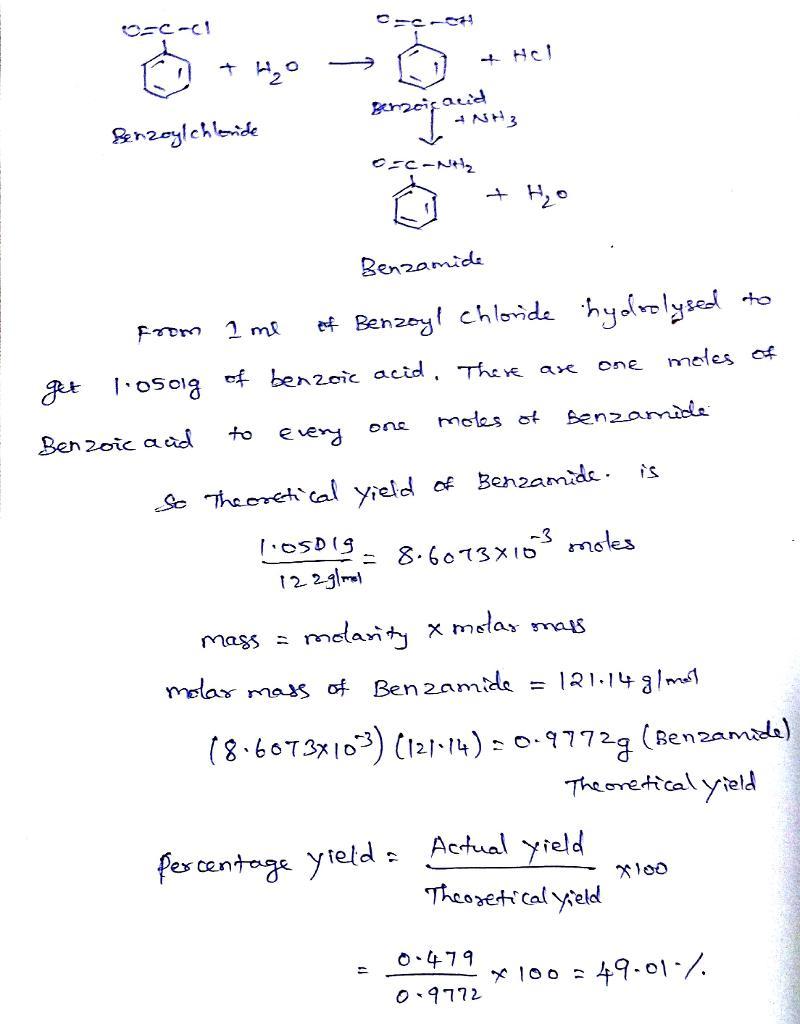
Consider the ammonolysis of benzoyl chloride by adding concentrated ammonium hydroxide to form the final product, benzamide. Rea
gizmo_the_mogwai [7]

Answer:

Explanation: see attachment below

4 0
2 years ago
Other questions:
  • Calculate the energy for one mole of photons (an einstein) for light absorbed at 6.90 × 10² nm.
    7·2 answers
  • If 75.0% of the isotopes of an element have a mass of 35.0 amu and 25.0% of the isotopes have a mass of 37.0amu what is the atom
    10·2 answers
  • A stone of mass 0.55 kilograms is released and falls to the ground. Measurements show that the stone has a kinetic energy of 9.8
    6·2 answers
  • What volume is equivalent to 14,000 mm3?
    5·2 answers
  • The solubility of acetanilide is 12.8 g in 100 mL of ethanol at 0 ∘C, and 46.4 g in 100 mL of ethanol at 60 ∘C. What is the maxi
    8·1 answer
  • If a neutral atom has 10 neutrons and 8 electrons how many protons does it have????
    8·2 answers
  • the electron affinity of nitrogen is lower (less negative) than that of both carbon and oxygen. This trend is best explained by
    6·1 answer
  • A car traveling at a constant speed travels 175 miles in four hours. How many minutes will it take for the car to travel 1000 fe
    5·1 answer
  • A gas balloon has a volume of 80.0 mL at 300K , and a pressure of 50.0 kPa. if the pressure changes to 80.0 kPa and the temperat
    14·1 answer
  • One of the commercial uses of sulfuric acid is the production of calcium sulfate and phosphoric acid. If 19.9 g of Ca₃(PO₄)₂ rea
    8·1 answer
Add answer
Login
Not registered? Fast signup
Signup
Login Signup
Ask question!