answer.
Ask question
Login Signup
Ask question
All categories
  • English
  • Mathematics
  • Social Studies
  • Business
  • History
  • Health
  • Geography
  • Biology
  • Physics
  • Chemistry
  • Computers and Technology
  • Arts
  • World Languages
  • Spanish
  • French
  • German
  • Advanced Placement (AP)
  • SAT
  • Medicine
  • Law
  • Engineering
Aleksandr [31]
2 years ago
7

Calculate the energy for one mole of photons (an einstein) for light absorbed at 6.90 × 10² nm.

Chemistry
2 answers:
Vesnalui [34]2 years ago
8 0

The energy for one mole of photons : <u>1.7343.10⁵ J</u>

<h3>Further explanation </h3>

The photoelectric effect is an electron coming out of a metal because of electromagnetic radiation

One type of electromagnetic radiation is light

Electrons can come out of metal because they absorb electromagnetic energy radiated on metals. There is also kinetic energy released from metal, which is according to the equation:

<h3> E = hf - hfo </h3>

fo = the threshold frequency of electromagnetic waves

Radiation energy is absorbed by photons

The energy in one photon can be formulated as

<h3> E = h. f </h3>

Where

h = Planck's constant (6,626.10⁻³⁴ Js)

f = Frequency of electromagnetic waves

f = c / λ

c = speed of light

= 3.10⁸

λ = wavelength

Known wavelength 6.90 × 10² nm

6.90 × 10² nm. = 6.9.10⁻⁷ m

We put it in the formula to find this light energy E = h. f

\rm E=\dfrac{h\times c}{\lambda}\\\\E=\dfrac{6,626.10^{-34}\times 3.10^8}{6.9.10^{-7}}\\\\E=2.88.10^{-19}

Because this is 1 photon energy, while the number of photons in one mole = 6.02.10²³, then the energy for one mole of photons

2.88 .10⁻¹⁹ x 6.02.10²³ = 1.7343.10⁵ J


<h3>Learn more </h3>

Electromagnetic radiation with wavelength of 745 nm

brainly.com/question/7590814

The energy of a photon

brainly.com/question/7353559

The equation E = hf

brainly.com/question/4177755

the approximate energy of a photon

brainly.com/question/7991589

The equation for photon energy

brainly.com/question/2741868

the wavelength of a photon whose energy is twice

brainly.com/question/6576580

Kay [80]2 years ago
5 0
We know that:
f * λ = c 
<span>and
E = h*f
so,rearranging:
 </span> 
<span>E/h = C/λ 
given:
h = </span><span>6.90 × 10^2 nm

</span><span>substituting the values:

E = </span> C/λ<span> x h  
(c is the speed of light;that is 3x10^8 m/s)

</span>    = 3x10^8 x 6.626x10^-34 / 6.90 x10^7m x 6.022x10^23
Hence,
using calculator:
we get,
 E = 1.69 x 10^5 Joules
You might be interested in
Write a balanced half-reaction describing the reduction of aqueous chromium(IV) cations to solid chromium.
Aliun [14]

The balanced half-reaction: Cr⁴⁺(aq)+ 4e⁻ → Cr(s).

<span> Chromium(IV) cations gain four electrons and became solid chromium with neutral charge.
</span>Reduction is lowering oxidation number because element or ions gain electrons. 

Oxidation reaction is increasing of oxidation number of element, because element or ion lost electrons in chemical reaction.

<span>
</span>

3 0
2 years ago
From the following reaction and data, find (a) S o of SOCl2 (b) T at which the reaction becomes nonspontaneous SO3(g) + SCl2(l)
disa [49]

Answer:

618 J/Kmol

T > 1.36 x 10³ K

Explanation:

The  balanced reaction of interest is:

                           SO₃ (g) + SCl₂ (l) ⇒    SOCl₂ (l) +     SO₂ (g)

with the data:

ΔHºf (kJ/mol)      -396          -50.0          -245.6         -296.8

Sº(J/mol·K)             256.7       184               ?               -248.1

ΔGº=  -75.2 kJ

We know, we can find the standard  change inGibb´s free energy from the equation:

ΔGºrxn =  ΔHºrxn - TΔSºrxn

So we can calculate ΔHºrxn  = ∑ ΔHºf prod  -  ΔHºreact, and substitute into this equation to solve Sº SOCl₂.

ΔHºrxn = ( -245.6 + (-296.8) ) - ( -396 - 50) kJ = - 96.4 kJ

Similarly  for ΔSºrxn

 ΔSºrxn = (-0.248.1 +Sº SOCl₂) - (0.256.7 +0.184) kJ/K

= -0.689 kJ /K -+ Sº SOCl₂

Plugging the values for the expression for  ΔGºrxn:

-75.2 kJ = -96.4 kJ - 298 K  x  ( -0.689 kJ /K + Sº SCl₂ )

-75.2 kJ = -96.4 kJ + 205.3 Kj - 298 Sº SCl₂

-184  kJ = -298 K  x Sº SCl₂

0.618 kJ/molK = Sº SCl₂

= 0.618 kJ/K x 1000 J = 618 J/Kmol

For the second part we will still be using the Gibb´s free energy change  equation as above , but now we will solve for T when the reaction becomes  non-spontaneous.

For the reaction to become non-spontaneous  ΔGº is positive, and this happens when the term  TΔSº becomes greater tha ΔHº:

ΔGºrxn =  ΔHºrxn - TΔSºrxn

0 =   ΔHºrxn - TΔSºrxn ⇒  TΔSºrxn  =  ΔHºrxn

                                           T= ΔHºrxn / ΔSºrxn

ΔSºrxn  = -0.689 J/Kmol + 0.618 J/Kmol = -0.0710 kJ/Kmol

( using the value  the value just calculated from above )

T =  - 96.4 kJ / -0.071 kJ/K = 1.36 x 10³ K

For temperatures greater than 1.36 x 10³ K the reaction becomes non-spontaneous.

4 0
2 years ago
one method for generating chlorine gas is by reacting potassium permanganate and hydrochloric acid. how many liters of Cl2 at 40
Ronch [10]

<u>Answer:</u> The volume of chlorine gas produced in the reaction is 2.06 L.

<u>Explanation:</u>

  • <u>For potassium permanganate:</u>

To calculate the number of moles, we use the equation:

\text{Number of moles}=\frac{\text{Given mass}}{\text{Molar mass}}

Given mass of potassium permanganate = 6.23 g

Molar mass of potassium permanganate = 158.034 g/mol

Putting values in above equation, we get:

\text{Moles of potassium permanganate}=\frac{6.23g}{158.034g/mol}=0.039mol

  • <u>For hydrochloric acid:</u>

To calculate the moles of hydrochloric acid, we use the equation:

\text{Molarity of the solution}=\frac{\text{Moles of solute}}{\text{Volume of solution (in L)}}

Molarity of HCl = 6.00 M

Volume of HCl = 45.0 mL = 0.045 L   (Conversion factor: 1 L = 1000 mL)

Putting values in above equation, we get:

6.00mol/L=\frac{\text{Moles of HCl}}{0.045L}\\\\\text{Moles of HCl}=0.27mol

  • For the reaction of potassium permanganate and hydrochloric acid, the equation follows:

2KMnO_4+16HCl\rightarrow 2MnCl_2+5Cl_2+2KCl+8H_2O

By Stoichiometry of the reaction:

16 moles of hydrochloric acid reacts with 2 moles of potassium permanganate.

So, 0.27 moles of hydrochloric acid will react with = \frac{2}{16}\times 0.27=0.033moles of potassium permanganate.

As, given amount of potassium permanganate is more than the required amount. So, it is considered as an excess reagent.

Thus, hydrochloric acid is considered as a limiting reagent because it limits the formation of product.

By Stoichiometry of the reaction:

16 moles of hydrochloric acid reacts with 5 moles of chlorine gas.

So, 0.27 moles of hydrochloric acid will react with = \frac{5}{16}\times 0.27=0.0843moles of chlorine gas.

  • To calculate the volume of gas, we use the equation given by ideal gas equation:

PV=nRT

where,

P = pressure of the gas = 1.05 atm

V = Volume of gas = ? L

n = Number of moles = 0.0843 mol

R = Gas constant = 0.0820\text{ L atm }mol^{-1}K^{-1}

T = temperature of the gas = 40^oC=[40+273]K=313K

Putting values in above equation, we get:

1.05atm\times V=0.0843\times 0.0820\text{ L atm }mol^{-1}K^{-1}\times 313K\\\\V=2.06L

Hence, the volume of chlorine gas produced in the reaction is 2.06 L.

3 0
2 years ago
Combined gas law problem: a balloon is filled with 500.0 mL of helium at a temperature of 27 degrees Celsius and 755 mmHg. As th
Papessa [141]
The statement of the combined gas law for a fixed amount of gas is,
PV/T = constant
Here, the units of pressure and volume must be consistent and the temperature must be the absolute temperature (Kelvin or Rankine).
0.65 atm is equivalent to 494 mmHg
Using the equation:
(755 x 500) / (27 + 273) = (494 x V) / (-33 + 273)
V = 3396 ml = 3.4 liters
8 0
2 years ago
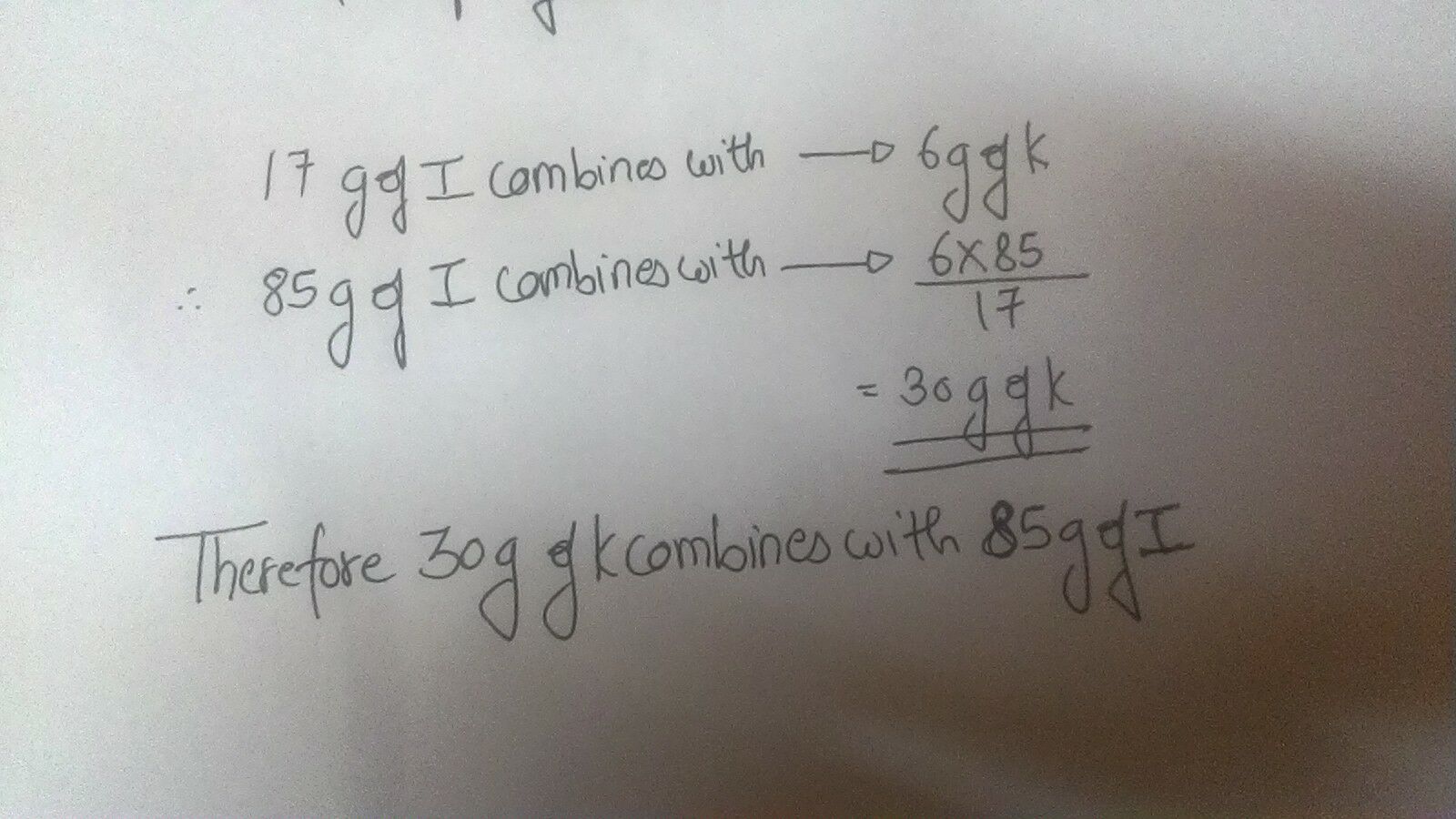
If 6 g of element k combine with 17 g of element l, how many grams of element k combine with 85 g of element l?
Ede4ka [16]
Hope this helps you.

5 0
2 years ago
Other questions:
  • A bird building a nest for its young is a reproductive strategy. Based on this example, what do you think the term “reproductive
    6·2 answers
  • Which set of reactants would result in a neutralization reaction?
    10·1 answer
  • In this scenario a battery is used to supply chemical potential energy. The potential energy is transformed and produces kinetic
    7·2 answers
  • Which biomolecule is composed of five basic elements: carbon, hydrogen, oxygen, nitrogen, and phosphorus arranged into two types
    13·1 answer
  • A chef is serving a lunch special with 1 sandwich and 2 corn cobs per plate. If there are 5 sandwiches and 14 corn cobs, what is
    5·2 answers
  • Butter has a specific gravity of 0.86. What is the mass of 2.15 L of butter?
    12·1 answer
  • A sample of krypton has a volume of 6.00 L, and the pressure is 0.960 atm. If the final temperature is 55.0°C, the final volume
    11·1 answer
  • Which is an example of how society affects science?
    9·2 answers
  • A student noticed a yellow, solid substance was formed when mixing two clear liquids during a lab. What term describes this yell
    11·1 answer
  • In 2021, you were given a 100. g wine sample to verify its age. Using tritium dating you observe that the sample has 0.688 decay
    14·1 answer
Add answer
Login
Not registered? Fast signup
Signup
Login Signup
Ask question!