answer.
Ask question
Login Signup
Ask question
All categories
  • English
  • Mathematics
  • Social Studies
  • Business
  • History
  • Health
  • Geography
  • Biology
  • Physics
  • Chemistry
  • Computers and Technology
  • Arts
  • World Languages
  • Spanish
  • French
  • German
  • Advanced Placement (AP)
  • SAT
  • Medicine
  • Law
  • Engineering
Setler79 [48]
2 years ago
14

The following reaction is spontaneous as written when the components are in their standard states:

Chemistry
1 answer:
Radda [10]2 years ago
8 0

Answer:

\large \boxed{\text{1 mol/L}}

Explanation:

We must use the Nernst equation

E_{\text{cell}} = E_{\text{cell}}^{\circ} - \dfrac{RT}{zF}\ln Q

We want Ecell < 0 for a reverse reaction, so assume it is 0.

Step 1. Calculate E°cell

Anode:     3Zn ⟶ 3Zn²⁺(4 mol·L⁻¹) + 6e⁻;                              E° = +0.7618 V

<u>Cathode: 2Cr³⁺ (x mol·L⁻¹) + 6e⁻ ⟶ 2Cr;                            </u>   E° = <u>-0.744   V</u>

Overall:   3Zn + 2Cr³⁺(x mol·L⁻¹) ⟶ 3Zn²⁺(4 mol·L⁻¹) + 2Cr;  E° = +0.018   V

Step 2. Calculate Q

\begin{array}{rcl}0 & = & 0.018 - \dfrac{8.314\times 298}{6 \times 96 485} \ln Q\\\\-0.18& = & -0.00428 \ln Q\\\ln Q & = & 4.16\\Q & = & e^{4.16}\\ & = & \mathbf{64.0}\\\end{array}

3. Calculate [Cr³⁺]

\begin{array}{rcl}Q & = & \dfrac{\text{[Zn$^{2+}$]$^{3}$}}{\text{[Cr}^{3+}]^{2}}\\\\64.0 & = & \dfrac{4^{3}}{\text{[Cr}^{3+}]^{2}}\\\\\text{[Cr}^{3+}]^{2}& = & \dfrac{64}{64.0}\\\\& = & 1\\\text{[Cr}^{3+}] & = & \textbf{1 mol/L}\\\end{array}\\\text{[Cr$^{3+}$] must be less than $\large \boxed{\textbf{1 mol/L}}$ for the reaction to be spontaneous in the reverse}\\\text{direction.}

You might be interested in
A student sets up the following equation to convert a measurement. (The stands for a number the student is going to calculate.)
Aliun [14]

The question is incomplete, here is the complete question:

A student sets up the following equation to convert a measurement. (The stands for a number the student is going to calculate.) Fill in the missing part of this equation.

23.Pa.cm^3=?kPa.m^3

<u>Answer:</u> The measurement after converting is 23\times 10^{-9}kPa.m^3

<u>Explanation:</u>

We are given:

A quantity having value 23.Pa.cm^3

To convert this into kPa.m^3, we need to use the conversion factors:

1 kPa = 1000 Pa

1m^3=10^6cm^3

Converting the quantity into kPa.m^3, we get:

\Rightarrow 23.Pa.cm^3\times (\frac{1kPa}{1000Pa})\times (\frac{1m^3}{10^6cm^3})\\\\\Rightarrow 23\times 10^{-9}kPa.m^3

Hence, the measurement after converting is 23\times 10^{-9}kPa.m^3

6 0
2 years ago
Suppose you are titrating vinegar, which is an acetic acid solution of unknown strength, with a sodium hydroxide solution accord
Marina CMI [18]

Answer:

M_{acid}=0.563M

Explanation:

Hello there!

In this case, given the neutralization of the acetic acid as a weak one with sodium hydroxide as a strong base, we can see how the moles of the both of them are the same at the equivalence point; thus, it is possible to write:

M_{acid}V_{acid}=M_{base}V_{base}

Thus, we solve for the molarity of the acid to obtain:

M_{acid}=\frac{M_{base}V_{base}}{V_{acid}} \\\\ M_{acid}=\frac{33.98mL*0.1656M}{10.0mL}\\\\ M_{acid}=0.563M

Regards!

5 0
2 years ago
Which statement describes the transfer of heat energy that occurs when an ice cube is added to an insulated container with 100 m
nadya68 [22]
Number 3 is the most likely answer
4 0
2 years ago
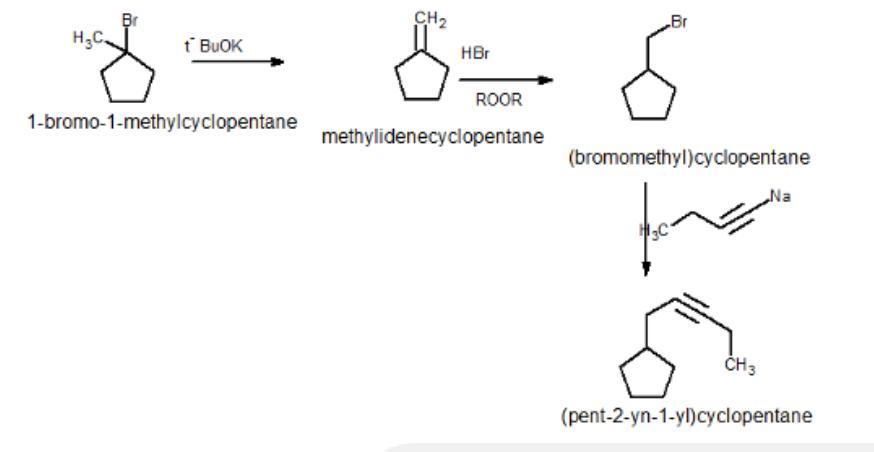
Question 096 Propose a three-step synthetic sequence to accomplish the transformation below. 1) HBr, ROOR; 2) t-BuOK; 3) CH3CH2C
salantis [7]

Complete Question

Question 096 Propose a three-step synthetic sequence to accomplish the transformation below.

Option 1 =>  1) HBr, ROOR; 2) t-BuOK; 3) CH3CH2CCNa

Option 2 => 1) NaOEt; 2) HBr, ROOR; 3) CH3CH2CCNa

Option 3 => 1) t-BuOK; 2) NaNH2; 3) CH3CH2CCNa

Option 4 => 1) CH3CH2CH2CH2Br; 2) NaOEt; 3) HBr, ROOR

Option 5 => 1) t-BuOK; 2) HBr, ROOR; 3) CH3CH2CCNa

Option 6 => 1) NaOEt; 2) NBS, hν; 3) NaSBu

Answer:

The correct option is option 5

Explanation:

   The mechanism of the reaction is shown on the first uploaded image

8 0
2 years ago
Which phrase describes the molecular structure and properties of two solid forms of carbon, diamond and graphite?(1) the same mo
vagabundo [1.1K]
I think the answer is (4) different molecular structures and different properties. Both structure are crystal. The structure of graphite is organized in layers. And structure of diamond is a strong network of atoms. Also due to the different structures, they have different properties.
4 0
2 years ago
Other questions:
  • Andrea is performing an experiment in which she needs to know when a strong acid is present. She is not sure which indicator to
    15·2 answers
  • Carbonic acid reacts with water to yield bicarbonate ions and hydronium ions: h2co3+h2o⇌hco3−+h3o+ identify the conjugate acid-b
    15·2 answers
  • What mass of ZnCO3 contains 3.11×10²² O atoms
    10·2 answers
  • The table shows the amount of radioactive element remaining in a sample over a period of time.
    5·1 answer
  • Urea is an organic compound widely used as a fertilizer. Its solubility in water allows it to be made into aqueous fertilizer so
    11·1 answer
  • The density of mercury is 13.6 g/cm3 . What volume (in quarts) is occupied by 100. g of Hg? (1 L = 1.06 qt)
    11·1 answer
  • Density of copper is 8.96 g/cm3 and density of zinc is 7.14 g/cm3 . Brass is an alloy made of copper and zinc. You are given a s
    6·1 answer
  • A piece of silver releases 202.8 J of heat while cooling 65.0 °C. What is the mass of the sample? Silver has a specific heat of
    10·1 answer
  • Aluminum has a specific heat of 0.902 j/gC. How much heat is lost when a piece of aluminum with a mass of 23.984 g cools from a
    6·1 answer
  • Shelby measured the volume of a cylinder and determined it to be 54.5 cm3 . The teacher told her that she was 4.25% too high in
    13·1 answer
Add answer
Login
Not registered? Fast signup
Signup
Login Signup
Ask question!