answer.
Ask question
Login Signup
Ask question
All categories
  • English
  • Mathematics
  • Social Studies
  • Business
  • History
  • Health
  • Geography
  • Biology
  • Physics
  • Chemistry
  • Computers and Technology
  • Arts
  • World Languages
  • Spanish
  • French
  • German
  • Advanced Placement (AP)
  • SAT
  • Medicine
  • Law
  • Engineering
Svetradugi [14.3K]
2 years ago
4

A chemistry student needs of heptane for an experiment. He has available of a w/w solution of heptane in chloroform. Calculate t

he mass of solution the student should use. If there's not enough solution, press the "No solution" button. Round your answer to significant digits.
Chemistry
1 answer:
tensa zangetsu [6.8K]2 years ago
6 0

The question is incomplete, here is the complete question:

A chemistry student needs 65.0 g heptane for an experiment. He has available 20.0 g of a 38.1% w/w solution of heptane in chloroform.

Calculate the mass of solution the student should use. If there's not enough solution, press the "No solution" button.  Round your answer to 3 significant digits.

<u>Answer:</u> The solution is not enough, "No Solution"

<u>Explanation:</u>

We are given:

Mass of solution needed = 20.0 g

Mass of heptane given = 65.0 g

38.1 % (w/w) solution of heptane

This means that 38.1 grams of heptane is present in 100 grams of solution

To calculate the amount of solution needed, we apply unitary method:

If 38.1 grams of heptane is present in 100 g of solution

So, 65.0 grams of heptane will be present in = \frac{100}{38.1}\times 65.0=170.6g of solution

As, the given amount of solution is less than the required solution. So, there is not enough solution

Hence, the solution is not enough, "No Solution"

You might be interested in
5. A Dumas bulb is filled with chlorine gas at the ambient pressure and is found to contain 7.1 g of chlorine when the temperatu
kati45 [8]

Answer:

a. The original temperature of the gas is 2743K.

b. 20atm.

Explanation:

a. As a result of the gas laws, you can know that the temperature is inversely proportional to moles of a gas when pressure and volume remains constant. The equation could be:

T₁n₁ = T₂n₂

<em>Where T is absolute temperature and n amount of gas at 1, initial state and 2, final states.</em>

<em />

<em>Replacing with values of the problem:</em>

T₁n₁ = T₂n₂

X*7.1g = (X+300)*6.4g

7.1X = 6.4X + 1920

0.7X = 1920

X = 2743K

<h3>The original temperature of the gas is 2743K</h3><h3 />

b. Using general gas law:

PV = nRT

<em>Where P is pressure (Our unknown)</em>

<em>V is volume = 2.24L</em>

<em>n are moles of gas (7.1g / 35.45g/mol = 0.20 moles)</em>

R is gas constant = 0.082atmL/molK

And T is absolute temperature (2743K)

P*2.24L = 0.20mol*0.082atmL/molK*2743K

<h3>P = 20atm</h3>

<em />

7 0
2 years ago
The nucleus of an atom is dense and positively charged. What was observed when positively charged particles were radiated onto a
ankoles [38]
<span>According to my knowledge, I feel the answer is -
Particles that struck the center of the atom were repelled.

Hope this helps!
</span>
8 0
2 years ago
Read 2 more answers
Joyce poured 200 milliliters (mL) of water into a beaker, placed a thermometer in it, and heated it until it started to boil. Sh
earnstyle [38]

Answer:

100°C

Explanation:

The boiling point of water is 100°C and the difference is when will the water start boiling.

3 0
2 years ago
Suppose, in an experiment to determine the amount of sodium hypochlorite in bleach, you titrated a 26.34 mL sample of 0.0100 M K
Dmitry [639]

Answer:

0.1 M

Explanation:

The overall balanced reaction equation for the process is;

IO3^- (aq)+ 6H^+(aq) + 6S2O3^2-(aq) → I-(aq) + 3S4O6^2-(aq) + 3H2O(l)

Generally, we must note that;

1 mol of IO3^- require 6 moles of S2O3^2-

Thus;

n (iodate) = n(thiosulfate)/6

C(iodate) x V(iodate) = C(thiosulfate) x V(thiosulfate)/6

Concentration of iodate C(iodate)= 0.0100 M

Volume of iodate= V(iodate)= 26.34 ml

Concentration of thiosulphate= C(thiosulfate)= the unknown

Volume of thiosulphate=V(thiosulfate)= 15.51 ml

Hence;

C(iodate) x V(iodate) × 6/V(thiosulfate) = C(thiosulfate)

0.0100 M × 26.34 ml × 6/15.51 ml = 0.1 M

5 0
2 years ago
Describe a single measurement that you could make that shows that a kettle is less than 100% efficient (providing evidence that
alexgriva [62]

Answer:

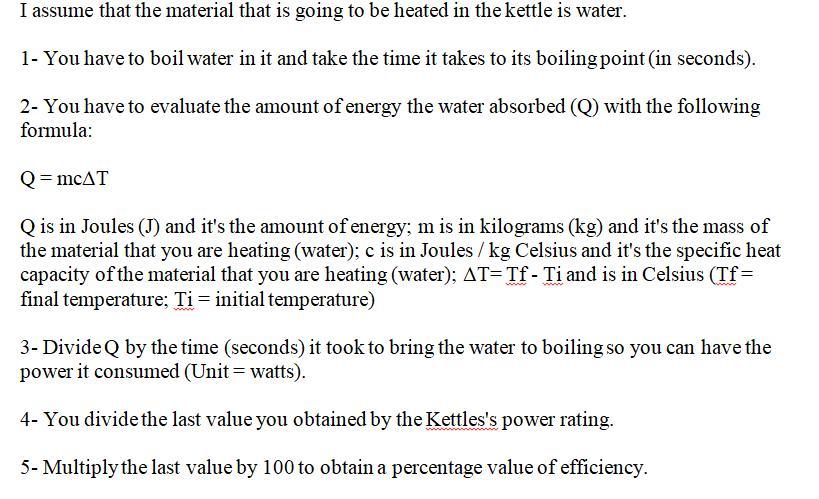
As you haven't explained what measurements you took before solving this problem, I will explain the general procedure to evaluate the efficiency of a kettle. I hope it helps you. I´ll send an attachement file with the full answer, since I couldn't write it here.

I assume that the material that is going to be heated in the kettle is water.

1- You have to boil water in it and take the time it takes to its boiling point (in seconds).  

2- You have to evaluate the amount of energy the water absorbed Q with the efficiency formula which I explain in the attachement file.

3- Divide Q by the time it took to bring the water to boiling so you can have the power it consumed.

4- You divide the last value you obtained by the Kettles's power rating.  

5- Multiply the last value by 100 to obtain a percentage value of efficiency.

Explanation:

Efficiency is the ration of a machine's useful work, in this case how much energy the water absorbed to get to its boiling point divided by the time it took to get to this point, and the total energy expended, in this case the kettles's power rating.

7 0
2 years ago
Other questions:
  • Now consider the reaction a+2b⇌c for which in the initial mixture qc=[c][a][b]2=387 is the reaction at equilibrium? if not, in w
    7·1 answer
  • How many moles of cacl2 are in 250 ml of a 3.0 m of cacl2 solution?
    12·2 answers
  • Which element has atoms with the strongest attraction for electrons in a chemical bond?1)aluminium, 2)carbon, 3)chlorine, 4)lith
    5·1 answer
  • What volume, in ml, of a 0.2089 m ki solution contains enough ki to react exactly with the cu(no3)2 in 43.88 ml of a 0.3842 m so
    12·1 answer
  • How did Mendeleev feel about Russian science education when he came back from Germany
    7·2 answers
  • A 10.0 g sample of LiOH is dissolved in 120.00 g of water at 23.0°C in a coffee-cup calorimeter with a heat capacity of 100 J/Â
    9·1 answer
  • What is the volume of 1.56 kg of a compound whose molar mass is 81.86 g/mole and whose density is 41.2 g/ml?
    5·1 answer
  • Classify each property as associated with a liquid that has strong or weak intermolecular forces Drag the appropriate items to t
    9·1 answer
  • 3. From the following formula, calculate the quantities required to make 5 lb o hydrophilic ointment. Methylparaben 0.25 g Propy
    10·1 answer
  • A 60.0 mL sample of 0.250 M NaOH is added to a beaker containing 125 mL of 0.120 M HOCl. Ka for HOCl is 3.5 x 10⁻⁸ at 25o C. Fin
    6·1 answer
Add answer
Login
Not registered? Fast signup
Signup
Login Signup
Ask question!