answer.
Ask question
Login Signup
Ask question
All categories
  • English
  • Mathematics
  • Social Studies
  • Business
  • History
  • Health
  • Geography
  • Biology
  • Physics
  • Chemistry
  • Computers and Technology
  • Arts
  • World Languages
  • Spanish
  • French
  • German
  • Advanced Placement (AP)
  • SAT
  • Medicine
  • Law
  • Engineering
lubasha [3.4K]
2 years ago
6

The bones of the forearm (radius and ulna) are hinged to the humerus at the elbow. The biceps muscle connects to the bones of th

e forearm about 2.15 cm beyond the joint. Assume the forearm has a mass of 2.25 kg and a length of 0.425 m. When the humerus and the biceps are nearly vertical and the forearm is horizontal, if a person wishes to hold an object of mass 6.15 kg so that her forearm remains motionless, what is the force exerted by the biceps muscle

Physics
1 answer:
sertanlavr [38]2 years ago
8 0

Answer:

The force exerted by the biceps is 143.8 kgf.

Explanation:

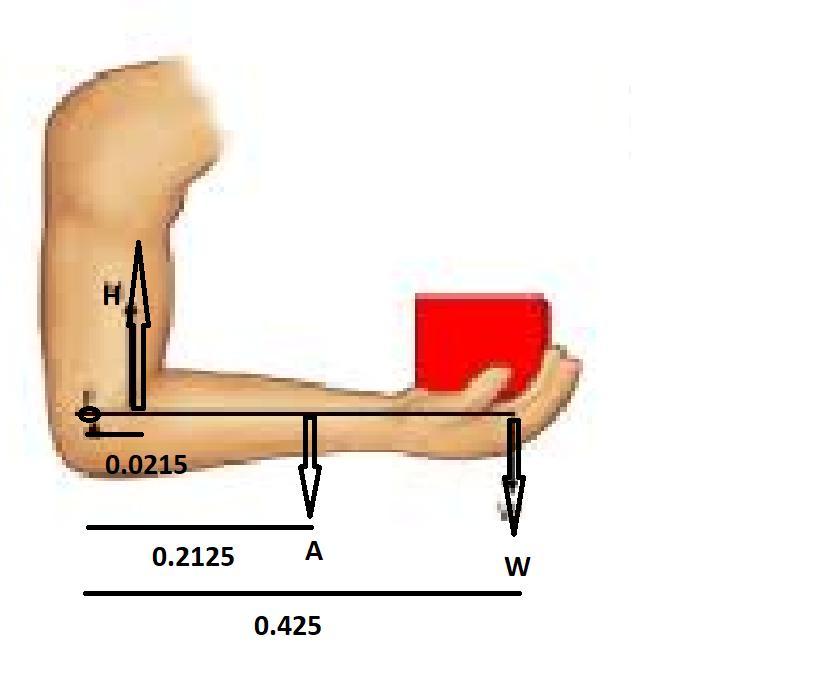
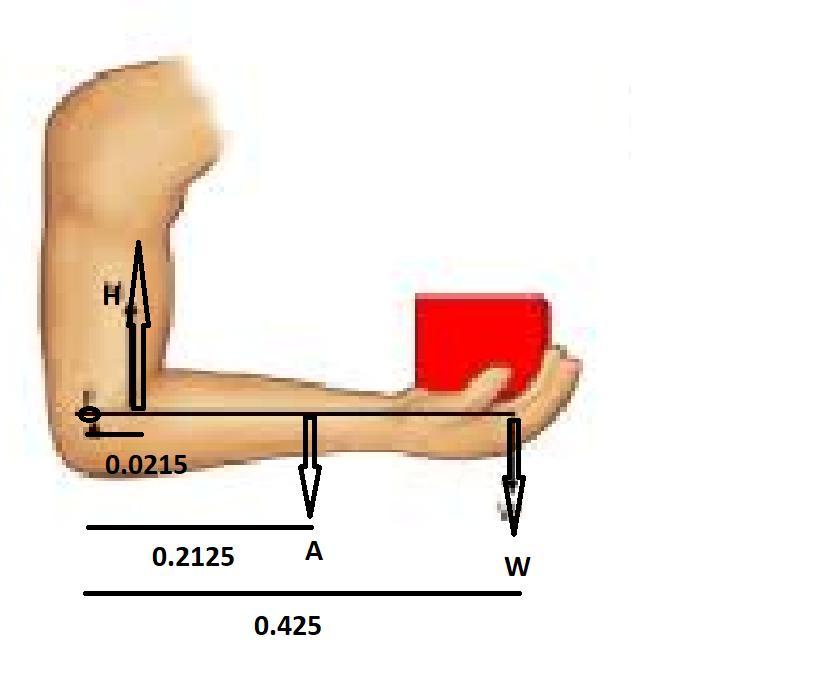
To calculate the force exerted by the biceps, we calculate the momentum in the elbow.

This momentum has to be zero so that her forearm remains motionless.

Being:

W: mass weight (6.15 kg)

d_W= distance to the mass weight (0.425 m)

A: weight of the forearm (2.25 kg)

d_A: distance to the center of mass of the forearm (0.425/2=0.2125 m)

H: force exerted by the biceps

d_H: distance to the point of connection of the biceps (0.0215 m)

The momemtum is:

H*d_H-A*d_A-W*d_W=0\\\\H=(A*d_A+W*d_W)/d_H\\\\H=(2.25*0.2125+6.15*0.425)/0.0215\\\\H=(0.478125+2.61375)/0.0215\\\\H=3.091875/0.0215=143.8

The force exerted by the biceps is 143.8 kgf.

You might be interested in
A magnetic field of 0.080 T is in the y-direction. The velocity of wire segment S has a magnitude of 78 m/s and components of 18
Annette [7]

Answer:

Part a)

Induced EMF when length vector is along Z direction is 0.72 V

Part b)

Induced EMF when length vector is along Y direction is ZERO

Explanation:

As we know that the motional EMF induced in the wire is given as

E = (v\times B). L

1)

As we know that

v = 18\hat i + 24\hat j + 72\hat k

B = 0.080 \hat j

L = 0.50 \hat k

now we have

\vec v \times \vec B = 1.44\hat k - 5.76 \hat i

so we have

E = 1.44 (0.50) = 0.72 V

2)

If the length vector is along Y direction then we have

L = 0.50 \hat j

so again we have

\vec v \times \vec B = 1.44\hat k - 5.76 \hat i

so we have

EMF = 0

6 0
2 years ago
If a train is 100 kilometers away, how much sooner would you hear the train coming by listening to the rails (iron) as opposed t
Whitepunk [10]
From tables, the speed of sound at 0°C is approximately
V₁ = 331 m/s (in air)
V₃ = 5130 m/s (in iron)

Distance traveled is
d = 100 km = 10⁵ m

Time required to travel in air is
t₁ = d/V₁ = 10⁵/331 = 302.12 s

Time required to travel in iron is
t₂ = d/V₂ = 10⁵/5130 = 19.49 s

The difference in time is
302.12 - 19.49 = 282.63 s

Answer:  283 s (nearest second)


6 0
2 years ago
An ant is crawling along a yardstick that is pointed with the 0-inch mark to the east and the 36-inch mark to the west. It start
FrozenT [24]

Answer:

  • The total distance traveled is 28 inches.
  • The displacement is 2 inches to the east.

Explanation:

Lets put a frame of reference in the problem. Starting the frame of reference at the point with the 0-inch mark, and making the unit vector \hat{i} pointing in the west direction, the ant start at position

\vec{r}_0 = 16 \ inch \ \hat{i}

Then, moves to

\vec{r}_1 = 29 \ inch \ \hat{i}

so, the distance traveled here is

d_1 = |\vec{r}_1 - \vec{r}_0  | = | 29 \ inch   \ \hat{i} - 16 \ inch   \ \hat{i}  |

d_1 =  | 13 \ inch   \ \hat{i}  |

d_1 =  13 \ inch

after this, the ant travels to

\vec{r}_2 = 14 \ inch \ \hat{i}

so, the distance traveled here is

d_2 = |\vec{r}_2 - \vec{r}_1  | = | 14 \ inch   \ \hat{i} - 29 \ inch   \ \hat{i}  |

d_2 =  | - 15 \ inch   \ \hat{i}  |

d_2 =  15 \ inch

The total distance traveled will be:

d_1 + d_2 = 13 \ inch + 15 \ inch = 28 \ inch

The displacement is the final position vector minus the initial position vector:

\vec{D}=\vec{r}_2 - \vec{r}_1

\vec{D}= 14 \ inch   \ \hat{i} - 16 \ inch \ \hat{i}

\vec{D}= - 2 \ inch \ \hat{i}

This is 2 inches to the east.

6 0
2 years ago
A cart, which has a mass of 2.30 kg is sitting at the top of an inclined plane, which is 4.50 meters long and meets the horizont
expeople1 [14]

Answer:

a) The gravitational potential energy before the cart rolls down the incline is 24.6 J.

b) The magnitude of the force that causes the cart to roll down is 5.47 N.

c) The acceleration of the cart is 2.38 m/s²

d) It takes the cart 1.94 s to reach the bottom of the incline.

e) The velocity of the cart at the bottom of the inclined plane is 4.62 m/s.

f) The kinetic energy of the cart as it reaches the bottom of the incline is 24.6 J.

g) The work done by the gravitational force is 24.6 J.

Explanation:

Hi there!

a) The gravitational potential energy is calculated using the following equation:

EP = m · g · h

Where:

EP = gravitational potential energy.

m = mass of the object.

g = acceleration due to gravity.

h = height at which the object is located.

The height of the inclined plane can be calculated using trigonomoetry:

sin 14.0° = height / lenght

sin 14.0° = height / 4.50 m

4.50 m · sin 14.0° = height

height = 1.09 m

Then, the gravitational potential energy will be:

EP = m · g · h

EP = 2.30 kg · 9.81 m/s² · 1.09 m = 24.6 J

The gravitational potential energy before the cart rolls down the incline is 24.6 J.

b) Please, see the attached figure for a graphical description of the problem and the forces acting on the cart. The force that causes the cart to accelerate down the incline is the horizontal component of the weight (Fwx in the figure). The magnitude of this force can be obtained using trigonometry:

sin 14° = Fwx / Fw

The weight of the cart (Fw) is calculated as follows:

Fw = m · g

Fw = 2.30 kg · 9.81 m/s²

Fw = 22.6 N

Then, the x-component of the weight will be:

FW · sin 14° = Fwx

22.6 N · sin 14° = Fwx

Fwx = 5.47 N

The magnitude of the force that causes the cart to roll down is 5.47 N.

c)Using the equation of Fwx we can calculate the acceleration of the cart:

Fwx = m · a

Where "m" is the mass of the cart and "a" is the acceleration.

Fwx / m = a

5.47 N / 2.30 kg = a

a = 2.38 m/s²

The acceleration of the cart is 2.38 m/s²

d) To calculate the time it takes the cart to reach the bottom of the incline, let´s use the equation of position of the cart:

x = x0 + v0 · t + 1/2 · a · t²

Where:

x = position of the cart at time t.

x0 = initial position.

v0 = initial velocity.

a = acceleration.

t = time.

Considering the initial position as the point at which the cart starts rolling (x0 = 0) and knowing that the cart starts from rest (v0 = 0), let´s find the time it takes the cart to travel the 4.50 m of the inclined plane:

x = 1/2 · a · t²

4.50 m = 1/2 · 2.38 m/s² · t²

2 · 4.50 m / 2.38 m/s² = t²

t = 1.94 s

It takes the cart 1.94 s to reach the bottom of the incline.

e) The velocity of the cart at the bottom of the inclined plane can be obtained using the following equation:

v = v0 + a · t

v = 0 m/s + 2.38 m/s² · 1.94 s

v = 4.62 m/s

The velocity of the cart at the bottom of the inclined plane is 4.62 m/s.

f) The kinetic energy can be calculated using the following equation:

KE = 1/2 · m · v²

Where:

KE =  kinetic energy.

m = mass of the cart.

v = velocity of the cart.

KE = 1/2 · 2.30 kg · (4.62 m/s)²

KE = 24.6 J

The kinetic energy of the cart as it reaches the bottom of the incline is 24.6 J.

The gain of kinetic energy is equal to the loss of gravitational potential energy.

g) The work done by the gravitational force can be calculated using the work-energy theorem: the work done by the gravitational force is equal to the negative change in the gravitational potential energy:

W = -ΔPE

W = -(final potential energy - initial potential energy)

W = -(0 - 24.6 J)

W = 24.6 J

This can also be calculated using the definition of work:

W = Fw · d

Where "d" is the distance traveled in the direction of the force, that is the height of the inclined plane:

W = 22.6 N · 1.09 m = 24.6 J.

The work done by the gravitational force is 24.6 J.
4 0
2 years ago
Two long straight wires enter a room through a window. One carries a current of 2.9A into the room, while the other carries a cu
Degger [83]

Answer and Explanation:

curents i = 2.9 A

           i ' = 4.4 A

the magnitude (in T.m) of the path integral of B.dl around the window frame = μo * current enclosed

          = μo* ( i '- i )

Since from Ampere's law

where μ o = permeability of free space = 4π * 10 ^-7 H / m

plug the values we get the magnitude (in T.m) of the path integral of B.dl = ( 4π*10^-7 ) (2.9+4.4)

                                 = 1.884 * 10^-6 Tm

4 0
2 years ago
Other questions:
  • Why are overuse injuries particularly frustrating set-backs?
    13·2 answers
  • Astronomers have discovered several volcanoes on io, a moon of jupiter. one of them, named loki, ejects lava to a maximum height
    13·1 answer
  • explain why the impact of one heavy stone would produce waves with higher amplitude than the impact of the light stone would
    6·1 answer
  • If the temperature is lowered from 60 °c to 30 °c, the volume of a fixed amount of gas will be one half the original volume. if
    11·1 answer
  • An object of mass 8.0 kg is attached to an ideal massless spring and allowed to hang in the Earth's gravitational field. The spr
    5·2 answers
  • In the future, people will only enjoy one sport: Electrodes. In this sport, you gain points when you cause metallic discs hoveri
    15·1 answer
  • Suppose that 8 turns of a wire are wrapped around a pipe with a length of 60 inches and a circumference of 4​ inches, so that th
    7·2 answers
  • The robot arm is elevating and extending simultaneously. At a given instant, θ = 30°, ˙ θ = 10 deg / s = constant θ˙=10 deg/s=co
    6·1 answer
  • Given three different locations on Earth's surface, where will the weight of a person be greatest? in New York City, which is ab
    13·1 answer
  • (HELP!!! 30 pts if answered right. )What formula gives the strength of an electric field, E, at a distance from a known source c
    11·1 answer
Add answer
Login
Not registered? Fast signup
Signup
Login Signup
Ask question!