answer.
Ask question
Login Signup
Ask question
All categories
  • English
  • Mathematics
  • Social Studies
  • Business
  • History
  • Health
  • Geography
  • Biology
  • Physics
  • Chemistry
  • Computers and Technology
  • Arts
  • World Languages
  • Spanish
  • French
  • German
  • Advanced Placement (AP)
  • SAT
  • Medicine
  • Law
  • Engineering
Andru [333]
2 years ago
3

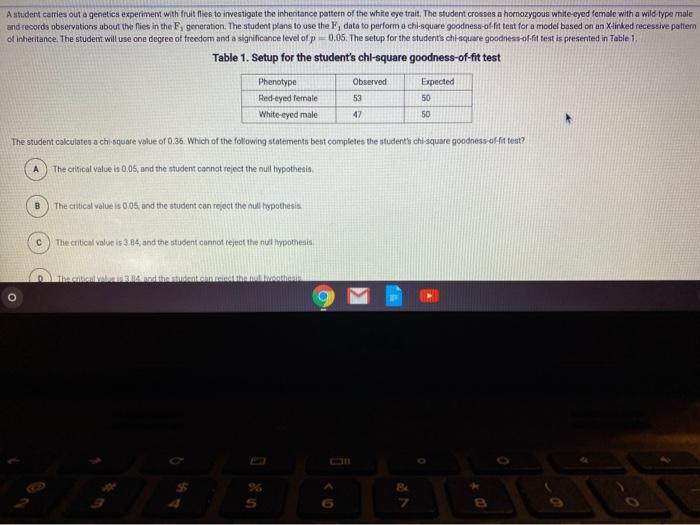
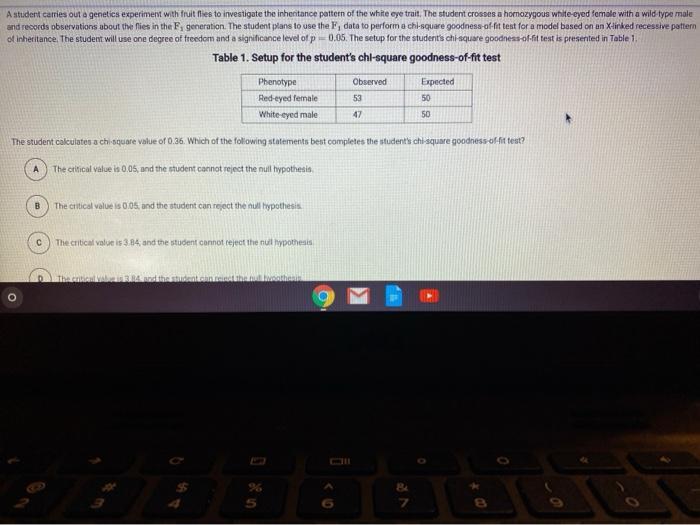
A student carries out a genetics experiment with fruit flies to investigate the inheritance pattern of the white eye trait. The

student crosses a homozygous white-eyed female with a wild-
type male and records observations about the flies in the F, generation. The student plans to use the F, data to perform a chi-square goodness-of-fit test for a model based on an X-linked
recessive pattern of inheritance. The student will use one degree of freedom and a significance level of p = 0.05. The setup for the student's chi-square goodness-of-fit test is presented in
Table 1
Table 1. Setup for the student's chl-square goodness-of-fit test
Phenotype
Red-eyed female
White-eyed male
Observed
53
47
Expected
50
50
The student calculates a chi-square value of 0.36. Which of the following statements best completes the student's chi-square goodness-of-fittest?

Chemistry
1 answer:
leonid [27]2 years ago
4 0

Full question attached

Answer:

c

Explanation:

To carry out the Chi squared test the following formula is used:

(O - E)² / E

Where O is the observed values and E is the expected values. The sum of this equation for each phenotype is the Chi squared value

<h3>Red eyed female</h3>

Observed: 53

Expected: 50

O - E= -3

(O - E)² = 9

(O - E)² / E = 9/ 50 = 0.18

<h3>White Eyed Male</h3>

Observed: 47

Expected: 50

O - E= 3

(O - E)² = 9

(O - E)² / E = 9/ 50 = 0.18

Sum = 0.36

The p value is dependent upon the number of degrees of freedom. The degrees of freedom is the number of categories in the experiment - 1. So here, there is one degree of freedom are there are two phenotypes being observed.

If we look up the critical values for each degree of freedom, we can see that for 1 degree of freedom the critical value is 3.841

Since the chi squared value is less than 3.84 (it is 0.36), we cannot reject the null hypothesis. So the answer is c

You might be interested in
A 0.0200 M NaCl solution was formed when 38.0 grams of NaCl was dissolved in enough water. What was the total volume of the solu
pashok25 [27]

First calculate the no of moles, that is 38 grams divided by molar mass which is 58.43 g/mol. The no of moles is 0.65 moles. Concentration= no of moles divided by volume in litre. From the above formula, volume= no of moles divided by concentration. So to get the total volume 0.65 moles divided by 0.02M (mol/L) which gives 32.5 L.

4 0
2 years ago
Read 2 more answers
A solution of SO2 in water contains 0.00023 g of SO2 per liter of solution. What is the concentration of SO2 in ppm? in ppb?
Mnenie [13.5K]

Answer:

= 230 ppb

Explanation:

Considering that;

1ppm = 1mg/L  

Then;

0.00023g = 0.23mg  

Therefore;

0.00023 g/L = 0.23 mg/L

0.23 mg/L = 0.23 ppm

1 ppm = 100 ppb

Therefore;

0.23 ppm = 0.23 ×1000

                = 230 ppb

5 0
2 years ago
Read 2 more answers
Calculate ΔH and ΔStot when two copper blocks, each of mass 10.0 kg, one at 100°C and the other at 0°C, are placed in contact in
ira [324]

Explanation:

The given data is as follows.

        m = 10.0 kg = 10,000 g    (as 1 kg = 1000 g)

      Initial temp. of block 1, T_{1} = 100^{o}C = (100 + 273) K = 373 K  

      Initial temp. of block 2, T_{2} = 0^{o}C = (0 + 273) K = 273 K

So, heat released by block 1 = heat gained by block 2

            mC \Delta T = mC \times \Delta T

  10000 g \times 0.385 \times (T_{f} - 100)^{o}C = 10000 g \times 0.385 \times (0 - T_{f})^{o}C

                  T_{f} - 100^{o}C = 0^{o}C - T_{f}    

                   2T_{f} = 100^{o}C

                          T_{f} = 50^{o}C

Convert temperature into kelvin as (50 + 273) K = 323 K.              

Also, we know that the relation between enthalpy and temperature change is as follows.

             \Delta H = mC \Delta T

                         = 10000 g \times 0.385 J/K g \times 323 K

                         = 1243550 J

or,                     = 1243.5 kJ

Now, calculate entropy change for block 1 as follows.

     \Delta S_{1} = mC ln \frac{T_{f}}{T_{i}}

            = 10000 g \times 0.385 J/K g \times ln \frac{323}{373}

            = 10000 g \times 0.385 J/K g \times -0.143

            = -554.12 J/K

Now, entropy change for block 2 is as follows.

   \Delta S_{2} = mC ln \frac{T_{f}}{T_{i}}

           = 10000 g \times 0.385 J/K g \times ln \frac{323}{273}

           = 10000 g \times 0.385 J/K g \times 0.168

           = 647.49 J/K

Hence, total entropy will be sum of entropy change of both the blocks.

            \Delta S_{total} = \Delta S_{1} + \Delta S_{2}

                       = -554.12 J/K + 647.49 J/K

                       = 93.37 J/K

Thus, we can conclude that for the given reaction \Delta H is 1243.5 kJ and \Delta S_{total} is 93.37 J/K.

6 0
2 years ago
The equilibrium constant, Kc, for the reaction H2 (g) + I2 (g) ⇄ 2HI (g) at 425°C is 54.8. A reaction vessel contains 0.0890 M H
Mars2501 [29]

Answer: The reaction is not at equilibrium and will proceed to make more products to reach equilibrium.

Explanation:  

Equilibrium constant is defined as the ratio of concentration of products to the concentration of reactants each raised to the power their stoichiometric ratios. It is expressed as K_{eq}

K is the constant of a certain reaction when it is in equilibrium, while Q is the reaction  quotient of activities of products and reactants at any stage other than equilibrium of a reaction.

For the given chemical reaction:

H_2(g)+I_2(g)\rightarrow 2HI(g)

The expression for Q is written as:

Q=\frac{[HI]^2}{[H_2]^1[I_2]^1}

Q=\frac{[0.0890]^2}{[0.215]^1[0.498]^1}

Q=0.074

Given : K_{eq} = 54.8

Thus as Q, the reaction will shift towards the right i.e. towards the product side.

4 0
2 years ago
You have two 500.0 ml aqueous solutions. solution a is a solution of a metal nitrate that is 8.246% nitrogen by mass the ionic c
almond37 [142]

1) Answer is: the ionic compound in the solution b is K₂CrO₄ (potassium chromate).

Ionic compound in solution b has two potassiums (oxidation number +1), one chromium (oxidation number +6) and four oxygens. Oxidation number of oxygen is -2 and compound has neutral charge:

2 · (+1) + 6 + x · (-2) = 0.

x = 4; number of oxygen atoms.

2) Answer is: the ionic compound in solution a is AgNO₃ (silver nitrate).

ω(N) = 8.246% ÷ 100%.

ω(N) = 0.08246; mass percentage of nitrogen.

M(MNO₃) = M(N) ÷ ω(N).

M(MNO₃) = 14 g/mol ÷ 0.08246.

M(MNO₃) = 169.8 g/mol; molar mass of metal nitrate.

M(M) = M(MNO₃) - M(N) - 3 · M(O).

M(M) = 169.8 g/mol - 14 g/mol - 3 · 16 g/mol.

M(M) = 107.8 g/mol; atomic mass of metal, this metal is silver (Ag).

3) Balanced chemical reaction:  

2AgNO₃(aq) + K₂CrO₄(aq) → Ag₂CrO₄(s) + 2KNO₃(aq).

Ionic reaction:  

2Ag⁺(aq) + 2NO₃(aq) + 2K⁺(aq) + CrO₄²⁻(aq) → Ag₂CrO₄(s) + 2K⁺(aq) + 2NO₃⁻(aq).

Net ionic reaction: 2Ag⁺(aq) + CrO₄²⁻(aq) → Ag₂CrO₄(s).

Answer is: the blood-red precipitate is silver chromate (Ag₂CrO₄).

4) m(Ag₂CrO₄) = 331.8 g; mass of solid silver chromate.

n(Ag₂CrO₄) = m(Ag₂CrO₄) ÷ M(Ag₂CrO₄).

n(Ag₂CrO₄) = 331.8 g ÷ 331.8 g/mol.

n(Ag₂CrO₄) = 1 mol; amount of silver chromate.

From balanced chemical reaction: n(Ag₂CrO₄) : n(AgNO₃) = 1 : 2.

n(AgNO₃) = 2 · 1 mol.

n(AgNO₃) = 2 mol.

m(AgNO₃) = n(AgNO₃) · M(AgNO₃).

m(AgNO₃) = 2 mol · 169.8 g/mol.

m(AgNO₃) = 339.6 g; mass of silver nitrate.

m(AgNO₃) = m(K₂CrO₄).

m(K₂CrO₄) = 339.6 g; mass of potassium chromate.

n(K₂CrO₄) = m(K₂CrO₄) ÷ M(K₂CrO₄).

n(K₂CrO₄) = 339.6 g ÷ 194.2 g/mol.

n(K₂CrO₄) = 1.75 mol; amount of potassium chromate.

5) Chemical reaction of dissociation of silver nitrate in water:

AgNO₃(aq) → Ag⁺(aq) + NO₃⁻(aq).

V(solution a) = 500 mL ÷ 1000 mL/L.

V(solution a) = 0.5 L; volume of solution a.

c(AgNO₃) = n(AgNO₃) ÷ V(solution a).

c(AgNO₃) = 2 mol ÷ 0.5 L.

c(AgNO₃) = 4 mol/L = 4 M.

From dissociation of silver nitrate: c(AgNO₃) = c(Ag⁺) = c(NO₃⁻).

c(Ag⁺) = 4 M; the concentration of silver ions in the original solution a.

c(NO₃⁻) = 4 M; the concentration of silver ions in the original solution a.

6) Chemical reaction of dissociation of potssium chromate in water:

K₂CrO₄(aq) → 2K⁺(aq) + CrO₄²⁻(aq).

V(solution b) = 500 mL ÷ 1000 mL/L.

V(solution b) = 0.5 L; volume of solution b.

c(K₂CrO₄) = n(K₂CrO₄) ÷ V(solution b).

c(AgNO₃) = 1.75 mol ÷ 0.5 L.

c(AgNO₃) = 3.5 mol/L = 3.5 M.

From dissociation of silver nitrate: c(K₂CrO₄) = c/2(K⁺) = c(CrO₄²⁻).

c(K⁺) = 7 M; the concentration of potassium ions in the original solution b.

c(CrO₄²⁻) = 3.5 M; the concentration of silver ions in the original solution b.

7) V(final solution) = V(solution a) + V(solution b).

V(final solution) = 500.0 mL + 500.0 mL.

V(final solution) = 1000 mL ÷ 1000 mL/L.

V(final solution) = 1 L.

n(NO₃⁻) = 2 mol.

c(NO₃⁻) = n(NO₃⁻) ÷ V(final solution)

c(NO₃⁻) = 2 mol ÷ 1 L.

c(NO₃⁻) = 2 M; the concentration of nitrate anions in final solution.

8) in the solution b there were 3.5 mol of potassium cations, but one part of them reacts with 2 moles of nitrate anions:

K⁺(aq) + NO₃⁻(aq) → KNO₃(aq).

From chemical reaction: n(K⁺) : n(NO₃⁻) = 1 : 1.

Δn(K⁺) = 3.5 mol - 2 mol.

Δn(K⁺) = 1.5 mol; amount of potassium anions left in final solution.

c(K⁺) = Δn(K⁺) ÷ V(final solution).

c(K⁺) = 1.5 mol ÷ 1 L.

c(K⁺) = 1.5 M; the concentration of potassium cations in final solution.
4 0
2 years ago
Other questions:
  • One atom of silicon can properly combined in a compound with
    5·1 answer
  • If a solution at pH 5 undergoes a 1000-fold increase in [OH-], what is the resulting pH?
    9·1 answer
  • How much heat is required to increase the temperature of 100.0 grams of iron from 15.0oC to 40.2oC? (The specific heat of iron i
    10·2 answers
  • What crossed-aldol product results when butanal is heated in the presence of excess benzaldehyde and sodium hydroxide? draw the
    10·1 answer
  • a student uses universal pH paper to find the pH of three solutions . solution A has a pH of 5 solution B has a pH of 11 and sol
    12·1 answer
  • From the list below, which items describe beta decay? Check all that apply. APEX
    7·1 answer
  • Choose ALL TRUE statements about calorimetry from the choices below:
    10·1 answer
  • What is the total mass of D-glucose dissolved in a 2-μL aliquot of the solution used for this experiment?
    11·1 answer
  • The energy gap between the valence band and the conduction band in the widely-used semiconductor gallium arsenide (GaAs) is Δ =
    13·1 answer
  • Which are examples of science rather than pseudoscience? Check all that apply. People can get rid of hiccups by holding their br
    13·2 answers
Add answer
Login
Not registered? Fast signup
Signup
Login Signup
Ask question!